Crypto
09 Dec 2025
Read 13 min
Ethereum vs Solana 2026 prediction: Which to Buy Now *
Ethereum vs Solana 2026 prediction helps investors choose which coin may deliver stronger returns.
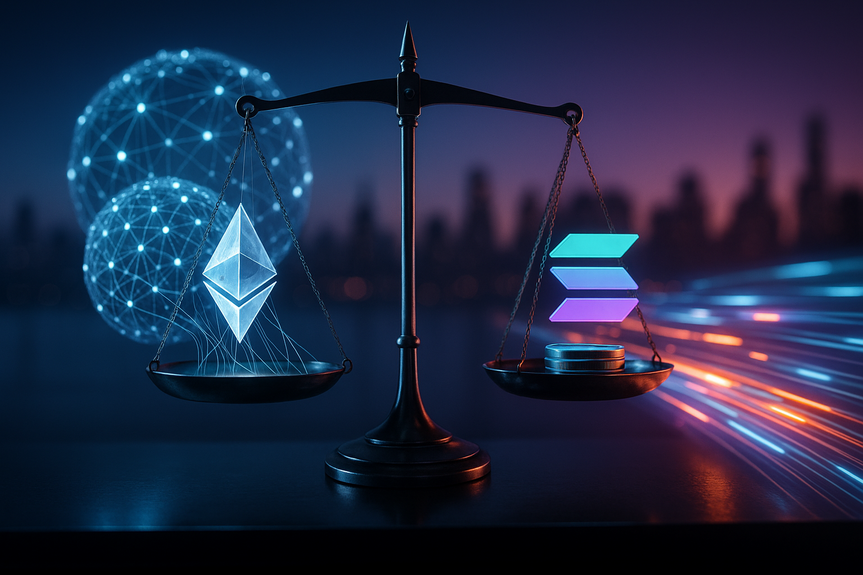
The Ethereum vs Solana 2026 prediction comes down to usage, fees, and investor trust. Ethereum leads in decentralization and brand strength, while Solana wins on speed and costs. We break down network activity, app ecosystems, and catalysts to see which coin could outperform in 2026—and when owning both might be smarter.
Crypto investors enter 2026 with one big question: will Ether or Solana do better next year? Ethereum still sets the standard for secure, decentralized apps. Solana keeps gaining traction with fast, low-cost transactions. An investor recently argued Ethereum could outperform again, while data shows Solana attracts more daily users. Here’s how to weigh both sides.
Ethereum vs Solana 2026 prediction: what will drive returns?
Decentralization and resilience
Ethereum runs on thousands of nodes that store a full copy of the chain. This design makes it hard to censor and hard to stop. If some nodes fail, the network stays up. Developers like this stability. They can build with more confidence that apps will not face long outages. Ethereum also has a strong base in decentralized finance and on-chain markets. Uniswap shows how smart contracts replace intermediaries and let users trade from a wallet. Apps like Polymarket ride on Ethereum and layer-2 networks such as Polygon to cut costs and raise speed. Each interaction uses smart contracts and can create demand for Ether through fees.Throughput, fees, and user experience
Solana also runs smart contracts but with a different design. It uses Proof of Stake and Proof of History to timestamp activity and speed up validation. The result is low fees and high throughput. Solana can process thousands of transactions per second under load. Ethereum’s base layer handles around 15 transactions per second before fees rise. That is why Ethereum’s scaling roadmap leans on rollups and other layer-2 tools to reduce costs for users. For builders focused on a smooth user experience, this difference matters. Cheap, fast transactions can make apps feel like mainstream software. That is a core reason Solana has drawn new projects.Ecosystems that matter
Both chains host busy apps that show real demand. – Ethereum: Uniswap (DEX), a broad DeFi stack, and prediction markets like Polymarket when paired with layer-2 networks such as Polygon. – Solana: Jupiter (DEX) and Magic Eden (NFTs), which benefit from quick settlement and tiny fees. Each ecosystem has a “flywheel.” More apps attract more users. More users attract more apps. The chain that spins its flywheel faster in 2026 could see stronger price momentum.Usage today vs. price tomorrow
Recent data shows a gap in daily activity. Solana has seen about 3.6 million daily unique wallet addresses, far above Ethereum’s roughly 530,000. That suggests Solana’s low-cost design is working for user growth. But price and usage do not always move together in the short run. In 2025, Solana fell around 27% while Ethereum was down about 9%, even with Solana’s stronger usage. This is a key point for any Ethereum vs Solana 2026 prediction: on-chain activity supports long-term value, but crypto prices can detach from fundamentals for months at a time.Institutional visibility and narratives
Ethereum still has the stronger brand with institutions. It is the first stop for many funds, analysts, and large allocators. It is widely covered on Wall Street. One well-known strategist, Tom Lee of Fundstrat, even floated a case for Ether reaching $7,000 per coin in the months ahead. Strong coverage helps keep Ethereum front of mind for new inflows, which can lift price during risk-on periods. Solana is catching up in awareness. If it continues to post strong user metrics and ships upgrades that improve reliability, more funds may add it as a core position. That could narrow the visibility gap in 2026.Costs, security, and the road ahead
– Ethereum’s path: Make the base layer maximally secure and decentralized, and push most user activity to layer-2 networks. This keeps core consensus simple and reduces systemic risk. The trade-off is user friction if bridging and rollups feel complex. As rollups improve and costs fall, this trade-off should ease. – Solana’s path: Keep execution on a single high-throughput layer to deliver a seamless user experience. This helps apps that need speed. The trade-off is engineering complexity and a higher bar for node hardware. Improvements in validator clients and tooling aim to raise performance and stability over time.Key catalysts to watch in 2026
– Fees and UX on Ethereum layer-2s: If rollups become cheap and easy for beginners, Ethereum’s app growth could accelerate. – Solana client upgrades and reliability: New validator software and performance work could boost stability and keep fees low at scale. – Developer traction: Where new, sticky apps launch first matters. Watch for consumer apps, gaming, DeFi, and payments. – Institutional adoption: Coverage, regulated products, and treasury usage could favor Ethereum in early innings, but Solana could close the gap with strong data. – Regulatory clarity: Better rules can unlock capital for both networks. These catalysts will shape any grounded Ethereum vs Solana 2026 prediction, because they affect the two things that move prices over time: sustained usage and fresh capital.Who could outperform in 2026?
A reasonable base case says Ethereum has a slight edge, given its deep liquidity, broad analyst coverage, and established role in DeFi. If risk appetite rises and institutions add exposure, Ether could benefit first. That view aligns with the idea that Ethereum might outperform Solana again in 2026. But a strong Solana year is easy to imagine. If Solana keeps leading in daily active wallets, and if upgrades improve reliability, more builders may choose it for consumer-facing apps. Low fees and fast finality make a difference for games, NFTs, payments, and social apps. If a breakout app lands on Solana and retains users, SOL could lead.Portfolio approach for the 2026 setup
Balancing conviction and risk
You do not need to pick only one coin. Many investors prefer a core-satellite approach to express a clear view while managing risk. – Core: Ethereum for resilience, liquidity, and brand. It anchors a portfolio and captures upside if institutions drive the next leg higher. – Satellite: Solana for growth optionality. It targets outsized gains if user adoption and app quality keep rising. – Rebalance: Set a schedule. Quarterly or semiannual rebalancing can lock in wins and control risk. – Watch usage: Track daily active wallets, transaction fees, and app traction. Prioritize sustained metrics, not one-time spikes. – Manage drawdowns: Crypto is volatile. Decide on position sizes that you can hold through large swings. This mix respects the data we have and the uncertainty we face. It also aligns with the core insight behind any Ethereum vs Solana 2026 prediction: both networks have credible paths to win, but at different speeds and with different risks.Red flags and what could change the call
– Major outages: A prolonged network halt would damage trust and push builders to alternatives. – Fee spikes: If user costs rise and stay high, activity could shift. – Weak app retention: New apps that fail to keep users will dampen network effects. – Unfavorable regulation: Rules that restrict key use cases could slow adoption. – Security issues: Exploits in key protocols or clients can hurt sentiment across a chain. Staying alert to these risks can help you adjust before the crowd. The bottom line: both coins have strong cases. Ethereum offers proven decentralization, a rich app base, and strong visibility with large investors. Solana delivers speed, low fees, and growing user activity. If you want a simple call, Ethereum has a small lead based on trust and coverage. If you want potential upside from rising usage, Solana is compelling. The smarter move for many is to own both, size positions to your risk, and watch the catalysts. That is the most honest take for the Ethereum vs Solana 2026 prediction. (Source: https://www.tipranks.com/news/ethereum-or-solana-one-crypto-could-outperform-in-2026-says-investor) For more news: Click HereFAQ
Q: What are the main technical differences between Ethereum and Solana?
A: Ethereum prioritizes decentralization and resilience, running thousands of full nodes and relying on layer-2 rollups for scaling, while Solana uses a hybrid Proof of Stake/Proof of History design to achieve much higher throughput and lower fees. In an Ethereum vs Solana 2026 prediction these contrasts—decentralization and brand strength versus speed and cost—are central to each chain’s investment case.
Q: How does Ethereum’s decentralization affect developer confidence and resilience?
A: Because Ethereum runs on thousands of nodes that store full copies of the chain, the network tends to stay operational even if some nodes fail, reducing the risk of long outages or censorship. That stability and transparency make developers more confident building apps on Ethereum and contribute to its strong institutional visibility.
Q: Why has Solana attracted more daily users than Ethereum according to the article?
A: Solana’s Proof of Stake plus Proof of History design enables faster validation, lower fees and thousands of transactions per second, which improves user experience and attracts consumer-facing apps. The article notes Solana logged about 3.6 million daily unique wallet addresses versus roughly 530,000 on Ethereum, highlighting stronger on-chain activity.
Q: Does higher on-chain activity guarantee better price performance for Solana or Ethereum?
A: No; the article points out that higher usage supports long-term value but does not always translate into short-term price gains, as seen when Solana fell about 27% in 2025 while Ethereum was down about 9% despite lower daily activity. For an Ethereum vs Solana 2026 prediction, that means investors should weigh usage metrics alongside market dynamics and sentiment.
Q: What catalysts should investors watch in 2026 that could influence Ethereum or Solana performance?
A: Key catalysts include fees and user experience improvements on Ethereum layer-2s, Solana client upgrades and reliability work, developer traction from new apps, institutional adoption, and regulatory clarity. The article emphasizes these factors affect sustained usage and fresh capital, which drive longer-term price trends.
Q: How does the article suggest structuring a portfolio between Ethereum and Solana for 2026?
A: The article recommends a core-satellite approach with Ethereum as a core holding for resilience, liquidity and brand strength, and Solana as a satellite for growth optionality tied to user adoption. It also advises setting a rebalancing schedule and sizing positions to manage drawdowns given crypto volatility.
Q: What red flags could change the outlook for either network in 2026?
A: Red flags listed include prolonged network outages, persistent fee spikes that push users away, weak app retention, unfavorable regulation, and security exploits in key protocols or clients. The article warns that any of these events could damage trust, shift builders to alternatives, and alter an Ethereum vs Solana 2026 prediction.
Q: Based on the article, which coin has a slight edge to outperform in 2026 and why?
A: The article’s base case gives Ethereum a slight edge because of its deep liquidity, broad analyst coverage and established role in DeFi, which could attract institutional inflows first. It also notes Solana could outperform if it sustains high daily active wallets and improves reliability, and concludes many investors may prefer owning both to balance conviction and risk.
* The information provided on this website is based solely on my personal experience, research and technical knowledge. This content should not be construed as investment advice or a recommendation. Any investment decision must be made on the basis of your own independent judgement.
Contents