Crypto
08 Jan 2026
Read 11 min
Riot Platforms bitcoin sales 2025: How they fund AI builds *
Riot Platforms bitcoin sales 2025 explain how $200M of BTC financed Phase 1 of Corsicana AI build.
Riot Platforms bitcoin sales 2025 show how miners turn BTC into cash to fund AI data centers. The company sold about $200 million of bitcoin in November and December, and an analyst at VanEck says that could cover the first phase of Riot’s Corsicana AI build. Here are the numbers, reasons, and risks.
Riot Platforms accelerated bitcoin sales at the end of 2025. The miner sold 1,818 BTC in December and 383 BTC in November, bringing in roughly $200 million. That trimmed its holdings to 18,005 BTC by year-end. The move came as bitcoin fell 1.2% on the day to $92,500, and Riot’s shares slipped about 2%.
November: 383 BTC sold, about $37 million.
December: 1,818 BTC sold, about $161.6 million.
Total two months: roughly 2,201 BTC, near $200 million.
Year-end BTC balance: 18,005 coins.
Market reaction on the day: BTC down 1.2%; Riot shares down 2%.
Core and shell spending hits early.
Power delivery and cooling systems follow.
AI tenants or in-house workloads bring revenue later.
This sequence explains why a miner with a large BTC treasury may choose to sell during windows of strength. Locking in capital now de-risks schedule, vendor terms, and power contracts.
Project delays: Longer build times push out revenue and raise costs.
Power constraints: Grid bottlenecks or pricier power can squeeze margins.
Tenant risk: Slower AI adoption or tighter budgets could delay leases.
BTC volatility: Lower prices reduce treasury value and raise funding risk.
Credit conditions: Tighter lending can force more coin sales at weaker prices.
Monthly production and BTC balances: Do sales slow or stay elevated?
Capex updates: Is spending tracking to plan for the Corsicana 112 MW phase?
Power deals: Are long-term supply and pricing locked in?
Leasing progress: Are AI tenants signing capacity as builds advance?
Operating efficiency: How do energy costs and uptime trend quarter to quarter?
Bull case: BTC holds firm, AI leasing is strong, and Corsicana hits milestones on time. Sales slow as cash inflows rise, and equity re-rates higher on execution.
Base case: BTC ranges, leasing is steady, and minor delays appear but stay manageable. Sales continue in pulses aligned with capex, while margins remain stable.
Bear case: BTC falls, credit tightens again, and leasing lags. Sales increase to cover overruns, share dilution rises, and project returns compress until conditions improve.
Riot Platforms bitcoin sales 2025: Key numbers
Why miners sold and where the money is going
AI build-outs need cash now
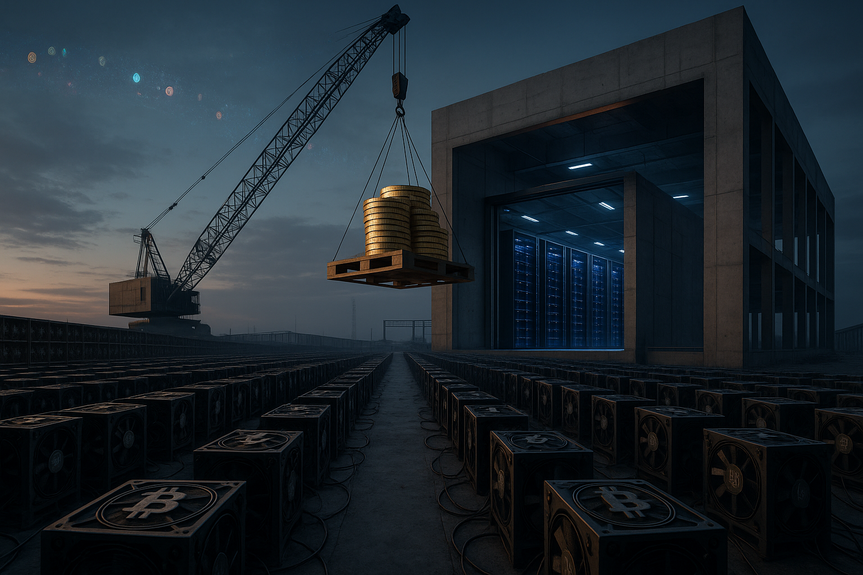
Large-scale data centers need land, power, cooling, and specialized racks. Those must be paid for long before revenue arrives. Matthew Sigel, head of digital assets research at VanEck, noted that the cash raised by Riot could fund the first 112 MW core and shell at the company’s Corsicana site, which targets completion in the first quarter of 2027. In simple terms, selling bitcoin today helps turn plans into steel, concrete, and megawatts.Miners as marginal sellers when credit tightens
When interest rates stay high or credit is scarce, miners have fewer cheap financing options. They can issue stock, borrow at higher rates, or sell some of their bitcoin. Selling BTC is fast and certain. That is why miners often become “marginal sellers” during tight credit cycles. In 2025, that pressure likely rose as firms raced to capture AI demand while juggling higher costs.Funding Corsicana: turning BTC into data centers
Capex math and timeline
Riot’s reported sales align with the capital needs for an early-phase AI data center build. The Corsicana project’s first 112 MW core and shell is a foundational step. It sets the stage for future fit-outs and tenant leases. The timeline into early 2027 shows how long these projects take. Money spent in late 2025 supports engineering, procurement, and construction through the next year and beyond.Treasury strategy: hold versus sell
Bitcoin miners balance two goals: keep a strong BTC treasury and keep growing capacity. Holding BTC can boost long-term value if price rises. Selling BTC funds expansion that can boost future cash flow. There is no perfect answer, but timing matters. By staging sales into late 2025, Riot matched cash needs with project milestones while BTC still traded near high levels for the year. That trade-off reduces financing risk even if it trims optionality on future price gains.Market impact: BTC, miner stocks, and liquidity
How miner selling can pressure price
When several large miners sell at once, the market can feel it. Miners hold liquid coin inventories and can pass through thousands of BTC in short periods. If broader demand is soft, these flows may weigh on price. That said, sales that fund new infrastructure can be bullish for the sector over a longer horizon, especially if they support high-margin AI revenue streams.Stock reactions and investor read-throughs
Riot shares fell about 2% alongside bitcoin’s 1.2% dip to $92,500. Short-term traders often see miner selling as a negative signal for BTC. Long-term holders, however, might view it as a pragmatic shift: convert part of a volatile asset into real assets that can earn cash. The net effect depends on execution quality, power pricing, tenant demand, and on-time delivery.Exchange activity sets the backdrop
In 2025, KuCoin captured a record share of centralized exchange volume, with more than $1.25 trillion traded across the year. Spot and derivatives volumes each surpassed $500 billion, and altcoins drove much of the activity. That pattern matters. When trading concentrates away from majors like BTC and ETH, liquidity can fragment. Fragmented liquidity can make large BTC sales more visible in order books, at least for a time, and can amplify short-term price swings.The AI-crypto link is getting tighter
Shared infrastructure, shared cycles
Bitcoin mining and AI computing share one core need: cheap, reliable power. They also share a growing footprint in North American data center corridors. As AI demand booms, miners see a chance to repurpose sites, reuse power contracts, and diversify revenue. This tie means crypto cycles and AI cycles may increasingly move together. When AI capex ramps, miners may sell BTC to join the wave. When AI demand cools, those sales might ease.Risks to watch
What investors should watch next
Key metrics and milestones
Scenario planning: bull, base, and bear
How to read the signal from Riot’s year-end moves
The Riot Platforms bitcoin sales 2025 tell a clear story. The company chose certainty today to fund capacity for tomorrow. Selling about $200 million in BTC reduces treasury size but also reduces project risk. It turns market value into physical assets with the potential for durable cash flows. For miners, that path can be wise when power, equipment, and contractors line up now, not later. For traders, the near-term signal may be mixed. More supply can weigh on price, especially if other miners do the same. For long-term investors, the signal is about execution. If Riot delivers Corsicana’s first 112 MW on time and fills it with paying AI workloads, the decision to sell coins in late 2025 could look like a strong strategic pivot. In the end, the link between bitcoin and AI is no longer a theory. It is showing up in budgets, build schedules, and balance sheets. The Riot Platforms bitcoin sales 2025 are a case study in how miners bridge that gap—and how one winter of BTC sales can fund the next wave of data center growth.For more news: Click Here
FAQ
Q: What did Riot Platforms sell at the end of 2025?
A: Riot Platforms bitcoin sales 2025 involved the company selling 1,818 BTC in December and 383 BTC in November. Those two months generated roughly $200 million and reduced Riot’s year-end holdings to 18,005 BTC.
Q: Why did Riot sell those bitcoins at year-end?
A: Matthew Sigel of VanEck said the proceeds could fully fund the first 112 MW core and shell at Riot’s Corsicana AI data center, which targets completion in Q1 2027. The article also notes miners commonly sell BTC to fund capex and infrastructure, especially when credit conditions tighten.
Q: How many bitcoins and how much revenue did Riot raise in November and December 2025?
A: Riot sold 383 BTC in November for about $37 million and 1,818 BTC in December for about $161.6 million, totaling roughly 2,201 BTC and near $200 million. Those sales reduced Riot’s bitcoin balance to 18,005 BTC by the end of 2025.
Q: What was the immediate market reaction to the sales?
A: On the day of the report bitcoin fell about 1.2% to $92,500 while Riot’s shares were down about 2%. The article cautions that large miner sales can weigh on price in the short term while potentially supporting sector growth if they fund high-margin AI infrastructure over the long term.
Q: What are the main risks of converting bitcoin treasury into AI data center capex?
A: Key risks cited include project delays, power constraints or higher energy costs, weak AI tenant demand, bitcoin price volatility, and tighter credit that could force additional coin sales. Any of these factors could push out revenue, raise costs, or increase funding pressure for the Corsicana project.
Q: Which metrics should investors watch to assess Riot’s execution after the sales?
A: Investors should track monthly production and BTC balances, capex pacing for the Corsicana 112 MW phase, progress on power contracts, leasing to AI tenants, and operating efficiency trends. Those indicators will show whether sales slow as cash inflows rise or if further coin sales are needed to meet spending.
Q: How does growing AI demand change miners’ strategic choices?
A: Because bitcoin mining and AI computing share needs for cheap, reliable power and data center space, miners increasingly consider repurposing sites and selling BTC to fund AI-related capex. The article suggests this link can cause crypto and AI cycles to move together, with miners acting as marginal sellers when AI capex ramps or credit tightens.
Q: Did exchange volume trends in 2025 affect liquidity around large BTC sales?
A: KuCoin recorded over $1.25 trillion in trading volume in 2025, with spot and derivatives each exceeding $500 billion and altcoins accounting for much activity. The article notes that when trading concentrates away from majors like BTC and ETH liquidity can fragment, making large bitcoin sales more visible in order books and amplifying short-term price swings.
* The information provided on this website is based solely on my personal experience, research and technical knowledge. This content should not be construed as investment advice or a recommendation. Any investment decision must be made on the basis of your own independent judgement.
Contents