AI News
02 Feb 2026
Read 10 min
DeepMind AlphaGenome AI explained How it maps disease genes
DeepMind AlphaGenome AI explained helps scientists map disease mutations faster to guide new therapies
DeepMind AlphaGenome AI explained: Google’s new model reads up to one million DNA letters at once to predict how mutations change gene control. It highlights which variants may drive disease and points to targets for drugs or gene therapy. Here’s how it works, what it can do, and why it matters.
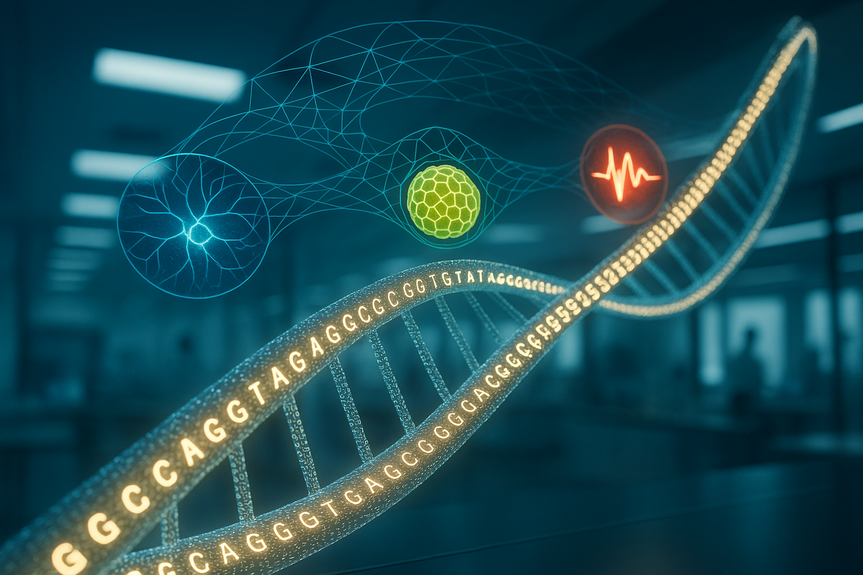
Google DeepMind has built a model that helps scientists read the “control panel” of our genes. Most diseases that run in families trace back to changes in gene regulation, not changes to proteins. This tool predicts when a mutation might flip a gene on or off in the wrong tissue or at the wrong level. It draws on large public datasets from humans and mice and aims to speed up research on cancer, heart disease, autoimmune disorders, and mental health. Consider this your DeepMind AlphaGenome AI explained in clear terms.
Which DNA regions regulate genes (like promoters and enhancers)
How specific tissues use those regions (such as nerve or liver cells)
What happens to gene control when mutations appear
The model reads up to one million DNA letters at once. It predicts how a mutation will affect gene regulation and which biological processes might shift as a result.
Scope the sequence: The model takes a wide DNA window to catch long-range control elements.
Learn the rules: It uses patterns learned from public datasets to map DNA letters to regulatory activity.
Test a change: It simulates a mutation and estimates its impact on when and where a gene turns on.
Flag importance: It scores variants that could drive disease in specific tissues.
Guide design: It can suggest DNA sequences that may switch a gene on in one cell type but not another.
This broad view helps researchers see both local and distant control signals that influence a gene. It offers a shortlist of variants and regions to test in the lab.
Point to likely disease drivers in non-coding DNA
Prioritize variants for follow-up in genome-wide studies
Map tissue-specific control for organs like brain, heart, and liver
Support cancer research by highlighting regulatory hotspots in tumors
Help design gene therapy switches to control where a gene turns on
Scientists outside DeepMind call this a step forward. One researcher noted the model can identify whether a mutation affects regulation, which genes it impacts, and in which cell types. Another said predictions across the non-coding 98% of the genome fill a major knowledge gap. A clinical professor studying childhood cancers described a “step change” in finding drivers of disease.
Faster triage of variants of unknown significance
Better links between patient mutations and likely tissue effects
Clearer hypotheses for targeted treatments
New targets tied to regulatory control, not only proteins
Tissue-focused strategies to reduce side effects
Candidate switches for cell-type selective delivery
Richer maps of functional DNA beyond coding regions
Stronger starting points for CRISPR and reporter assays
Cross-species insights from human and mouse datasets
Genome-wide association studies for variant discovery
Single-cell data for cell-type context
Functional assays to validate causal variants
Design tools for gene therapy regulatory elements
As these tools connect, the time from variant discovery to actionable insight should shrink.
The bottom line: DeepMind’s model gives researchers a stronger map of the non-coding genome and its control logic. It reads long DNA stretches, predicts how mutations shift gene activity, and suggests what to test next. With careful validation and safeguards, this could speed up research on common diseases and cancer.
In short, DeepMind AlphaGenome AI explained shows how AI can turn raw DNA letters into clues about disease risk and treatment paths—linking variants to gene control, tissue context, and potential therapy design.
(Source: https://www.theguardian.com/science/2026/jan/28/google-deepmind-alphagenome-ai-tool-genetics-disease)
For more news: Click Here
DeepMind AlphaGenome AI explained: what it is and why now
The problem it tackles
Most of our DNA does not code for proteins. About 98% of the genome helps control which genes switch on, where, and how strongly. Many risk variants for common diseases sit in this “non-coding” space. Finding which variants matter is hard because these regions act like dimmer switches and circuit breakers, and they work differently in different tissues.What AlphaGenome studies
AlphaGenome learns patterns that link DNA changes to gene activity across tissues. It was trained on public human and mouse data that track:How the model works, step by step
DeepMind AlphaGenome AI explained through key actions
What AlphaGenome can do today
Use cases researchers are pursuing
Who benefits and how
Clinicians and clinical labs
Drug discovery teams
Academic researchers
Limits and safeguards to keep in mind
Predictions are not proof
AlphaGenome generates predictions that need lab tests for confirmation. It narrows the search. It does not replace experiments.Tissue and context matter
Gene control is different across cell types, ages, and states (like inflammation). A correct call in one tissue may not hold in another.Data gaps and bias
Public datasets may not cover all populations or rare tissues. Results can improve as more diverse data appear.Ethics and safety
Work on gene control can inform powerful therapies. Researchers need strong review, consent, and safeguards.What to watch next
From prediction to therapy design
Expect more studies that pair the model’s calls with CRISPR tests and clinical data. If predictions match lab results at scale, this could change how teams pick drug targets and design gene switches.Broader access and benchmarks
Some groups have started to use AlphaGenome already. Clear benchmarks, shared test sets, and peer-reviewed reports will help the field judge performance across tissues and diseases.Integrated pipelines
Look for AlphaGenome to sit inside workflows with:FAQ
Q: What is AlphaGenome and what problem does it address?
A: AlphaGenome is a Google DeepMind model that reads up to one million DNA letters at once to predict how mutations affect gene regulation across tissues. DeepMind AlphaGenome AI explained shows it aims to identify variants in the non-coding genome that may drive diseases and point to drug or gene-therapy targets.
Q: How does AlphaGenome analyse DNA sequences?
A: The model scopes wide DNA windows—up to one million letters—to capture local and long-range regulatory elements, and it was trained on public human and mouse datasets that map promoters, enhancers and tissue-specific activity. It simulates mutations and predicts their effects on when, where and how strongly genes are switched on.
Q: Which diseases or research areas could benefit from AlphaGenome?
A: Researchers are using AlphaGenome to study genetic drivers in cancer, heart disease, autoimmune conditions and mental health problems by prioritising regulatory variants in the non-coding genome. It can also map tissue-specific control for organs such as brain, heart and liver to guide follow-up experiments.
Q: Can AlphaGenome be used directly to design gene therapies?
A: AlphaGenome can suggest DNA sequences and regulatory designs that might switch a gene on in one cell type but not another, which could underpin gene therapy strategies. However, these suggestions are predictive and must be tested and validated in the lab before any clinical application.
Q: Who are the main users of AlphaGenome and how do they benefit?
A: Clinicians and clinical labs can use AlphaGenome to triage variants of unknown significance and form clearer hypotheses about tissue effects, while drug discovery teams gain new regulatory targets and tissue-focused strategies. Academic researchers benefit from richer functional maps beyond the 2% coding genome and stronger starting points for CRISPR and reporter assays.
Q: What are the main limitations and safeguards associated with AlphaGenome?
A: AlphaGenome’s predictions are not proof and require laboratory confirmation, because gene regulation varies by cell type, age and state and a correct call in one context may not hold in another. Public-data gaps and biases mean results can improve with more diverse datasets, and work on gene control requires ethical review, consent and safety safeguards.
Q: How are AlphaGenome’s predictions validated and evaluated?
A: Validation typically pairs AlphaGenome predictions with CRISPR functional assays, clinical data and lab tests to confirm causal variants, and the field needs clear benchmarks, shared test sets and peer-reviewed studies to judge performance. Some groups have already begun using the model, but broad evaluation across tissues and populations is still required.
Q: How does AlphaGenome help researchers prioritise variants for follow-up experiments?
A: AlphaGenome scores variants by estimating their impact on gene regulation in specific tissues and produces shortlists of likely disease drivers for targeted follow-up. This focused ranking helps researchers choose which non-coding regions and mutations to test experimentally.
Contents