AI News
21 Apr 2026
Read 18 min
Ant-inspired swarm robots: How to toggle build and excavate
Ant-inspired swarm robots switch via two parameters to build or remove structures remotely for rescue.
Harvard engineers built ant-inspired swarm robots that can both build and dig with no central boss. The bots read light “pheromones,” follow simple rules, and switch tasks by tuning only two settings: how strongly they cooperate and how fast they add or remove material. This approach hints at safer, faster, and more adaptable automation.
Ants show how small actions can add up. An ant carries a grain of soil. Another ant smells a cue and follows. Soon a mound forms or a tunnel opens. The same idea now guides a fleet of small robots from Harvard’s SEAS and FAS teams. The group set out to learn how simple rules, clear cues, and constant feedback can produce steady work without micromanagement. Their results appear in PRX Life and come from a lab led by Professor L. Mahadevan, who studies how form and motion shape living and built systems.
How ant-inspired swarm robots switch between building and excavating
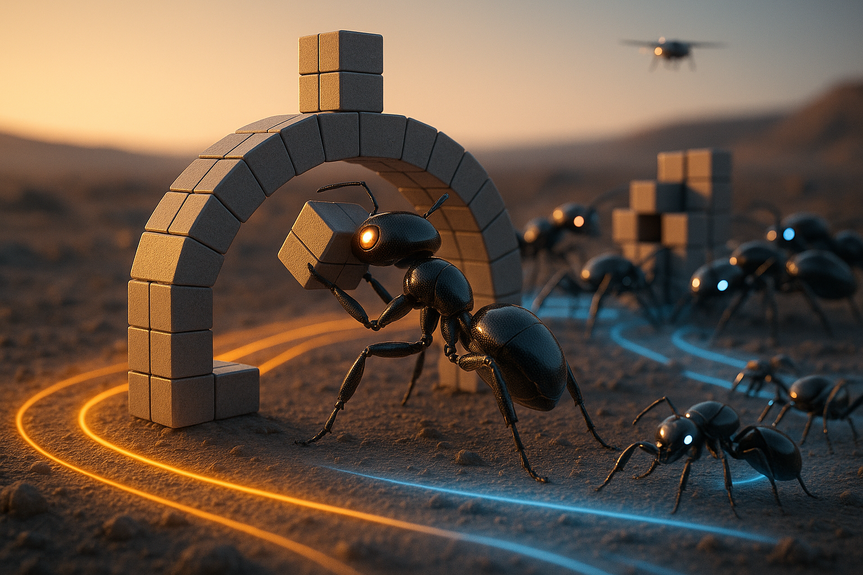
Ant colonies do not use maps or managers. Each ant follows local signals. The Harvard robots do the same. The team calls them RAnts. The bots sense light patterns, which stand in for the pheromone fields that ants leave for each other. The researchers call these light cues “photormones.” The bots move up or down these light gradients, carry small blocks, and either add or take away material when local signal thresholds are met. Two dials decide what happens on the site: – Cooperation strength: how strongly a bot follows the local light gradient. – Deposition rate: whether a bot tends to place or remove a block, and how often it does so. Turn the first dial up, and bots stick more closely to bright trails, which pulls them into shared work zones. Turn the second dial toward “place,” and the pile grows. Turn it toward “remove,” and a structure gets cut back. The same fleet can switch from building to clearing just by tweaking these two numbers. No new code. No new hardware. No central plan.The simple rules behind self-organized teamwork
The bots follow three clear rules: – Move along the local light gradient. – Pick up and carry a block when the signal says “go.” – Drop or remove material when a signal level crosses a set point. These rules are short, but they spark rich group behavior. As bots march on light trails, they also leave or change light signals. This closes a feedback loop. The environment talks to the bots. The bots talk back by changing the environment. Over time, small choices add up to large patterns that look planned.From random starts to clear shapes
At first, bots spread out and search. Soon, they start to cluster at spots where the light guides them to meet. The team describes this as a “trapping instability.” When several bots follow a shared signal, they reinforce it and get pulled into the same zone for longer. That zone becomes a nucleation site where structure takes shape. More bots arrive, and the pace picks up. In build mode, stacks grow. In dig mode, material clears.From light signals to living structures
Biologists call this kind of teamwork “stigmergy.” One agent changes the environment. Another agent responds to that change. No one needs a global plan. Ants do it with pheromones. Termites do it with mud pellets and scent. The Harvard team shows the same trick with light and small plastic blocks. Light is easy to project and adjust. It is also safe, fast, and precise for lab studies. This setup lets the team test ideas on how a group reads and writes to a shared workspace. They vary the brightness, the shape of the light field, and the rules that connect signal levels to actions. Then they watch the swarm adapt in real time. Sometimes the field pushes bots to lay the first stones of a wall. Sometimes it draws them into a pit to haul material out.Exbodied intelligence: thinking with the world
Professor Mahadevan and his co-authors use a helpful phrase for what they see: “exbodied intelligence.” The idea is simple. The group’s “smarts” are not just inside each robot. The world outside also holds part of the memory and logic. The signal field stores hints of what to do next. The bricks on the floor store progress already made. The swarm reads and writes to this shared “board” on every step. This makes the system strong and adaptive, even when single bots fail.Two dials that change the mission
The most impressive part is how the team reduces control to two main dials. These dials do not just change speed. They change the mission itself.Dial 1: Cooperation strength
Cooperation strength sets how much a bot trusts the signal. With low strength, bots explore and avoid getting stuck. With high strength, bots align and gather into active zones. A site manager could set this dial based on the task: – Low strength for scouting or surveying. – Medium strength for even coverage. – High strength for fast, focused work at one hotspot.Dial 2: Deposition rate
Deposition rate sets whether bots place or remove blocks, and how often they do so. If the rate is positive, bots tend to build. If it is negative, bots tend to excavate. Move the slider toward zero to pause and re-balance. This dial could shift on a schedule or in response to sensors. For example: – After a quake, start with negative rate to clear debris. – When a safe base appears, switch to positive rate to raise a wall. – If a sensor flags a weak column, go neutral to inspect before action.When dials work together
The dials work best as a pair. High cooperation plus positive deposition grows a structure fast. High cooperation plus negative deposition clears a target zone fast. If the site changes or a blockage appears, the manager can drop cooperation strength to spread out the swarm, then raise it again to focus on the next hotspot. Because the rules stay simple, the group reacts fast and does not need a central command.Why decentralization matters
Central control can be brittle. If one link fails, the line stops. A decentralized swarm does not stop when a single bot has a fault. Others keep going. The site keeps speaking through the signal field and the half-built wall or trench. This gives several wins: – Resilience: Bots fail gracefully. The swarm still moves and works. – Scalability: Adding or removing bots does not require re-planning. – Flexibility: The same rules fit many tasks just by tuning two dials. – Speed: Many hands make quick work with few delays.A theory that matches the lab
The team did not only run trials. They wrote down a model that tracks how agents, signals, and materials change over time. This model extends classic ideas about how living things clump and move. It also includes the way the site itself evolves as bots act on it. The model helps predict when a cluster will form, when it will dissolve, and how fast the build or dig will proceed. That makes it a guide for future designs and new sites.Where we might see this technology
The work points to clear use cases. Some are near-term. Others are bold but within reach.Safer construction and maintenance
– Hazard zones: Send swarms to clear rubble or shore walls where it is too risky for people. – Confined spaces: Let small bots fit into pipes, crawl spaces, and mine shafts to add bracing or remove blockages. – Night work: Use light fields to guide shifts without loud radios or fragile GPS.Planetary exploration
– Lunar habitats: Use bots to move regolith to make shields for radiation and heat. – Mars digs: Excavate test pits, then switch to berm building, all with the same fleet. – No maps required: Work in dust or low light using robust local cues.Science and education
– Biology in a box: Model ant and termite building to test ideas about animal teamwork. – Classroom labs: Show how simple rules make rich patterns. Students can tune the two dials and watch shapes appear.Smart farms and disaster relief
– Soil shaping: Form water channels or raised beds that adapt with rain and growth cycles. – Rapid shelters: Clear ground, then stack modules for field clinics or supply hubs.Limits, risks, and open questions
Every new tool brings trade-offs. This approach is strong, but it still faces hurdles.Scaling up from lab blocks
The trials use small units and light cues in clean rooms. Real sites have dust, glare, and uneven ground. Future work must test: – Stronger sensing under sun and shade. – Grippers for bricks, sandbags, or regolith. – Power and charging for long shifts.Robust signaling outdoors
Light is great indoors. Outside, wind, fog, or bright sun can wash out cues. Teams may mix photormones with other signals: – Radio beacons for wide guidance. – QR-like ground tags for precise drops. – Sound or vibration for underground work.Ethics and safety
Swarms must stay safe around people and wildlife. Clear rules help: – Geofences that bots never cross. – “Stop now” signal that overrides all actions. – Logs for traceability when something goes wrong.Human roles
Swarms take on dull, dirty, and dangerous jobs. People still design goals, tune dials, and ensure safety. Training for site leads and first responders will be key.Takeaways for builders, coders, and students
– Simple rules can do real work. You do not need a huge plan if the environment holds the cues. – Two well-chosen dials can steer an entire job. Cooperation strength and deposition rate are easy to adjust and explain. – Feedback loops matter. Let agents read and write to the world, not just to each other. – Decentralize for resilience. Expect some units to fail. Design so the group carries on. – Prototype in mixed media. Try light in the lab, then test hybrid cues in the field.From lab insight to field impact
This study stands out because it packages a big idea in a small, testable form. The bots are simple. The rules are short. The dials are few. Yet the group can build, unbuild, and adapt as sites change. It also gives language that helps teams in robotics, biology, and civil work talk to each other. Terms like “stigmergy,” “trapping instability,” and “exbodied intelligence” are not just labels. They point to design choices that turn local actions into reliable outcomes. Funding from the National Science Foundation, the Simons Foundation, and the Henri Seydoux Fund supported the project. Co-authors Fabio Giardina and S. Ganga Prasath helped join theory and practice. Their shared effort shows how study across fields can produce tools that matter on the ground. As cities grow, climates shift, and missions reach the Moon and Mars, we need machines that help us work with speed and care. Swarms that learn from ants fit this need. They do not argue. They do not wait for orders. They read the room—literally—and get on with the job. The path from controlled light fields to dusty job sites will take time, new sensors, and lots of trials. But the map is clear, and the dials are already in hand. When you think about the future of work sites, picture a team of small units that glide along soft beams of light, find each other, and decide together what to do next. With two small twists—cooperation and deposition—you can flip the job from raise to raze. That is the rare kind of control that stays simple while the world stays messy. In short, ant-inspired swarm robots show that small brains plus smart surroundings can build, dig, and switch tasks on cue. That lesson can help us design safer sites, faster responses, and tools that bend with change instead of breaking under it.(Source: https://seas.harvard.edu/news/simple-robots-collectively-build-and-excavate-are-inspired-ants)
For more news: Click Here
FAQ
Q: What are ant-inspired swarm robots and how do they work?
A: Ant-inspired swarm robots are simple, ant-like machines (called RAnts) that coordinate without a central controller by sensing and modifying a shared light field called a photormone. They follow a few rules—move along light gradients, pick up and carry blocks, and deposit or remove material when signal thresholds are met—to collectively build or excavate structures.
Q: How do ant-inspired swarm robots switch between building and excavating?
A: Ant-inspired swarm robots switch between construction and excavation by tuning two simple parameters: cooperation strength and deposition rate. Adjusting cooperation strength changes how strongly robots follow the light gradient and deposition rate sets whether they place or remove material, so changing those two dials flips the swarm between building and digging without new code or hardware.
Q: What is a photormone and what role does it play in the swarm?
A: A photormone is a projected light field used as a digital stand-in for pheromone cues, and the robots both sense its gradients and leave signals as they move. This feedback loop between robots and the photormone field enables coordination across the swarm, producing clustering and nucleation sites where structures form or material is removed.
Q: What simple rules govern the robots’ behavior?
A: The robots operate under three short rules: move along local light gradients, pick up and carry a block when signals indicate to do so, and drop or remove material when signal thresholds are met. Despite their simplicity, these rules create a feedback loop with the environment that leads to sophisticated, self-organized group behavior.
Q: What potential applications could ant-inspired swarm robots serve?
A: Ant-inspired swarm robots could be used for autonomous construction and maintenance in hazardous or confined sites, planetary exploration like moving regolith for lunar habitats and Mars digs, and as experimental models for studying animal behavior. Other suggested uses in the article include soil shaping for smart farms, rapid shelter assembly for disaster relief, and classroom or lab demonstrations of stigmergy and collective behavior.
Q: What limits and challenges must be addressed before these swarms work outdoors or at scale?
A: Challenges include scaling from lab blocks to real materials, providing stronger sensing and grippers, ensuring power and charging for long shifts, and making signaling robust outdoors where light can be washed out by wind, fog, or bright sun. The article also highlights ethics and safety concerns like geofences, stop signals, and human training to ensure ant-inspired swarm robots operate safely around people and wildlife.
Q: How do simple local interactions produce complex group behavior in these swarms?
A: Ant-inspired swarm robots use stigmergy, where each agent modifies the environment and responds to those changes, letting the shared light field and material positions store memory and guide future actions. That feedback can produce trapping instabilities that draw robots into nucleation sites, where collective action rapidly builds or excavates organized structures.
Q: What roles do humans play in deploying and controlling these robot swarms?
A: Humans set goals, tune the cooperation and deposition dials, and oversee safety rather than micromanaging individual robots. Site managers can also employ geofences and emergency stop signals, keep logs for traceability, and train teams to deploy the system safely.
Contents