AI News
06 Jul 2026
Read 9 min
Why AI failed in auto manufacturing and how to fix it
why AI failed in auto manufacturing led to rehiring veteran engineers to cut defects and lower costs
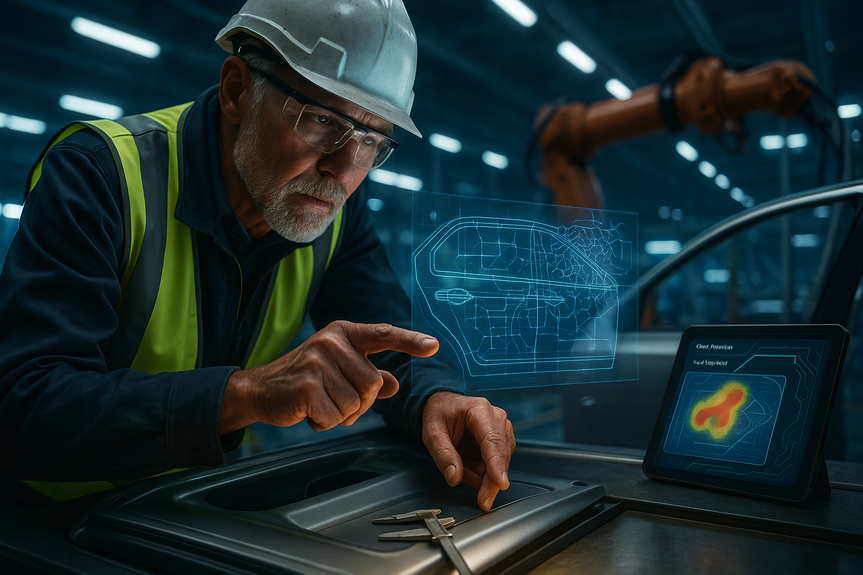
Ford’s recent quality turnaround shows why AI failed in auto manufacturing: data alone can’t replace veteran know-how. Algorithms missed edge cases and process flaws. Ford rehired hundreds of seasoned engineers to train, audit, and guide AI. The result: fewer defects, lower warranty costs, and top JD Power rankings across key models.
Ford tried to lean on AI to improve quality. It did not work on its own. The company learned that models are only as good as the data and the people who train them. Many veteran technicians had left, and their know-how never reached the systems. So Ford brought experience back in.
Retain and rehire veterans. Make them trainers, auditors, and reviewers.
Put human-in-the-loop gates before tooling, PPAP, and launch.
Build training sets around real failure modes, not just happy-path runs.
Pair data scientists with process engineers on the floor daily.
Track leading indicators: design change escapes, first-pass yield, and time-to-detect.
Close the loop fast. Feed AI findings into engineering changes within days, not months.
Document tribal knowledge. Standardize names for faults and fix methods.
Fewer defects per 100 vehicles and higher first-pass yield
Lower scrap and rework hours
Shorter time-to-detect and time-to-correct new issues
Fewer late-stage engineering changes
Lower warranty claims and recall rates
Why AI failed in auto manufacturing: lessons from Ford
AI tools read specs well. They struggle with messy factory reality. Charles Poon, Ford’s VP of vehicle hardware engineering, said the company expected AI to turn design rules into quality. It did not. The issue was not the idea of AI. It was the missing human expertise behind it. This is the core of why AI failed in auto manufacturing at first.Data without context
AI saw clean drawings and nominal settings. It did not see worn tools, supplier variation, or winter startup quirks. – Sensors miss rare faults unless trained on them. – Historical data often skips near-misses and tribal fixes. – Models generalize to averages, not one-off edge cases that cause recalls.Process blind spots
Quality starts before the line runs. AI flagged problems after the fact. That is too late. – Design choices locked in failure points downstream. – AI had no gate to stop weak designs from reaching production. – Feedback loops were slow, so the same errors kept repeating.Skill and knowledge gap
People carry tacit knowledge that is hard to code. – Veterans spot a misaligned clip by sound or feel. – They know which dimension truly drives fit and finish. – Without those people, AI learned from incomplete and noisy examples.How Ford fixed the miss
Ford rehired about 300 experienced engineers into vehicle engineering. They now act as internal auditors. They run weekly design reviews to hunt for failure points before blueprints hit the floor. They also train and guide the AI and automation tools. What changed: – Experts now label, curate, and prioritize the data AI sees. – Reviews insert human gates early in design to remove error-prone features. – AI augments inspectors instead of replacing them, speeding checks and catching more defects. The payoff: – Ford topped JD Power’s 2026 Initial Quality Study for the first time since 2010. – F-150, Mustang, and Super Duty led their segments again. – CEO Jim Farley said warranty and recall costs are down, which lifts margins.A practical playbook for automakers
Use these steps to avoid the same pitfall and address why AI failed in auto manufacturing elsewhere:Metrics that matter
If quality is improving, these should move:What this means for AI in the factory
AI is a force multiplier, not a silver bullet. It needs good data, clear ownership, and expert feedback. The best results come when people design the system and the system helps people do their jobs better. That balance turns models into money.Building durable capability
– Keep capturing new failure modes as products and suppliers change. – Refresh models with seasonality, plant moves, and new materials. – Reward teams for preventing defects upstream, not just fixing them downstream.Cultural shifts
– Treat AI advice like a skilled apprentice: useful, but supervised. – Make it safe to report near-misses. They are gold for training. – Celebrate pre-launch fixes as much as launch speed. In short, Ford shows how to convert AI hype into real gains. The company answered why AI failed in auto manufacturing early on: it lacked human context and control. By putting veterans back in charge and using AI as a tool, not a substitute, Ford cut defects and costs while raising customer trust.(Source: https://www.foxbusiness.com/technology/ford-rehires-experienced-engineers-after-ai-misses-mark)
For more news: Click Here
FAQ
Q: Why did Ford’s AI tools fall short in improving production quality?
A: Ford found its AI missed messy factory realities and lacked the tacit knowledge of veteran technicians, so algorithms often missed edge cases and process flaws. This illustrates why AI failed in auto manufacturing: models were trained on incomplete data and lacked human context.
Q: What specific data and process problems caused the AI to underperform?
A: Sensors and historical datasets often missed rare faults and near-misses, which led models to generalize to averages instead of catching one-off failure modes. Process blind spots meant AI frequently flagged problems after the fact and slow feedback loops allowed the same errors to repeat.
Q: How many veteran engineers did Ford rehire and what roles do they now fill?
A: Ford rehired about 300 veteran engineers who now act as internal auditors running mandatory weekly design reviews to hunt for and eliminate potential failure points before blueprints reach the factory floor. They also train and guide the company’s AI and automation tools and help curate the data those systems use.
Q: What changes did Ford make to its AI training and deployment after the failures?
A: Experts began labeling, curating, and prioritizing the data fed to AI, and human-in-the-loop gates were inserted early in design to remove error-prone features before production. The automaker reframed AI as an augmentation for inspectors rather than a replacement, focusing training sets on real failure modes.
Q: What measurable results did Ford achieve after rehiring engineers and adjusting AI use?
A: Ford topped JD Power’s 2026 Initial Quality Study for the first time since 2010, with the F-150, Mustang and Super Duty leading their segments and seven of its top 10 models ranking in the top three. CEO Jim Farley said warranty and recall spending has come down, which improved the company’s financial performance.
Q: What practical steps does the article recommend automakers take to avoid similar AI problems?
A: The article recommends rehiring and retaining veterans as trainers, auditors and reviewers; inserting human-in-the-loop gates before tooling and launch; and building training sets around real failure modes rather than happy-path runs. It also advises pairing data scientists with process engineers on the floor, tracking leading indicators, and documenting tribal knowledge.
Q: Which quality metrics should automakers monitor to see if their AI improvements are working?
A: Key metrics include defects per 100 vehicles, first-pass yield, scrap and rework hours, time-to-detect and time-to-correct new issues, late-stage engineering changes, and warranty and recall rates. Movement in these indicators signals whether AI and human interventions are improving quality.
Q: How should companies balance AI and human expertise in the factory to prevent repeating Ford’s mistakes?
A: Companies should treat AI as a force multiplier and keep humans in the loop with clear ownership and expert feedback so models are trained on realistic failure modes. The article recommends supervising AI like an apprentice, capturing new failure modes as products change, and rewarding upstream prevention as much as downstream fixes.
Contents