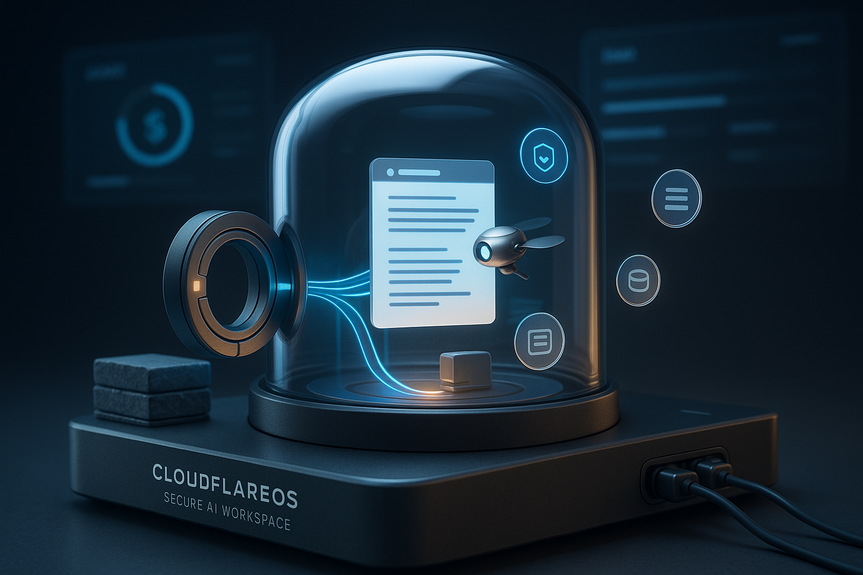
CloudflareOS secure AI workspace gives employees controlled access to live internal systems and data.
CloudflareOS secure AI workspace gives every employee safe AI tools tied to company systems. It checks every user and every agent before access. It moves past old VDI by spinning up on-demand apps with strict controls. It also tracks spend across models and teams, so leaders can steer cost and risk together.
Most AI tools know public facts but lack your company’s rules, data, and approvals. That creates rework and risk. Cloudflare’s open-source platform aims to fix this. It brings your processes, terms, and data into a space where people and agents can work under zero-trust controls. The CloudflareOS secure AI workspace enforces who can see, use, and share each result, every time.
What changes compared to virtual desktops
Old VDI streamed the same apps to everyone. Modern VDI added app masking and streaming, but it still shipped a fixed set of tools. CloudflareOS goes further. It lets people and agents build and run new apps on the fly, each with its own storage and access guardrails. It keeps live links to data and logs every action.
CloudflareOS secure AI workspace: how it protects data
Capability-based access beats raw API keys
Handing an agent a broad API key is risky. With CloudflareOS, a user grants a narrow capability to a single resource or action. The system records what the agent saw and did. It also checks that anyone who views the output has rights to the source. This closes a common data leak path.
Gatekeepers speak the language of each service
A Gatekeeper sits between CloudflareOS and an external API. It knows the API’s resources and allowed operations. It exposes only what the granted capability permits. Outbound network calls are off by default. This reduces blast radius if an agent goes off the rails.
Dynamic Workers and Durable Objects Facets
Dynamic Workers load code for each mini-app only when needed. Durable Objects Facets give each app isolated SQLite storage with platform-level supervision. Together, they let you run thousands or even millions of small, stateful apps safely and efficiently.
Zero trust by default
Every user, app, and agent request is verified before access. Resources are visible only when a capability exists. Logs show who asked for what, when, and why. This fits security teams that already enforce least privilege and continuous verification.
Why unmanaged AI creates risk
Teams often paste data into random AI tools or bake API keys into one-off agents. That can move sensitive data out of controlled systems. It can also spread access far wider than intended. CloudflareOS pulls this activity back into a monitored space. It gives IT a way to approve, limit, and audit without stopping work.
Context is the real asset, not the model
Models are commodities. Your written processes, terms, and decisions are not. Capturing this context in a form that agents can use is the hard part. It also decays over time. The winning teams will keep their context fresh. They will document approvals, steps, and guardrails so agents can act with less confusion and fewer risks.
Turn spend into an engineering signal
Price-per-token is not the best meter. Through Cloudflare AI Gateway, teams can use many models and route tasks to the right one. Leaders can see spend by person, team, and app. They can set rate limits or budgets. They can move routine work to smaller models and reserve premium models for high-value tasks.
Practical steps to protect your data with CloudflareOS
Map the first wave of agent tasks
List 10 repeatable tasks that waste time today.
Write the exact steps and approval rules for each task.
Define the smallest resource an agent needs to touch.
Enforce least privilege with capabilities
Replace broad API keys with narrow capabilities.
Grant time-bound access to a single dataset or action.
Log what the agent reads, writes, and shares.
Wrap external services with Gatekeepers
Expose only the endpoints and operations a task needs.
Keep outbound networking disabled until a review is done.
Use logs to confirm the Gatekeeper blocks scope creep.
Treat context like code
Store procedures, terms, and templates in version control.
Review context every quarter with the system owners.
Test agents against edge cases and update the docs fast.
Make cost visible and actionable
Tag spend by person, team, and app in AI Gateway.
Set budgets and alert on spikes.
Route simple prompts to smaller models by default.
What teams can build safely
Living documents and dashboards
People and agents can create docs, slides, and sheets that stay linked to live data. Rights carry through to anyone who views the output.
Micro-apps that do one job well
Spin up small apps with their own storage, real-time updates, and tight access. Retire them when the job is done. Keep the logs.
Workflows that match real approvals
Capture the true approval path. Let agents move tickets, update systems, and notify owners under watchful logs and limits.
Getting started without lock-in
CloudflareOS is open source and runs in your Cloudflare account. You own what you build. You can use any model provider and switch as needs change. This lowers vendor lock-in while keeping security controls in one place.
In closing, the CloudflareOS secure AI workspace brings company context, strict capabilities, and spend controls into one flow. It helps people and agents work faster without leaking data. The key is to treat your processes as the product. Keep them current, keep access narrow, and let the platform enforce the rest.
(Source: https://thenewstack.io/cloudflare-os-agentic-workspace-security/)
For more news: Click Here
FAQ
Q: What is CloudflareOS secure AI workspace?
A: Cloudflare launched the CloudflareOS secure AI workspace as an open-source platform that gives every employee a secure workspace equipped with AI tools and access to internal company systems. It runs in an organization’s Cloudflare account and brings company context into agentic work under zero-trust controls.
Q: How does CloudflareOS differ from traditional virtual desktop infrastructure (VDI)?
A: Traditional VDI streamed a fixed set of applications to users, while the CloudflareOS secure AI workspace spins up on-demand apps that people and agents can build and run, each with isolated storage and strict access guardrails. It also keeps live links to data and logs every action rather than delivering a static remote screen.
Q: What is capability-based access and how does it improve security?
A: The CloudflareOS secure AI workspace uses capability-based access to replace broad API keys with narrow, time-bound permissions that grant a specific resource or action, and it records exactly what the agent observed and performed. It also verifies that anyone who views an output has rights to the source, reducing common data leak paths.
Q: What are Gatekeepers and what role do they play in protecting integrations?
A: In the CloudflareOS secure AI workspace, Gatekeepers are service-specific Workers that sit between the platform and external APIs to interpret the API’s resources and allowed operations. They expose only the permitted endpoints, keep outbound networking disabled by default, and reduce the blast radius if an agent goes off the rails.
Q: How do Dynamic Workers and Durable Objects Facets enable safe, on-demand apps?
A: Dynamic Workers load each mini-app’s code on demand while Durable Objects Facets provide isolated SQLite storage with platform-level supervision. Together they let organizations run thousands or even millions of small, stateful apps safely and efficiently within the CloudflareOS secure AI workspace.
Q: How does CloudflareOS prevent sensitive data from leaking into unmanaged AI tools?
A: The CloudflareOS secure AI workspace verifies every user and agentic request, enforces least-privilege capabilities, and logs who asked for what, when, and why to pull AI activity into a monitored space. This gives IT the ability to approve, limit, and audit AI usage without blocking employee workflows.
Q: How can organizations control AI model costs with CloudflareOS?
A: Through Cloudflare AI Gateway, organizations can use any model provider, tag spend by person, team, or app, and set budgets or rate limits to steer cost. They can also route routine work to smaller models by default so premium models are reserved for high-value tasks.
Q: What practical steps should teams take to adopt CloudflareOS securely?
A: Start by mapping repeatable agent tasks, write exact steps and approval rules, and replace broad API keys with narrow, time-bound capabilities while wrapping external services with Gatekeepers. Treat context like code by storing procedures in version control, reviewing them regularly, tagging AI spend by person/team/app, and routing routine prompts to smaller models within the CloudflareOS secure AI workspace.