 AI-generated
Crypto
07 Nov 2026
Read 12 min
Satoshi Nakamoto monument in Buenos Aires: What It Reveals *
Satoshi Nakamoto monument in Buenos Aires brings Bitcoin’s history and principles to life through art.
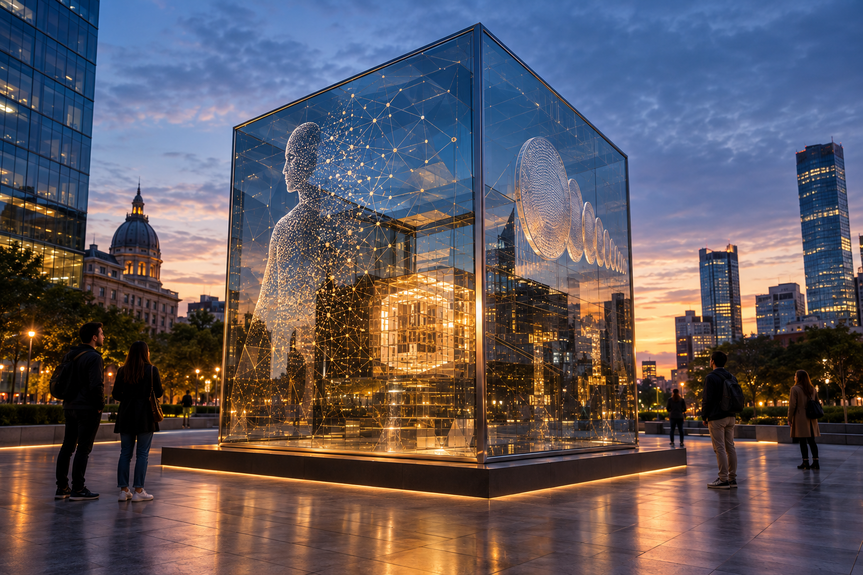
The Satoshi Nakamoto monument in Buenos Aires turns Bitcoin’s history into a public art experience. Presented on October 29 at Polo Dot during the Open Fest of LABITCONF 2026, the 2.40-meter cube uses stainless steel, glass, and five display faces to explain Bitcoin’s origins, scarcity, and core principles.
Key takeaways
- Bitcoin.ar drove the monument project through the fifth edition of the Premio B·Arte.
- Ricardo Alonso and Celeste Difabio Videla created the stainless steel and glass cube.
- The monument explores Satoshi Nakamoto, Bitcoin’s halving, the white paper, the genesis block, and verification.
- Fundación Bitcoin Iberoamérica financed the project as a cultural and educational resource.
Bitcoin often reaches people through screens, technical terms, or market headlines. This work offers another starting point: a physical object that visitors can walk around and study. According to the organization’s announcement, the installation honors Bitcoin’s unknown creator while helping a wider public understand the ideas behind the technology.
What does the Satoshi Nakamoto monument in Buenos Aires represent?
The monument represents Bitcoin’s beginnings and principles rather than a confirmed portrait of its creator. Satoshi Nakamoto remains the name used by the person—or group of people—behind Bitcoin, whose identity is unknown.
Named “The Genesis of Satoshi Nakamoto,” the work is a multi-dimensional cube measuring 2.40 meters in width, length, and height. Four lateral faces and one upper face guide visitors through different parts of Bitcoin’s story.
Its materials and repeated shapes form part of that explanation. Reflections and multiplied geometric forms suggest a network that copies information and expands across many participants. The work connects an anonymous beginning with the thousands of people who later helped Bitcoin grow around the world.
Readers interested in the identity debate can also explore the evidence discussed around whether Adam Back is Satoshi Nakamoto. The monument takes a different approach: it focuses on what Satoshi created, not on resolving who Satoshi was.
How do the five faces explain Bitcoin?
The five faces use images, text, and geometry to introduce Bitcoin’s creator, supply rules, founding document, first block, and guiding principles. Visitors can approach each subject separately, then connect the ideas as they move around the cube.
Satoshi’s anonymity and the wider network
The representation of Satoshi points to both anonymity and shared participation. Bitcoin began with a creator whose identity remains hidden, but its development did not remain the work of one known individual.
The reflections reinforce that shift from a single origin to a distributed network. Instead of presenting a conventional portrait of a public figure, the work asks visitors to consider how a technology can grow beyond its founder.
Scarcity and the halving
Another face uses a cube divided into successively smaller halves to represent Bitcoin’s programmed scarcity. It refers to the halving, which reduces the new bitcoins awarded to miners for validating blocks by half approximately every four years.
The original reward was 50 bitcoins per block. Repeated reductions slow the creation of new bitcoins over roughly 130 years, with issuance approaching the 21 million supply limit before the new-coin reward reaches zero.
For visitors, the central lesson is simple: Bitcoin’s issuance follows programmed rules. The sculpture gives that otherwise technical process a visible form.
The white paper and direct payments
The work also includes the opening words of Bitcoin’s white paper, which Satoshi published on October 31, 2008. The document proposed electronic payments directly between people without requiring a financial institution to process them.
This face brings attention back to Bitcoin’s original purpose. It introduces a payment system, not simply an asset discussed through its market price. Visitors do not need to understand the full technical document to grasp that starting point.
The genesis block and its historical message
A further face reproduces information from the genesis block, the first block in Bitcoin’s chain, created on January 3, 2009. It includes a reference to the headline from The Times that Satoshi placed inside that block.
The newspaper reference gives the installation a historical anchor. It connects the digital record with the world in which Bitcoin began and helps visitors distinguish the white paper’s publication from the network’s first block.
Verification and strength in numbers
The upper face carries two expressions: “Don’t trust, verify” and “Vires in numeris.” The first encourages people to check information themselves rather than accept it at face value.
The second means “strength in numbers.” It points to cryptographic protection and the strength of a distributed community, rather than reliance on a central authority. Together, the phrases give visitors a short introduction to the values expressed throughout the installation.
Who created and supported the monument?
Engineer Ricardo Alonso and architect Celeste Difabio Videla, a couple of artists from Bariloche, created the work after winning the fifth edition of the Premio B·Arte.
Bitcoin.ar drove the initiative through the award, and Fundación Bitcoin Iberoamérica financed it. Production brought together teams and collaborators from different parts of Argentina, combining several trades, materials, and techniques.
Aída Pippo led the project and coordinated production and assembly. She is a visual artist, a researcher of new technologies applied to art, and a member of Bitcoin.ar’s Board of Directors.
The creators described the finished work as both a community meeting point and an introduction for newcomers. “You don’t always have the possibility of leaving something for posterity,” they said when discussing its installation in Buenos Aires.
What happened at the October 29 inauguration?
The inauguration combined guided explanations by Rodolfo Andragnes with a musical performance by Mayumaná at Polo Dot during the Open Fest of LABITCONF 2026.
Andragnes, co-founder of Bitcoin.ar and LABITCONF, walked the public through the work’s elements and their meanings. His remarks helped connect the visual details with the Bitcoin concepts they represent, while Mayumaná added rhythm and sound to the presentation.
“It gives me great pride to feel that this is something we can leave in our city and in our country,” Andragnes said. The Satoshi Nakamoto monument in Buenos Aires was presented as a lasting cultural and educational contribution, not only an event installation.
Bitcoin.ar wants schools, universities, families, and visitors to use the space to learn. Educational activities and new experiences could extend its role, although the supplied announcement gives no detailed program or timetable.
Our take
The Satoshi Nakamoto monument in Buenos Aires offers a useful new setting for Bitcoin education, though its lasting value will depend on how people use it. Compared with learning through screens or specialist events, a public sculpture gives newcomers a physical starting point for questions.
Schools, families, and local visitors are the clearest intended beneficiaries. Developers and Bitcoin companies may also find it a useful place to explain basic ideas without beginning with software or products. For readers in Germany and the EU, its relevance is cultural and educational; the announcement does not describe changes to services or regulation.
One open question is whether visitors without a guide will understand the symbols. Art can spark curiosity, but simplified imagery can also leave gaps. In the coming weeks, watch for educational activities and visitor guidance. Those practical steps could help turn the organization’s long-term ambition into a resource people can use independently.
The Satoshi Nakamoto monument in Buenos Aires gives readers and visitors a way to explore Bitcoin beyond market headlines. Its five faces offer a starting point for understanding the technology’s history and rules, while inviting people to question, learn, and verify for themselves.
For more news: Click Here
FAQ
Keep reading, keep building
Three things from our own workshop that fit this topic:
- Diktly Free is our dictation app for Mac: speech becomes text entirely on your own machine, nothing goes to the cloud. Free version, Basic 14.99 €.
- 1000+ Prompts to Level Up Your Life is our most downloaded pack. Pay what you want, including 0.
- OpenAI Agent Mode for Beginners walks you through letting AI agents handle tasks for you. 19.99 $.
Our own products. Tech Moments is our newsletter on AI and tech in plain language, one email, no noise. Subscribe below.
* The information provided on this website is based solely on my personal experience, research and technical knowledge. This content should not be construed as investment advice or a recommendation. Any investment decision must be made on the basis of your own independent judgement.
Contents