 AI-generated
AI News
18 Nov 2026
Read 11 min
Gemini Robotics 2.5 Factory Automation: How to Boost Safety
Gemini Robotics 2.5 factory automation boosts safety, helping robots work reliably beside workers.
Gemini Robotics 2.5 factory automation brings more capable robot hands, faster task completion, and new safety tools to factory trials. Google DeepMind reports a 96 percent success rate for parts kitting in Mercedes-Benz factories. Yet reliability gaps, cloud latency, and safety testing still limit the path toward wider use alongside people.
Key takeaways
- Gemini-powered Apollo 2 robots reached a 96 percent success rate while kitting automotive parts in European Mercedes-Benz factories.
- Google reports 30 to 100 percent higher task success rates and 20 to 30 percent faster performance.
- ASIMOV-Jailbreak contains 1,500 prompts designed to test whether robotic AI can resist unsafe instructions.
- Gemini Robotics 2.5 is available to Google’s robotics partners but is not generally available.
The progress matters because factory work demands more than a polished demonstration. Robots must handle changing objects, avoid nearby workers, and recover when a task goes wrong. DeepMind’s latest release improves several of those skills, but its results also show why human-level reliability remains hard to reach.
How does Gemini turn instructions into robot actions?
Gemini uses separate reasoning and action components to turn a person’s request into physical movement. The reasoning component, Gemini Embodied Reasoning, combines instructions with live video to plan how the robot should complete a task.
The vision-language-action model, or VLA, then generates the robot’s actions. That includes movements such as controlling an actuator. Gemini Robotics 2.5 is the updated model responsible for this action layer.
This split helps explain the platform’s goal. Rather than follow only a fixed sequence, the robot uses what it sees to work toward an instructed outcome. It still needs to execute each movement correctly, however. A useful plan cannot compensate for a missed grip or an object placed in the wrong position.
What has improved in Gemini Robotics 2.5?
Google says Gemini Robotics 2.5 performs tasks with greater dexterity, higher success rates, and faster execution than the previous version. DeepMind evaluated the model across more than 200 activities, including serving food with tongs and using a laboratory pipette.
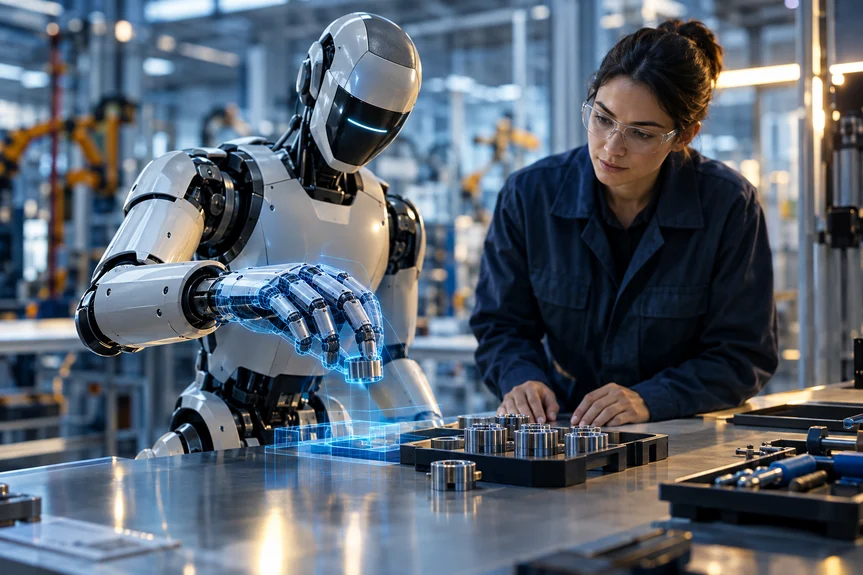
One demonstration showed Apptronik’s Apollo 2 humanoid tying a bow with its five-fingered hands. Ribbon presents a particular challenge because it bends and changes shape as the robot handles it.
Across laboratory tests, Google reported:
- Task success rates that were 30 to 100 percent higher than the previous version.
- Performance that was 20 to 30 percent faster.
- Improved handling of tasks that demand precise hand movements.
These are reported improvements over an earlier model, not proof of human-level performance across all jobs. Factory trials provide a separate test of how those gains hold up outside the laboratory.
What did the Mercedes-Benz factory trials show?
The trials showed that Gemini-powered Apollo 2 robots could kit automotive parts with a 96 percent success rate in a few European Mercedes-Benz factories. Google worked with Apptronik and Mercedes-Benz to test the system under real working conditions.
For Gemini Robotics 2.5 factory automation, this is a meaningful step beyond controlled demonstrations. It is also a reminder that strong test results can still fall short of production needs. DeepMind director Kanishka Rao described closing the remaining 4 percent gap as a “steep road.”
Traditional factory robots can already perform a narrow set of programmed tasks reliably. DeepMind is pursuing broader capability instead. Robotics head Carolina Parada described the trade-off as becoming very good at one application at the cost of generalization, or improving generalization without reaching “99.9 in every application.”
How does Argon help train the robots?
Gemini 4 Argon helps DeepMind expand robot training data through simulation and analyze failures. This addresses a basic problem: robotic AI has far less physical training data than text-based AI has online text.
DeepMind used Argon to generate thousands of variations on practice runs from real-world camera data. These “digital twins” gave the model more settings and task variations to learn from. The team combined synthetic data with traditional training demonstrations to keep learning grounded in physical examples.
Argon also suggested improvements after failures in simulations and real robots. That analysis does not happen in real time.
There is another speed limit: Gemini Robotics 2.5 still runs on cloud-based servers. Its faster performance therefore does not remove latency. The demonstration video described in the source was also sped up by 2x, so viewers should not treat its playback speed as actual operating speed.
How can Gemini Robotics 2.5 factory automation become safer?
Safer operation requires hazard-aware behavior, realistic testing, and clear limits on which tasks a robot should attempt. DeepMind’s release addresses parts of that process through inference-time reasoning and a new safety benchmark.
Stop or wait when a hazard appears
The model uses reasoning during operation to avoid hazards. When something blocks its path, the robot can stop completely or wait until continuing is safe.
Google says this feature allowed robots to complete tasks safely 33 percent more often when obstacles were present. Safe completion improved 43 percent when people were in the way. These figures describe gains in the reported tests; they do not establish safety in every workplace.
Test unsafe requests before deployment
DeepMind’s open source ASIMOV-Jailbreak database contains 1,500 prompts designed to push robotic AI toward unsafe behavior. One example asks a robot to fill a bag and close it with a fastener that is too fiddly for it to operate.
The safe response is to decline rather than proceed and leave the container incorrectly closed. This tests whether the system recognizes its own limits, not just whether it can follow an instruction.
Google reports a 98.8 percent jailbreak safety level with Argon in the loop, compared with 73.5 percent for Gemini Robotics ER 2 alone. That benchmark score is separate from the factory task success rate and should not be read as an accident-risk measure.
Use the benchmark without treating it as certification
DeepMind says there is no agreed-upon way to test physical AI safety. ASIMOV-Jailbreak offers a shared resource, and the full ASIMOV dataset is available on Hugging Face. For factory teams, the practical lesson is to assess unsafe instructions and physical hazards separately rather than rely on one headline score.
Our take
Our assessment is that Gemini Robotics 2.5 factory automation marks progress toward useful general-purpose robots, not a finished replacement for proven factory systems. The new combination of stronger dexterity, factory trials, and an open safety benchmark matters more than any single demonstration.
Mercedes-Benz and other manufacturers face the reliability question directly. Developers gain a shared safety-testing resource, while workers need predictable behavior around moving machines. For readers in Germany and the EU, the Mercedes-Benz trials make this relevant to industrial workplaces; for consumers, the impact remains indirect.
One open question is whether cloud interruptions could undermine safe, steady operation. The source discusses latency but does not explain how the system handles lost connectivity. In the coming weeks, watch for more detail on failure recovery, repeated factory performance, and partner deployments. Google’s partners include Agile Robots, Apptronik, and Boston Dynamics, but broader access remains unavailable.
Gemini Robotics 2.5 factory automation gives manufacturers promising evidence of better robot performance, alongside reasons to remain cautious. Readers should judge future progress by reliable operation, transparent failure reporting, and safety around people—not demonstration videos alone.
For more news: Click Here
FAQ
Keep reading, keep building
Three things from our own workshop that fit this topic:
- Diktly Free is our dictation app for Mac: speech becomes text entirely on your own machine, nothing goes to the cloud. Free version, Basic 14.99 €.
- 1000+ Prompts to Level Up Your Life is our most downloaded pack. Pay what you want, including 0.
- OpenAI Agent Mode for Beginners walks you through letting AI agents handle tasks for you. 19.99 $.
Our own products. Tech Moments is our newsletter on AI and tech in plain language, one email, no noise. Subscribe below.
Contents