AI News
02 Apr 2026
Read 10 min
AI for early Alzheimer’s detection: How to spot signs sooner
AI for early Alzheimer's detection can scan records to flag cases sooner and enable earlier care now.
AI for early Alzheimer’s detection is moving from labs to real clinics. Massachusetts teams are testing tools that scan brain MRIs for tiny changes and read clinic notes for early red flags. The goal is to find memory problems sooner, when new drugs may help. Here is what the tools do, their limits, and how patients can act now.
Alzheimer’s often hides in plain sight. Many people in the earliest stage, called mild cognitive impairment, never get flagged at a regular visit. New medicines can slow decline a bit, but they work only if started early. That is why researchers are building fast, practical AI that can surface warning signs doctors might miss in a busy day.
How AI reads brain scans for hidden shrinkage
The MRI signal
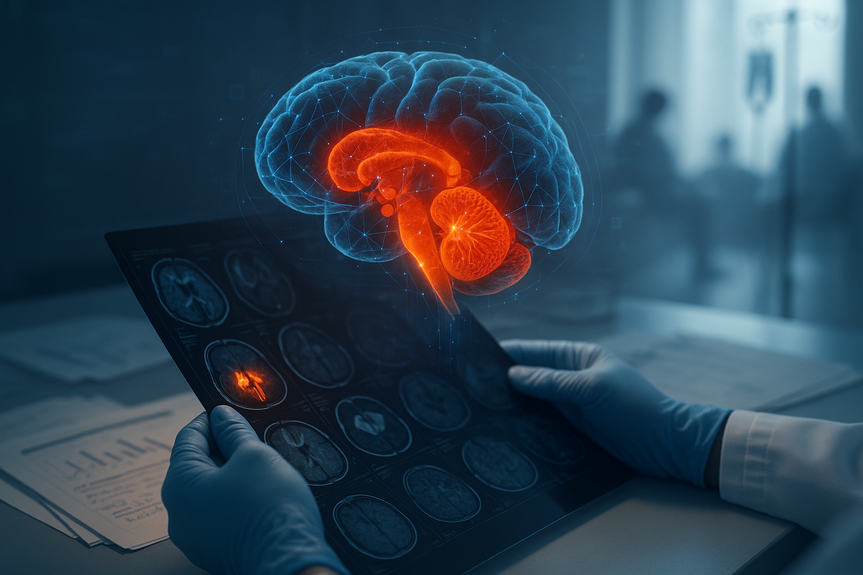
Scientists at Worcester Polytechnic Institute trained machine learning models to measure brain volume in dozens of regions on standard MRI scans. They reported that differences in the hippocampus, amygdala, and entorhinal cortex were the strongest clues. Their system reached about 93% accuracy in a research study of older adults.Why volume loss matters
– The hippocampus helps form new memories. – The amygdala helps process emotions. – The entorhinal cortex links memory, navigation, and perception. When these areas shrink faster than expected for age, it can point to early disease. Human readers can miss very subtle changes. Algorithms can compare patterns across many regions at once and spot small trends.What this could mean for clinics
– Faster triage: flag at-risk patients from routine MRIs. – Clearer next steps: prompt a cognitive test, blood biomarkers, or a specialist visit. – Better trial matching: enroll people early, when treatments target amyloid buildup.AI for early Alzheimer’s detection in everyday clinic notes
The note-reading assistant
A Mass General Brigham team built a system that scans electronic health record notes from regular visits, not just neurology. It looks for everyday clues that suggest memory trouble: – Missed appointments or confusion with scheduling – A spouse or child reporting new forgetfulness – Trouble managing medicines or following discharge instructions – Repeated calls for the same question The team used multiple AI “agents” that read notes like a care team, then cross-check each other before flagging a case. In a study of thousands of notes from anonymized patients, the tool identified likely early issues about 88% of the time. The group aims to pilot the system soon, pending funding.Why this matters
– Early, low-cost screening: use data that already exists. – Equity boost: find signals even if a patient does not see a specialist right away. – Workflow fit: nudge a clinician to order a brief cognitive screen during a routine visit.Why catching it early helps
Two medicines, Leqembi and Kisunla, can modestly slow decline if started during mild cognitive impairment or mild dementia. They also carry risks, including brain swelling and bleeds, so careful screening and monitoring are key. Still, a timely diagnosis can: – Open the door to disease-modifying therapy – Enable clinical trial access – Help families plan care, finances, and support – Motivate brain-healthy habits like sleep, exercise, and puzzles One Massachusetts patient described how years passed before he finally got tested after a suspected mini-stroke. Once he started treatment and daily brain exercises, he felt sharper. Earlier answers could have saved stress and started care sooner.Limits, risks, and how to use these tools safely
AI can help, but it is not a diagnosis. It should guide next steps, not replace judgment. Doctors stress the need to avoid false alarms and missed cases.Common reasons for look-alike symptoms
– Depression or anxiety – Poor sleep or sleep apnea – Medication side effects – Substance use – Thyroid issues or vitamin deficienciesBuild a safe pathway
– Confirm with standard tests: brief cognitive screens, blood biomarkers, MRI, and when needed PET. – Track sensitivity and specificity: know how often the tool is right. – Protect privacy: use strong data governance and audit logs. – Watch for bias: test across ages, races, languages, and care settings. – Keep the clinician in charge: use explainable flags and clear next steps. Any system for AI for early Alzheimer’s detection must prove real-world value. That means faster, fairer referrals, fewer missed cases, and better outcomes without overloading clinics.What patients and families can do now
Simple steps that help your doctor help you
– Keep a journal of memory slips with dates and examples. – Bring a trusted person to visits; ask them to share changes they see. – Ask your primary care doctor for a brief cognitive screen. – Review your medicines; flag drugs that can affect thinking. – Treat sleep, hearing, mood, and blood pressure problems. – Stay mentally and socially active with reading, games, or puzzles. – Ask about blood tests and imaging if concerns continue. – Learn about clinical trials and registries in your region.The bottom line
Early signs are often hiding in MRIs and everyday clinic notes. Used wisely, AI for early Alzheimer’s detection can help surface those signs sooner and prompt timely care. The promise is real, but it must come with safety checks, clear follow-up, and human judgment at every step.(Source: https://www.bostonglobe.com/2026/03/27/business/ai-alzheimers-mass-general-brigham/)
For more news: Click Here
FAQ
Q: What is AI for early Alzheimer’s detection and how are researchers using it?
A: AI for early Alzheimer’s detection refers to tools researchers are developing to spot subtle signs of dementia earlier; Massachusetts teams are testing systems that analyze brain MRIs for tiny volume changes and read routine clinic notes for red flags. The goal is to surface warning signs sooner so patients can receive timely follow-up, testing, or treatment when appropriate.
Q: How accurate are the AI tools described in the article?
A: In research studies cited in the article, a Worcester Polytechnic Institute MRI-based system reached about 93% accuracy and the Mass General Brigham note-reading tool detected likely early issues about 88% of the time. Those figures come from study settings and indicate promise but still require real-world validation before broad clinical use.
Q: Which brain regions do MRI-based AI tools focus on to detect early Alzheimer’s?
A: The studies found volume loss in the hippocampus, amygdala, and entorhinal cortex were the top predictors of early Alzheimer’s. Researchers also noted that loss in the right hippocampus appeared as an early bellwether in people at risk.
Q: What kinds of signals do AI systems look for in everyday clinic notes?
A: The note-reading AI scans routine electronic health record entries for everyday clues such as missed appointments, a spouse’s report of new forgetfulness, trouble managing medications, or repeated calls about the same issue. The Mass General Brigham system used multiple AI “agents” that cross-check findings before flagging patients for follow-up.
Q: Can AI replace doctors in diagnosing Alzheimer’s?
A: No—AI for early Alzheimer’s detection is intended to guide clinicians to patients who need further evaluation, not to make a diagnosis on its own. Confirmed diagnosis should follow standard steps like brief cognitive tests, blood biomarkers, MRI or PET scans, and clinician judgment to avoid false positives and missed alternative causes.
Q: What are the main limitations and risks of using AI to detect early Alzheimer’s?
A: Main limitations include the risk of false positives or negatives, other causes of cognitive symptoms such as depression, sleep problems, medication effects, or thyroid and vitamin issues, and the need to measure sensitivity and specificity. There are also concerns about privacy, bias across ages and languages, and the importance of keeping clinicians in charge of follow-up decisions.
Q: How could earlier detection with AI change treatment and care?
A: Earlier detection could enable starting disease-modifying therapies such as Leqembi or Kisunla during mild cognitive impairment, offer entry to clinical trials, and help families plan care and finances. Because those drugs carry risks like brain swelling and bleeds, AI-driven flags would still require careful screening and monitoring before treatment.
Q: What practical steps can patients and families take now while these AI tools are developed?
A: Patients and families can keep a journal of memory lapses, bring a trusted person to appointments to share observations, ask their primary care doctor for a brief cognitive screen, and review medications and sleep or mood problems. They can also stay mentally and socially active, ask about blood tests or imaging if concerns persist, and learn about clinical trials and registries in their region.
Contents