AI News
09 Apr 2026
Read 9 min
AI retinal screening for mental health: How it detects risk
AI retinal screening for mental health helps clinicians noninvasively detect psychiatric risk earlier.
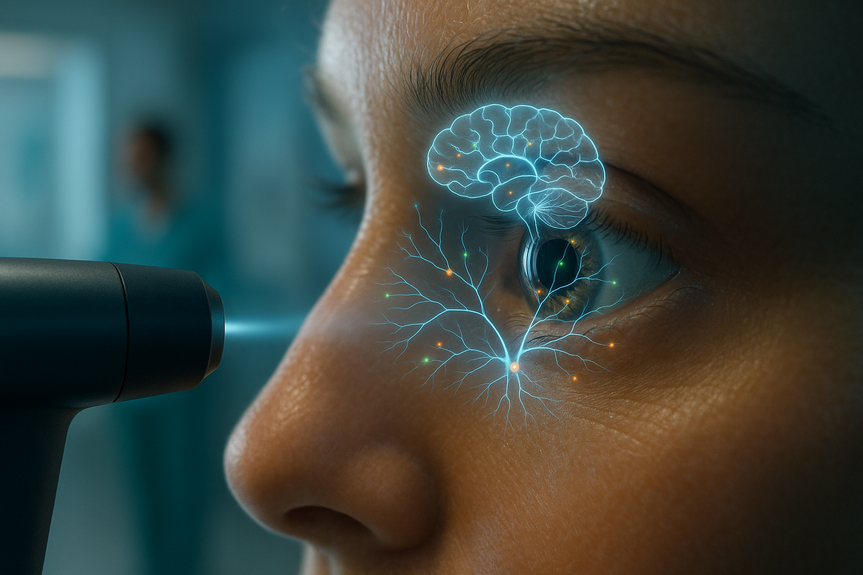
AI retinal screening for mental health uses images of the eye to spot early risk signals linked to stress and some psychiatric conditions. It analyzes tiny blood vessels in the retina—how thick they are, how they branch, and how they curve. This fast, noninvasive check can guide earlier referrals, better monitoring, and broader access to care.
Abhishek Appaji, an IEEE senior member and medical electronics engineer in Bengaluru, helped build a kiosk that scans the retina and uses AI to estimate stress and screen for basic eye diseases. His team worked with clinicians to turn lab research into a practical tool. The result aims to support doctors, not replace them, especially in clinics that serve remote communities.
Capture: A fundus camera or kiosk takes a high-quality image of the back of the eye.
Clean: Software improves contrast and outlines the blood vessels.
Measure: Algorithms measure vessel thickness, branching angles, and curvature across the network.
Analyze: AI models compare these patterns to clinical data to estimate risk or flag unusual findings.
Refer: Results guide a clinician to review, recommend follow-up, or order more tests.
No needles or dyes: a quick photo of the eye is enough.
Supports busy clinics: rapid checks can prioritize who needs a deeper exam.
Helps remote care: portable systems expand access outside large hospitals.
Primary care doctors can use quick retinal checks to decide on mental health referrals.
Telehealth programs can combine kiosk results with remote consults.
Community clinics and screening camps can reach more people in less time.
Hospitals can track stress trends during treatment or recovery.
Research teams can study how retinal vessel patterns change over time and across families.
Set up a standard image protocol to get sharp, well-lit photos.
Train staff to position patients and check image quality.
Use clear thresholds and workflows for referrals.
Explain to patients that this is a screening, not a diagnosis.
Protect patient data with secure storage and access controls.
Audit model performance regularly and track false positives and negatives.
Keep a clinician in the loop for every decision that affects care.
In short, AI retinal screening for mental health offers a fast, gentle way to spot risk and guide care earlier. With strong clinical oversight, good data practices, and ongoing studies, it can extend mental health support to more people, in more places, at the right time.
How AI retinal screening for mental health works
The retina as a window to the brain
The retina is part of the central nervous system. Doctors can see it directly and safely. Changes in tiny retinal blood vessels can mirror changes in brain blood vessels. Researchers study vessel thickness, the angles where vessels branch, and how much they curve. These features can act as biomarkers linked to mental health risk.From image to insight: the basic pipeline
Inside the Smart Eye Kiosk
Stress and psychiatric risk signals
Appaji’s Smart Eye Kiosk analyzes the retinal vasculature and estimates stress levels. Research links microvascular changes to disorders such as schizophrenia and bipolar disorder. In a study supported by India’s Department of Science & Technology (Cognitive Science Research Initiative), relatives of affected patients also took part. The goal is to find earlier, clearer risk patterns that support timely care.Screening for common eye disease
The kiosk also checks for basic eye issues, including diabetic retinopathy. High blood sugar can damage retinal vessels. Early alerts help patients seek treatment before vision loss occurs.Why AI retinal screening for mental health matters
Fast, noninvasive, and clinic-friendly
Built through clinical collaboration
The kiosk was developed with Tan Tock Seng Hospital and Nanyang Technological University, supported by the Ng Teng Fong Healthcare Innovation Program. Engineers, an ophthalmologist, and a psychiatrist shaped the tool together. This teamwork helped turn signal patterns into practical screening outputs that doctors can trust.What the results really mean
Screening is not a diagnosis
AI retinal screening for mental health highlights risk. It does not confirm a disorder. A trained clinician must review the findings and consider symptoms, history, and other tests. The best use is to guide earlier referrals and continuous monitoring.Data quality and fairness
AI works best with clear images and diverse training data. Teams must test models across ages, skin tones, and health conditions to reduce bias. Ongoing clinical studies will refine the thresholds and improve confidence in real-world use.Beyond the eye: linked patient monitoring
Contactless vital signs from a smart bed
Appaji also helped improve a wireless bed sensor that reads tiny body vibrations. The system, built with Dozee in India, tracks heart and breathing rhythms through a thin sheet under the mattress. Deep learning algorithms turn these signals into useful alerts, helping staff check patients without wires or wearables.Who benefits first
Primary care, telehealth, and community clinics
Hospitals and research centers
Getting started with AI retinal screening for mental health
Practical steps for clinics
Safeguards to put in place
(Source: https://spectrum.ieee.org/abhishek-appaji-ai-diagnostic-tool)
For more news: Click Here
FAQ
Q: What is AI retinal screening for mental health?
A: AI retinal screening for mental health uses images of the eye to spot early risk signals linked to stress and some psychiatric conditions. It analyzes tiny retinal blood vessels—measuring thickness, branching angles, and curvature—to provide a fast, noninvasive check that can guide earlier referrals and monitoring.
Q: How does AI retinal screening for mental health work in practice?
A: A fundus camera or kiosk captures a high-quality image of the retina, software cleans and outlines the blood vessels, and algorithms measure vessel features such as thickness, branching angles, and curvature. AI models then compare those vascular patterns to clinical data to estimate risk or flag unusual findings for clinician review.
Q: Who developed the Smart Eye Kiosk and who collaborated on it?
A: Abhishek Appaji and his team turned lab research into the Smart Eye Kiosk by working with an ophthalmologist, a psychiatrist, and engineering colleagues. The kiosk was developed in collaboration with Tan Tock Seng Hospital and Nanyang Technological University and was supported by the Ng Teng Fong Healthcare Innovation Program.
Q: What kinds of conditions can AI retinal screening for mental health flag?
A: The system estimates stress levels and can flag microvascular changes that research links to psychiatric disorders such as schizophrenia and bipolar disorder. It also screens for basic eye diseases, including diabetic retinopathy and retinal vessel damage caused by high blood sugar.
Q: Can AI retinal screening for mental health provide a diagnosis?
A: No, AI retinal screening for mental health is a screening tool that highlights risk and does not confirm a disorder. A trained clinician must review the findings alongside symptoms, history, and other tests to make any diagnosis or treatment decisions.
Q: Who stands to benefit first from AI retinal screening for mental health?
A: Primary care providers, telehealth programs, and community clinics can use quick retinal checks to prioritize referrals and reach more people in remote settings. Hospitals and research centers can also use the data to track stress trends and study vascular patterns over time.
Q: What data-quality and fairness issues should be considered with AI retinal screening for mental health?
A: The method works best with clear, well-lit images and diverse training data, and teams must test models across ages, skin tones, and health conditions to reduce bias. Ongoing clinical studies and regular audits are needed to refine thresholds and improve real-world confidence.
Q: How should clinics implement AI retinal screening for mental health safely?
A: Clinics should adopt standard imaging protocols, train staff on patient positioning and image quality, and set clear referral workflows so results guide follow-up care. They should also secure patient data, audit model performance regularly, and keep a clinician involved in every decision that affects care.
Contents