AI News
19 Mar 2026
Read 9 min
How AI-designed canine mRNA cancer vaccine cut tumor by half
AI-designed canine mRNA cancer vaccine shrank a dog's tumor by half and improved her quality of life.
An AI-designed canine mRNA cancer vaccine helped shrink a senior dog’s tumor by about half, according to its owner. Guided by chatbots and scientists, the custom shot followed failed chemo and surgery. The case shows how AI can speed options for pets, while raising questions about safety, access, and proof.
When Rosie, a senior rescue mutt in Sydney, got mast cell cancer in 2024, her owner, tech entrepreneur Paul Conyngham, went beyond standard care. After costly chemotherapy and surgery delivered poor results, he used AI tools to explore new options. Conversations with chatbots pointed him toward immunotherapy. He worked with scientists to analyze Rosie’s genetics and used well-known AI models to study possible targets. When a drug maker would not supply a candidate therapy, a nanomedicine expert crafted a custom mRNA shot. Conyngham says the final design drew on an AI assistant. He reports that after starting treatment in December, Rosie’s tumor shrank by about half and her daily life improved. Her cancer was not cured.
What evidence supports this approach for my pet’s cancer type and stage?
What are the known risks, side effects, and warning signs?
Is there a clinical trial that fits my pet?
What does it cost in money, time, and travel?
Who oversees safety, and what laws apply where I live?
What outcomes are realistic, and how will we measure them?
AI can help find papers, list options, and prompt smart questions. It should not replace licensed experts or approved pathways.
From standard care to an AI-guided bet
When usual treatment fell short
Chemo and surgery are common tools against mast cell tumors. Rosie tried both. They did not stop the disease. Conyngham looked for another path and used AI to map the next steps. He did not act alone. He hired experts, shared data, and asked hard questions.What AI actually did
AI chatbots helped him learn about immunotherapy and how it might help a case like Rosie’s. With scientists, he reviewed genetic data from Rosie’s tumor and used AI models that can predict protein shapes and targets. These tools did not replace doctors. They sped up reading, sorting, and forming ideas that specialists then checked.Inside the AI-designed canine mRNA cancer vaccine
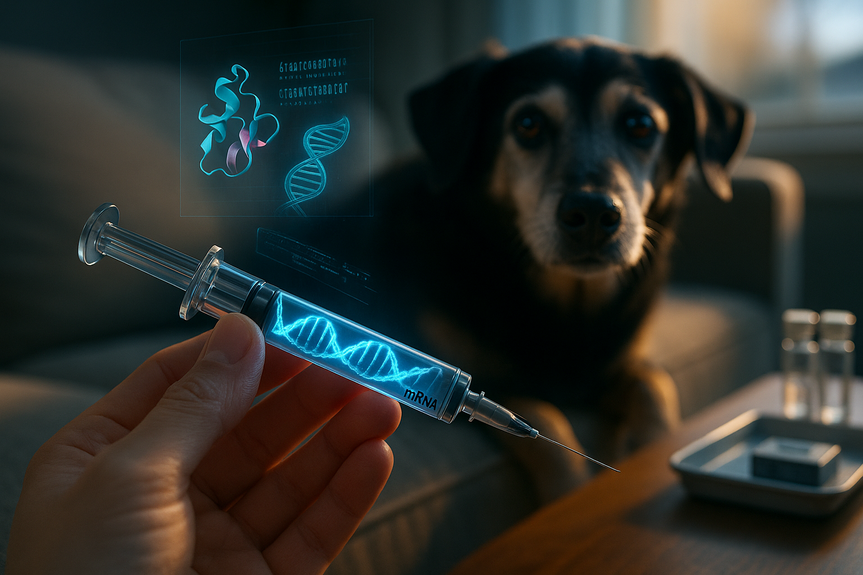
mRNA vaccines carry instructions that tell cells to make a harmless protein piece. The immune system sees that piece and learns to react. In cancer, the goal is to help the body spot and attack tumor markers. In Rosie’s case, a nanomedicine pioneer prepared an injection built around this idea. An AI system helped shape the design, according to Conyngham. The result was a one-off shot meant for a single patient, not a product on a shelf.Why it stood out
– It aimed at targets linked to Rosie’s tumor. – It used AI to explore candidates faster. – It involved a small team that could move quickly. – It required money, time, and expert support that most owners do not have.Results so far—and why they are not proof
Conyngham says the tumor went from the size of a tennis ball to about half that size after starting the shot. Rosie also seemed more comfortable and active. These are good signs for a single pet. But one story is not a study. Popular science voices, like Hank Green, warn that this case does not prove the approach will work for other dogs. We need controlled trials, shared data, and peer review to test safety and benefit. Many cancers behave differently, and results can vary a lot.What could explain the response
– Natural ups and downs in tumor growth – Effects from past treatments – Immune changes not tied to the shot – Real impact from the mRNA approach Only careful studies can sort these out.What pet owners should know before chasing AI cures
Before you follow a headline, talk to your veterinarian and a veterinary oncologist. Ask simple, direct questions:The bigger picture: AI’s growing role in vet medicine
This story shows how AI can scan research, suggest leads, and speed collaboration. It also shows limits. Access is uneven. Custom work is expensive. Data sharing is hard. The next step is to test ideas like an AI-designed canine mRNA cancer vaccine in transparent studies, with safety checks and clear endpoints. If researchers can prove benefit, regulators and vets can guide wider use. Until then, case reports should inspire curiosity, not shortcuts. The bottom line: AI is a strong helper when humans lead with care, evidence, and ethics. Rosie’s progress is hopeful, and her owner’s drive is remarkable. But pets everywhere need proof, not just promise. In the end, this case hints at a future where an AI-designed canine mRNA cancer vaccine may become one tool among many. For now, it remains a bold experiment, a reminder to balance hope with science, and a prompt to keep asking better questions.For more news: Click Here
FAQ
Q: What happened in the case of Rosie the dog?
A: Paul Conyngham, a tech entrepreneur in Sydney, worked with scientists and AI tools to develop a custom mRNA injection for his rescue dog Rosie after chemo and surgery produced poor results. The AI-designed canine mRNA cancer vaccine was a one-off shot that Conyngham says shrank Rosie’s tumor by about half and improved her quality of life, though the cancer was not cured.
Q: How did AI tools contribute to creating the custom treatment?
A: Chatbots guided Conyngham toward immunotherapy and helped him find relevant research and experts, while scientists sequenced Rosie’s tumor and ran the data through AI models like AlphaFold to identify targets. Conyngham says an AI assistant called Grok helped design the final construct, but human specialists reviewed the findings and a nanomedicine expert made the actual injection.
Q: Did the custom mRNA injection cure Rosie’s cancer?
A: No, Conyngham reports that after starting the custom treatment Rosie’s tennis-ball-sized tumor shrank by about half and her quality of life improved, but her cancer was not cured. This single case does not prove the treatment works generally.
Q: Can this AI-designed approach be expected to work for other dogs?
A: No, critics and scientists cautioned that one feel-good case does not generalize, and commentators like Hank Green have raised concerns. Researchers need controlled trials, shared data, and peer review before an AI-designed canine mRNA cancer vaccine can be considered proven.
Q: What should pet owners consider before pursuing similar AI-guided treatments?
A: Pet owners should talk with a veterinarian and a veterinary oncologist and ask about evidence, known risks, clinical trials, costs, oversight, and realistic outcomes. AI can help find papers and prompt questions, but it should not replace licensed experts when evaluating an AI-designed canine mRNA cancer vaccine or other options.
Q: What might explain Rosie’s tumor shrinking after the shot?
A: Possible explanations include natural ups and downs in tumor growth, lingering effects from previous chemo or surgery, immune changes not tied to the shot, or a real effect from the mRNA approach. Only careful studies and controlled trials can determine which explanation is correct.
Q: How was the one-off mRNA injection produced after a drug maker refused to supply a therapy?
A: After identifying a candidate therapy that the manufacturer would not supply, Conyngham’s team engaged a nanomedicine expert to formulate a custom mRNA injection tailored to Rosie’s tumor. The process involved genetic sequencing, AI-supported target selection, and human oversight, resulting in a patient-specific, one-off shot.
Q: What are the broader implications of this case for veterinary medicine?
A: The case shows AI can speed literature review, suggest leads, and accelerate collaboration between owners and specialists, potentially expanding options in veterinary medicine. However, questions about safety, access, cost, data sharing, and the need for trials and regulatory guidance mean an AI-designed canine mRNA cancer vaccine remains experimental and should be tested transparently before wider use.
Contents