AI News
28 Mar 2026
Read 9 min
How AI NPC generation for Witcher 4 creates realistic crowds
AI NPC generation for Witcher 4 speeds realistic crowd creation and lets teams prototype worlds faster
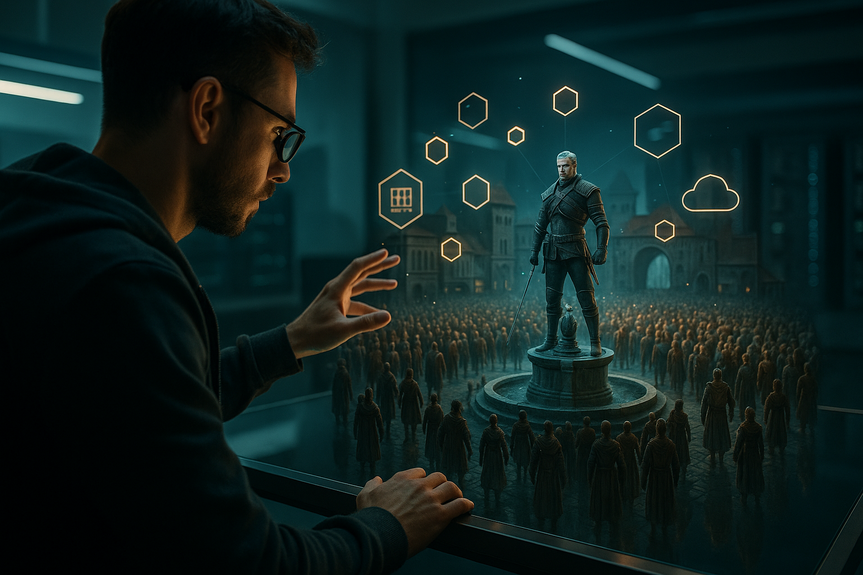
CD Projekt RED is testing AI tools to build livelier towns and streets. AI NPC generation for Witcher 4 aims to automate prototyping, speed up QA, and create dense, believable crowds with varied looks and routines. Similar research supports Cyberpunk 2, promising richer worlds without replacing writers or actors.
CD Projekt RED’s latest report confirms an internal AI team working on tools that help build and test game systems faster. The group has explored automation for prototypes, quality checks, and large-scale NPC crowds across The Witcher 4, Cyberpunk 2, and the online-focused Project Sirius. AI NPC generation for Witcher 4 is part of this push, but it supports developers rather than replaces them.
Blend clothing, body types, and accessories to reduce clones
Swap micro-animations like fidgeting or idle glances
Attach light backstories for believable barks and actions
This approach to AI NPC generation for Witcher 4 is about scale and speed. Artists still set the style and rules, while tools fill in safe variations to populate markets, inns, and city gates.
Daily loops: work, shop, rest, travel between districts
Local rules: guards check trouble spots; vendors respond to time and weather
Event triggers: crowds gather for fights, flee from danger, or cheer bards
By simulating hundreds of agents, designers can spot pathing jams and tune crowd density. This supports smoother movement, fewer pileups, and more natural reactions.
Automated path checks to find stuck spots before playtests
Performance sweeps to see how many NPCs a scene can hold
Behavior audits that flag broken schedules or looping states
The result is more time for human designers to craft quests, write characters, and polish set pieces.
Cyberpunk 2 can use improved traffic and pedestrian flow for denser streets
Project Sirius, with online elements, can scale crowds and events more reliably
Tools built once can reduce rework across future updates
The studio notes it has about a dozen AI research tracks running, with some already in testing. That suggests steady, practical adoption rather than a single big leap.
DLSS can upscale frames to keep high detail in busy scenes
RTX Mega Geometry can handle rich meshes with lower VRAM cost
Better budgets allow more NPCs on screen without harsh frame drops
When paired with smarter crowd logic, these gains can turn “packed but choppy” plazas into smooth, atmospheric hubs.
Busier markets and roads that feel alive
Fewer look-alike NPCs and stiffer loops
More emergent moments that fit the setting
Smoother performance in crowded spaces
Strong tools rarely grab headlines, but they set the floor for the kind of worlds CD Projekt RED wants to build next.
In short, AI NPC generation for Witcher 4 looks like a behind-the-scenes upgrade that helps teams ship richer crowds, smarter routines, and steadier frames, while keeping human creators in charge of the heart of the game.
(p (Source: https://www.pcguide.com/news/cd-projekt-red-has-been-testing-out-ai-tools-to-create-realistic-npcs-in-the-witcher-4-and-cyberpunk-2/)
How AI NPC generation for Witcher 4 could work
Procedural variety that avoids copy-paste crowds
Crowds often break immersion when they reuse the same faces, clothes, and movements. AI-assisted pipelines can mix assets and animations at scale so each passerby feels distinct.Schedules, reactions, and crowd flow
Smart NPCs follow simple daily plans and react to the world. AI tools can help generate and test those routines faster.Faster prototyping and smarter testing
The report highlights automation for prototyping and QA. In practice, that can mean bots that stress-test maps, measure frame times, or try weird player actions.Shared wins for Cyberpunk 2 and Project Sirius
CD Projekt RED says its AI research spans multiple games. Lessons from one setting can benefit another.Tech fit: DLSS 4/5 and RTX Mega Geometry
The Witcher 4 is set to support Nvidia DLSS 4, with possible DLSS 5 later, plus RTX Mega Geometry. These features can free up performance that crowds usually eat.Creative lines developers say they will not cross
Many studios, like Capcom, say they avoid using generative AI for final game content but will use it for development. CD Projekt RED’s report echoes this idea: research targets workflows such as prototyping, testing, and crowd creation. That does not mean replacing writers, actors, or quest designers. Clear boundaries help protect story quality, voice talent, and player trust. Ethical use also means reviewing data sources, reducing bias in crowd models, and keeping human sign-off on anything that reaches players.Release timing and expectations
The Witcher 4 is not planned for 2026. Current estimates point to 2027 or later. Until then, expect slow, visible progress: better tools, cleaner builds, and occasional tech details. If the studio hits its goals, players should see:For more news: Click Here
FAQ
Q: What is AI NPC generation for Witcher 4?
A: AI NPC generation for Witcher 4 refers to CD Projekt RED testing AI-based tools to automate prototyping, speed up QA, and generate realistic crowds of NPCs to make towns and streets feel livelier. The studio’s internal AI research team explores mixing assets, micro-animations and light backstories while artists set style and rules.
Q: How would AI NPC generation for Witcher 4 create more varied crowds?
A: AI NPC generation for Witcher 4 uses AI-assisted pipelines to blend clothing, body types, accessories and micro-animations while attaching light backstories so each passerby feels distinct. Artists set the style and rules while tools fill in safe variations to populate markets, inns and city gates.
Q: Will AI NPC generation for Witcher 4 replace writers and actors?
A: CD Projekt RED’s report says AI NPC generation for Witcher 4 is intended to support developers rather than replace writers or actors, and human creators remain in charge. The studio emphasizes human sign-off and creative control to protect story quality and voice talent.
Q: In what ways can AI NPC generation for Witcher 4 speed up prototyping and testing?
A: AI NPC generation for Witcher 4 can automate prototyping and QA with automated path checks to find stuck spots, performance sweeps to measure how many NPCs a scene can hold, and behavior audits that flag broken schedules or looping states. These automated tests help designers spot pathing jams and tune crowd density before playtests.
Q: Are AI crowd tools being tested for Cyberpunk 2 and Project Sirius as well?
A: Yes, AI NPC generation for Witcher 4 research is part of a broader AI effort that also targets Cyberpunk 2 and Project Sirius, allowing lessons from one setting to benefit another. CD Projekt RED says it is pursuing about a dozen AI research tracks, with some initiatives already in testing and preliminary utilization.
Q: How will DLSS and RTX Mega Geometry affect AI NPC generation for Witcher 4?
A: Support for Nvidia DLSS 4 (and possibly DLSS 5) and RTX Mega Geometry can free up performance and VRAM so denser crowds produced by AI NPC generation for Witcher 4 render more smoothly. When paired with smarter crowd logic, these technologies help keep high detail in busy scenes and reduce choppy framerates.
Q: When might players see AI-driven crowds from AI NPC generation for Witcher 4 in the final game?
A: The Witcher 4 is not planned for 2026 and current estimates place release in 2027 or later, so AI NPC generation for Witcher 4 features would likely appear after that timeframe. CD Projekt RED expects slow, visible progress as tools are tested, refined, and occasionally detailed ahead of release.
Q: What ethical or creative boundaries has CD Projekt RED set for AI NPC generation for Witcher 4?
A: CD Projekt RED says AI NPC generation for Witcher 4 research targets development workflows like prototyping, testing and crowd creation while avoiding replacing writers, actors or quest designers. The studio also highlights reviewing data sources, reducing bias in crowd models and keeping human sign-off on anything that reaches players.
Contents