Crypto
07 Apr 2026
Read 12 min
Odds of solo bitcoin mining explained with 1-in-28,000 win *
Odds of solo bitcoin mining show clear upside as a 230 TH miner won a $210,000 block reward today.
A home miner with about 230 TH/s just hit block 943,411 and earned roughly $210,000 in rewards. That lucky result puts a spotlight on the odds of solo bitcoin mining. With a daily chance near 1-in-28,000 for a setup like this, wins are rare but real. Here is how those probabilities work and what they mean.
A solo miner using CKpool claimed the full 3.139 BTC payout: a 3.125 BTC subsidy and about 0.014 BTC in fees. CKpool, which launched in 2014, lets individuals mine solo while keeping any full block reward, minus a small pool fee. The miner’s hashrate, about 230 TH/s, is a tiny slice of Bitcoin’s roughly 1 ZH/s network hashrate. That is close to a few home ASICs running under one roof, not an industrial farm.
The win also broke a 33-day dry spell for CKpool. Over the last year, solo pools have found 20 blocks and paid out about 62.96 BTC. On average, that is one solo win every 18 to 19 days, with the longest recent gap around two months. These sparse results help frame why solo mining looks like a lottery: long waits, sudden payouts, and big variance.
Full block reward if you win (minus a small fee)
No payout dilution from a pool
Simple setup with CKpool’s solo option
Very low daily probability of a win
Long, uncertain waits with zero income
High variance can strain cash flow and morale
Steadier, smaller payouts based on your share
Fees and pool policies affect returns
No single, life-changing win, but less variance
Many home miners blend approaches: they point rigs to a standard pool for steady income, and occasionally try solo sessions when network conditions or fees look favorable. CKpool’s solo option makes that flip simple.
About 230 TH/s hit block 943,411 for roughly $210,000
Roughly 270 TH/s landed a block in December for more than $280,000
A tiny 6 TH/s setup beat 1-in-180-million odds and earned about $265,000
A 200 TH/s rig secured around $350,000 last fall
One miner rented about 1 PH/s of cloud hashrate for roughly $75 and hit a $200,000 reward in February
These outliers are exciting, but they do not change base probabilities. They remind us that, while rare, improbable events can still happen on any given day.
Riot Platforms sold 3,778 BTC for about $289.5 million, ending with 15,680 BTC in treasury
MARA Holdings sold about 15,133 BTC for around $1.1 billion, using the funds to buy back convertible notes
Nakamoto Inc. sold 284 BTC for roughly $20 million
Genius Group exited its 84.15 BTC position
Institutional miners face power costs, machine cycles, and financing realities. Solo wins grab headlines, but they do not offset macro pressure like difficulty increases and price swings. On the day of the CKpool win, bitcoin traded near $66,600, roughly flat over 24 hours.
Find your rig’s total hashrate (TH/s)
Check the network hashrate (usually displayed in EH/s or ZH/s)
Compute your share = your hashrate / network hashrate
Approximate daily chance ≈ your share × 144
Expected wait in days ≈ 1 / daily chance
Example: With 230 TH/s and a 1 ZH/s network, your share is about 2.3 × 10^-7. Multiply by 144 to get a daily chance on the order of 1-in-30,000. As difficulty and network hashrate move, your odds change too. If network hashrate rises, your share falls, and the expected wait grows longer.
Variance can beat or crush your expectations for long stretches
Power cost matters; long solo runs can be expensive with no payout
Pool fees, uptime, and hardware efficiency also impact net results
Solo mining is best viewed as a high-variance experiment, not a steady income plan
If you want a quick mental model, think of each day as 144 small coin flips weighted by your share of the network. Most days, a small solo miner flips “tails” 144 times. Once in a while, lightning strikes.
You accept high variance and can afford dry spells
You value the thrill of a full block hit
You plan short bursts during fee spikes or lower difficulty windows
If you need consistent payouts to pay electricity, a standard pool is more practical. You can still devote a slice of your hashrate to solo mining to keep a shot at a headline moment.
Understanding the odds of solo bitcoin mining
What “daily odds” really mean
When people talk about the odds of solo bitcoin mining, they are describing the chance your hashrate will discover at least one valid block in a given time. The network aims for one block about every 10 minutes. That comes to roughly 144 blocks per day. Your probability depends on your share of the total hashrate and the current difficulty. – Your share of hashrate = your hashrate / total network hashrate – Chance to find a given block ≈ your share of hashrate – Daily chance ≈ 1 − (1 − your share) ^ 144 For very small shares, a quick shortcut is daily chance ≈ your share × 144. If your share is 0.00000023 (about 230 TH/s in a 1 ZH/s network), the back-of-the-envelope daily chance is on the order of a few in 100,000, or around 1-in-30,000. That is close to the 1-in-28,000 figure shared for the winning rig. The exact number moves with difficulty and hashrate.Why variance looms large
Expected time to find a block is the inverse of your daily probability. But variance is extreme. One miner can get lucky in a week; another with the same hashrate might wait years. This is why solo mining feels like buying a lottery ticket with changing odds. The laws of probability hold over very long periods, not short streaks.Subsidy vs fees: where the money comes from
In this win, the miner earned almost entirely from the subsidy. The block included low fees (about 0.014 BTC). Post-2024 halving, the subsidy is 3.125 BTC. Fee spikes can happen in busy periods, but on most days, fees are a small slice. Solo miners count on the subsidy, which halves roughly every four years, tightening economics over time.What a 230 TH/s home setup looks like
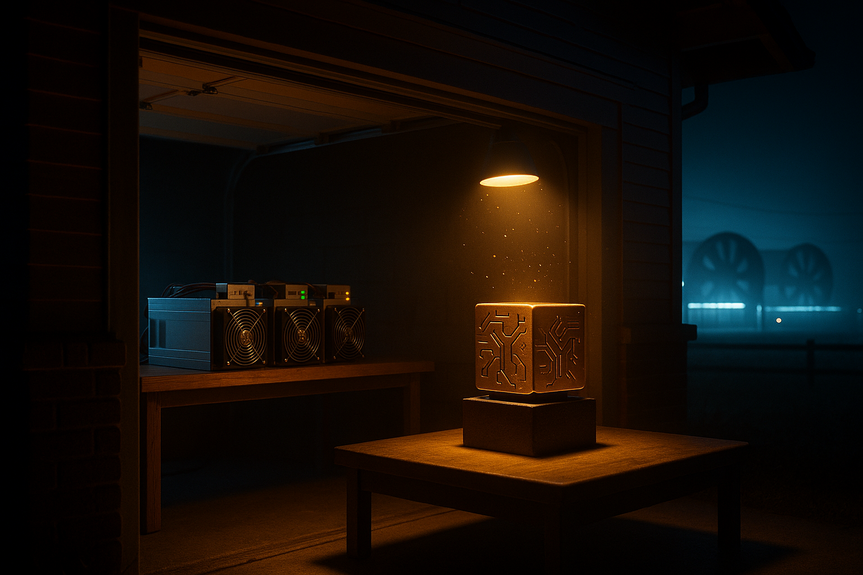
A 230 TH/s footprint could be: – Two recent-generation ASICs running around 100–150 TH/s each – A small stack of mid-generation rigs that add up to the same total – Power draw in the mid–single kilowatt range, depending on models and efficiency This is still real hardware, heat, noise, and power costs. But it is far smaller than a warehouse-scale farm. It is also small enough that, on most days, the miner will earn nothing unless they find a full block. That is the trade-off: no steady payouts, but full reward on a lucky hit.Solo vs pooled mining: risk and reward
Solo mining pros
Solo mining cons
Pooled mining trade-offs
Recent solo wins that shape expectations
These cases show the extremes of luck and scale:The market backdrop: a two-speed mining economy
Home miners hunt for windfalls while large listed miners manage corporate balance sheets and rising difficulty. In the first quarter:How to estimate your own chances
Step-by-step approach
Practical notes
Takeaways for home miners
When does solo make sense?
Solo attempts may appeal if:Mind the moving targets
Network hashrate, difficulty, and fees change all the time. A rig that had a 1-in-28,000 day last week might face 1-in-32,000 this week if network hashrate climbs. Keep checking current figures, and adjust your expectations. The 230 TH/s win proves that small setups can still grab full rewards. It does not change the math. The odds of solo bitcoin mining remain long on any given day, but they are never zero. In the end, solo mining is a test of patience, bankroll, and luck. If you try it, know your numbers, track the market, and respect the odds of solo bitcoin mining from the start to the finish. (pSource: https://www.theblock.co/post/396366/lucky-solo-bitcoin-miner-beats-1-in-28000-daily-odds-to-win-210000-block-reward)For more news: Click Here
FAQ
Q: What happened when the CKpool solo miner found block 943,411?
A: A small solo miner using CKpool with about 230 TH/s solved block 943,411 and collected 3.139 BTC, roughly $210,000, made up of a 3.125 BTC subsidy and about 0.014 BTC in fees. CKpool, launched in 2014, lets individual miners keep full block rewards minus a 2% fee. The outcome highlights the odds of solo bitcoin mining, which for a miner this size was reported to be roughly 1-in-28,000 on any given day.
Q: How are the odds of solo bitcoin mining calculated?
A: The odds of solo bitcoin mining are based on your share of total network hashrate: share = your hashrate ÷ total network hashrate, and the chance to find any given block is approximately that share. Daily chance is roughly 1 − (1 − share)^144, and for very small shares a quick approximation is daily chance ≈ share × 144.
Q: What does a 230 TH/s home mining setup represent in network terms?
A: At about 230 TH/s the winning rig represented roughly 0.00002% of Bitcoin’s total estimated hashrate of around 1 ZH/s as of April 2, making it consistent with a small stack of home-scale ASICs rather than an industrial farm. That tiny share explains why the daily odds of solo bitcoin mining were so long for the setup.
Q: Why does solo mining have such extreme variance in outcomes?
A: Variance is large because the expected time to find a block is the inverse of your daily probability, so low daily chances translate into long average waits. Consequently one miner can get lucky in a week while another with the same hashrate might wait years, which is why solo mining behaves like a lottery.
Q: How frequently have solo pools found blocks recently?
A: Over the past 12 months solo pools have found 20 blocks and paid out a combined 62.96 BTC, which averages to about one solo block every 18.7 days and included a longest gap of 58 days. CKpool specifically ended a 33-day drought with the April win.
Q: How much of the $210,000 reward came from the subsidy versus transaction fees?
A: The April block paid 3.139 BTC total, made up of a 3.125 BTC subsidy and roughly 0.014 BTC in transaction fees (about $937). That split reflects post-2024 halving subsidy levels, so most solo payouts still come primarily from the subsidy rather than fees.
Q: What are the main pros and cons of solo mining compared with pooled mining?
A: Solo mining offers the chance to capture a full block reward (minus a small pool fee) and avoids payout dilution, but it comes with a very low daily probability of a win and long, uncertain dry spells. Pooled mining trades away that possibility for steadier, smaller payouts based on your share, with fees and no single life-changing hit.
Q: How can I estimate my own daily chance of finding a solo block?
A: To estimate your personal odds of solo bitcoin mining, find your rig’s hashrate, check the network hashrate, compute share = your hashrate ÷ network hashrate, and use the small-share shortcut daily chance ≈ share × 144 to approximate your daily chance. The expected wait in days is roughly 1 ÷ daily chance, and remember these figures shift as network hashrate and difficulty change.
* The information provided on this website is based solely on my personal experience, research and technical knowledge. This content should not be construed as investment advice or a recommendation. Any investment decision must be made on the basis of your own independent judgement.
Contents