AI News
21 Apr 2026
Read 9 min
AI-driven digital twins for particle accelerators Save years
AI-driven digital twins for particle accelerators cut years from design and tuning and increase uptime.
Fermilab and DOE partners are building AI-driven digital twins for particle accelerators to speed design, setup, and operations. These living models sync with real machines, test fixes safely, and learn over time. Early tools like Osprey AI agents show 100x task speed-ups, pointing to years saved and major cost cuts across labs.
Particle accelerators drive big wins in physics, medicine, and clean tech. They make medical isotopes, power materials science, and even help remove “forever chemicals” from water. But accelerators are hard to build and run. They include tens of thousands of parts, take years to design, and need expert hands every day. A new U.S. Department of Energy effort, led by Berkeley Lab with Fermilab and five other national labs, aims to change that. The team, called the Multi-Office particle Accelerator Team (MOAT), is creating AI tools that learn from data, plan actions, and improve with use. At the center is a bold idea: connect smart software to virtual models and real machines so both get better together.
Design cycles take many years and many simulations
Tuning beams can be slow and error-prone
Operators rely on scattered notes and memory
Testing risky changes on live hardware is dangerous and costly
Streaming data from controls and diagnostics
Physics-based models that capture beam dynamics
AI that adapts the model when data and predictions differ
Virtual diagnostics that can “measure” what real tools cannot
With AI-driven digital twins for particle accelerators, teams can try “what if” plans before touching the hardware. They can tune beams virtually, spot bad settings early, and push performance with less wear and tear. The same twin helps in design, construction, and daily operations, so lessons carry across the full life cycle.
Faster design: AI-driven digital twins for particle accelerators cut trial-and-error and move ideas from months to weeks
Safer operations: risky changes test in the twin first
Higher uptime: quick, cited fixes reduce downtime
Better beams: smarter tuning improves stability and brightness
Lower costs: fewer wasted runs, longer component life, and energy savings
Shared gains: one lab’s win becomes everyone’s upgrade
Historical logs and real-time streams teach the twin
Physics models set guardrails so AI stays grounded
Osprey-like agents plan scans, adjust settings, and check limits
Humans stay in the loop for oversight and policy
Twin performance improves as more runs and edge cases flow in
Updates roll out across machines with similar systems
This approach does not replace experts. It gives them superpowers. Engineers spend less time on routine scans and more time on new ideas. Operators shift from firefighting to guiding smart tools and setting safe boundaries.
The payoff is clear. With shared AI tools, a live virtual model, and a testbed at FAST/IOTA, MOAT is building a faster path from concept to beam. If early gains hold, the field could save years on new projects and unlock more science from existing machines. In short, AI-driven digital twins for particle accelerators can help labs discover more, waste less, and deliver better results for medicine, energy, and basic research.
(Source: https://news.fnal.gov/2026/04/fermilab-researchers-develop-ai-tools-to-advance-the-future-of-particle-accelerators)
For more news: Click Here
Why accelerators need AI now
Today’s pain points
The Genesis Mission push
The DOE’s Genesis Mission and its ModCon consortium bring top labs together to build self-improving AI. Instead of each lab coding alone, MOAT shares data, tools, and results. This speeds progress and keeps solutions aligned across the nation’s accelerator fleet.AI-driven digital twins for particle accelerators
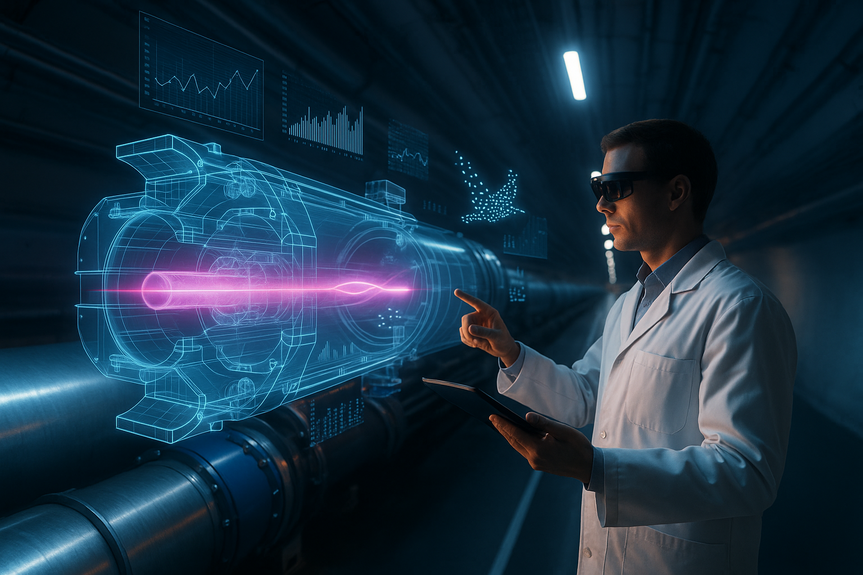
Digital twins are virtual versions of real accelerators. They do not just copy blueprints; they mirror live behavior. Sensors feed data from the machine into the twin. The twin tests new settings, predicts results, and sends safe changes back. This loop runs all the time, so the model learns how magnets, RF systems, and beams respond in the real world.What makes the twin “live”
From control room to code: Osprey and AI agents
AI agents plan steps, run tests, read logs, and act with minimal help. MOAT’s first demo tool, Osprey, speeds some tasks by 100x. It breaks a job into clear actions, checks results, and adapts. Think of a tireless junior operator that never forgets.Capturing expert fixes
Operators have decades of playbooks for rare faults and tricky drifts. MOAT is training AI on these documented fixes from Fermilab and other DOE sites. When a fault hits, the system can suggest proven steps with citations. This shortens downtime and spreads best practices fast.FAST/IOTA: the proving ground
Fermilab’s FAST/IOTA facility is a flexible testbed. It can run different beams and setups, which makes it ideal for trying new AI tools. Here, the team will connect twins to real hardware, test virtual diagnostics, and show safe, automatic beam tuning.One team, many labs
MOAT joins seven labs: Berkeley, Fermilab, Argonne, Brookhaven, Jefferson, Oak Ridge, and SLAC. They share data, models, and software under the DOE’s ModCon effort. This shared path keeps standards aligned and speeds rollout across many machines, from light sources to colliders.What success looks like
How the pieces fit together
Data and models
Agents and automation
Continuous learning
FAQ
Q: What are AI-driven digital twins for particle accelerators?
A: AI-driven digital twins for particle accelerators are virtual models that mirror the live behavior of real accelerator complexes and stay synchronized through streaming data. They provide a continuous feedback loop to test settings, predict results, and learn from the machine over time.
Q: How will MOAT use AI agents like Osprey in accelerator operations?
A: MOAT’s initial demonstration deployed the Osprey AI tool, which uses AI agents to accelerate specific tasks by a factor of 100 and to reason, plan, and take actions with minimal supervision. These agents can break jobs into actions, run tests, read logs, and adapt based on results while keeping humans in the oversight loop.
Q: Why do particle accelerators need AI now?
A: Modern accelerators have tens or hundreds of thousands of components, long design cycles, slow and error-prone beam tuning, and operators who rely on scattered notes, making testing risky and costly. AI-driven digital twins for particle accelerators address these pain points by enabling faster design cycles, safer virtual testing, and better access to documented operator fixes.
Q: What benefits can AI-driven digital twins for particle accelerators provide?
A: They can shorten trial-and-error in design and move ideas from months to weeks, let teams test risky changes virtually before applying them to hardware, and reduce downtime by surfacing cited fixes from past operator knowledge. Across design, construction, and operations this approach aims to improve beam stability and brightness, extend component life, and lower costs.
Q: How do the digital twins stay accurate and improve over time?
A: The twins combine streaming data from controls and diagnostics, physics-based models of beam dynamics, and AI that adapts the model when predictions and measurements differ. This continuous feedback loop allows virtual diagnostics to capture edge cases and evolve as the real accelerator responds to adjustments.
Q: Where will MOAT test these tools and which labs are collaborating?
A: Fermilab’s FAST/IOTA facility will serve as a key proving ground for connecting twins to real hardware, testing virtual diagnostics, and demonstrating safe automatic beam tuning. MOAT is led by Berkeley Lab in partnership with Fermilab, Argonne, Brookhaven, Jefferson, Oak Ridge, and SLAC under the DOE’s ModCon and Genesis Mission efforts.
Q: Will AI replace accelerator operators and engineers?
A: No, MOAT emphasizes that humans remain in the loop for oversight, policy, and guidance while AI handles routine scans, planning, and repetitive tasks. AI-driven digital twins for particle accelerators are intended to augment operators’ capabilities so engineers spend less time firefighting and more time on new ideas.
Q: What is the current development status of MOAT and its expected impact?
A: MOAT’s AI systems are still in early development, and the team recently presented their first demonstration, including the Osprey tool, to the DOE Office of Science. If early gains persist, AI-driven digital twins for particle accelerators stand to save years of effort and billions of dollars across labs by accelerating design, setup, and operations.
Contents