Crypto
28 Apr 2026
Read 13 min
Trump Mar-a-Lago crypto event: What investors must know *
Trump Mar-a-Lago crypto event reveals investor risks and how to quickly assess exposure and protect capital.
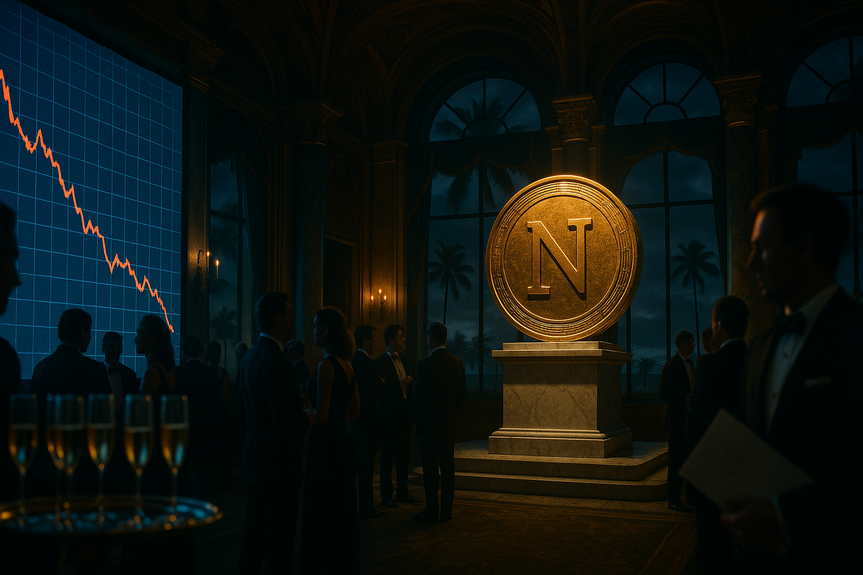
The Trump Mar-a-Lago crypto event drew nearly 300 top token holders as the $TRUMP coin slid more than 95% from last year’s peak. The private gala mixed politics, promotion, and policy talk. For investors, the headline is clear: price momentum is weak, risks are rising, and legal and regulatory clouds now matter as much as hype.
Donald Trump hosted a day-long gala for major $TRUMP token holders at Mar-a-Lago in Palm Beach. He delivered a keynote and held a small VIP reception for 29 select guests. The gathering came as the token hovered near its lows and as questions grew about the family’s broader crypto moves. According to reporting and blockchain data, the crowd was smaller in value and conviction than last year. Analysts now see a sharp shift from early accumulation to quick trading and fading demand.
Trump Mar-a-Lago crypto event: Key takeaways investors can act on
Who attended and why it matters
– 297 of the largest $TRUMP holders received invites. – A core group of 29 attended a VIP reception and toast. – Entry linked to token holdings and purchases of Trump-branded goods like watches, sneakers, and fragrance. This matters because access and perks can influence short-term buying. But this year, that push did not create the same hold-and-hype cycle. Attendance tied to both token size and merchandise also adds a “pay-to-rank” dynamic that may not support long-term holders.Price action shows stress, not strength
– $TRUMP traded near $3 late Friday. – It fell to about $2.53 while Trump spoke Saturday morning and stayed under $2.60 after he left Florida. – That is a steep drop from the roughly $75 high after the January 2025 launch. This pattern signals weak conviction. Price fell during headline news that would normally lift a meme coin. That tells us the audience is more short-term and less willing to hold through news spikes.The contest rules pushed spending, not holding
Contest rankings did not rely only on token size. They also rewarded buyers of Trump-branded merchandise during a March 12 to April 14 window. Prizes include a poster, two trading cards, a “Fight Fight Fight Red Beauty” watch, and a fragrance. This kind of game can lift activity for a moment, but it may not build a sticky base of holders. It also risks creating a fast inflow and outflow cycle instead of steady demand.Ethics and policy overlap raise new questions
Government ethics experts say the mix of public power, private branding, and crypto wealth has little modern precedent. Trump told reporters he felt an “obligation” to support the industry and called crypto a “big” and “somewhat mainstream” sector. A White House spokesperson said his assets sit in a trust run by his children and that there are no conflicts. Still, when policy talk and personal exposure meet, markets can move on words as much as deeds. Investors should expect headline risk and fast swings tied to statements, meetings, and events.How the market read the moment
Nansen’s view: demand did not stick
A Nansen analysis prepared for Reuters showed a sharp shift from 2025. Last year, buyers accumulated and held, which fueled a rally. In 2026, a brief activity burst did not last. The 297 winners held about $29 million in $TRUMP, far below the $148 million reported for the first contest. This gap points to reduced whale interest and smaller balance sizes, both bearish signs for stability.Meme coin math still rules
Meme coins usually have no utility. They ride trends and online energy. Prices often go up fast at launch, then fall hard. $TRUMP is now close to its lows after a parabolic start. That is not unusual for this category. In this lane, attention is the main fuel. Without strong, sticky demand or a clear use case, attention fades and price follows.The wider crypto web around the event
Reported earnings and holdings
A Reuters review found the Trump family took in more than $1 billion from crypto asset sales, including at least $336 million from meme-coin sales in the first half of 2025. There may be more in unrealized gains. These figures show how personal stakes and public signals can intersect. When leaders can move markets with speech, and also hold related assets, price risk increases for everyone else.World Liberty Financial and legal noise
World Liberty Financial, cited as the family’s most lucrative crypto venture, hosted a February conference at Mar-a-Lago with high-profile guests. This week, investor Justin Sun—linked to a top $TRUMP wallet and the contest’s first-place finisher for two years—sued the company, saying it froze his holdings. World Liberty’s CEO called the suit meritless and said it acted to protect users. Legal disputes like this can drag on. They can also spook buyers and spur fast exits.How to read the signals from the Trump Mar-a-Lago crypto event
Focus on five checks
– Liquidity depth: Can you enter and exit without moving the price too much? Thin books can trap traders. – Holder concentration: A few big wallets can move price at will. Track top-wallet flows for clues. – Catalyst quality: Are events tied to real adoption or only to short-term contests and merch drops? – Regulatory overhang: Policy talk can spark rallies or selloffs. Watch for agency actions or new bills. – Legal risk: Disputes around related ventures can hurt sentiment and delay new launches.Action steps for risk control
– Size small. Assume a 100% loss is possible on any meme coin. – Avoid leverage. Volatility plus margin can wipe out accounts fast. – Set exits. Use staged profit-taking on spikes and a hard stop for downturns. – Track on-chain data. Watch exchange inflows, whale wallets, and new holder growth. – Separate hype from holdings. Access perks and autographs do not change token economics.Possible paths for $TRUMP over the next quarter
Bull case
– A clear pro-crypto policy move or a friendly agency signal lifts sentiment. – A big-name endorsement, partnership, or high-utility feature (even if symbolic) reignites attention. – Whales accumulate quietly, and exchange liquidity improves.Bear case
– Continued legal disputes around related ventures and investors. – More selling from large wallets into any bounce. – More contest-style promotions that spark brief pumps but faster dumps.Base case
– Range-bound trade near recent lows, with sharp spikes on headlines from future appearances or statements. – Short bursts of volume around new events, then fade. – No sustained uptrend without clear, non-promotional catalysts. None of this is financial advice. It is a framework to weigh risk in a market led by stories and speed.How policy words can move meme coins
Speech risk is real
Trump’s supportive comments on crypto may reduce broad regulatory fear. But when price drops during a positive speech, it shows traders are selling news, not buying it. Going forward, expect price to swing on remarks from the White House, Congress, and key agencies. In this setup, the calendar of appearances can be as important as a blockchain roadmap.Event-driven volatility playbook
– Map dates for speeches, conferences, and contests. – Expect higher spreads and slippage around live remarks. – If you must trade, plan your order types and size before the event begins. The big picture is simple. The crowd was VIP, but the market was not convinced. The token sold off into the news and stayed weak after. The value held by this year’s winners fell versus last year. Analyst data says demand did not stick. Legal and ethics questions are louder, not quieter. In short, the story is hot, but the tape is cold. For investors, treat this as a caution sign. The Trump Mar-a-Lago crypto event showed how hype, perks, and politics can drive bursts of attention without building lasting price support. If you stay involved, keep positions small, watch top-wallet flows, and respect headline risk. Until steady demand returns, capital preservation should be the main goal. (Source: https://www.independent.co.uk/news/world/americas/us-politics/trump-crypto-conference-mar-lago-b2965011.html) For more news: Click HereFAQ
Q: What happened at the Trump Mar-a-Lago crypto event?
A: Donald Trump hosted a day-long gala at his Mar-a-Lago club for major $TRUMP token holders where he delivered the keynote and held a VIP reception for 29 select guests. The private gathering drew 297 of the largest $TRUMP holders and occurred as the token had slid more than 95% from its peak last year.
Q: Who attended the gathering and how were winners chosen?
A: 297 of the largest $TRUMP token holders were invited and a core group of 29 attended a VIP reception and toast. Entry and contest rankings were based on token holdings and purchases of Trump-branded merchandise during a March 12 to April 14 window, with prizes including a poster, trading cards, a watch, and a fragrance.
Q: How did the $TRUMP token price react around the event?
A: The $TRUMP token was near its all-time lows, trading around $3 late Friday before falling to about $2.53 while Trump spoke and remaining below $2.60 afterward, down steeply from roughly $75 after its January 2025 launch. That intra-event price drop signaled weak conviction as traders appeared to sell the news rather than hold through it.
Q: Why have ethics and legal concerns followed the Trump Mar-a-Lago crypto event?
A: Government ethics experts noted the mix of public power, private branding and crypto wealth has little modern precedent, and Democratic leaders demanded investigations amid scrutiny of the family’s expanding crypto ventures. Reuters reporting found the Trump family took in more than $1 billion from crypto asset sales, including at least $336 million in meme-coin sales in early 2025, and legal disputes such as Justin Sun’s lawsuit against World Liberty Financial have added further scrutiny.
Q: What did analyst and on-chain data reveal about holder concentration and demand?
A: A Nansen analysis showed the 297 qualifying winners held roughly $29 million in $TRUMP this year, far below the $148 million reported for the inaugural contest, signaling reduced whale interest and smaller balances. The article also noted that meme coins typically lack utility and often exhibit parabolic rises followed by sharp plunges.
Q: What immediate risks for $TRUMP investors did the article highlight?
A: The article emphasized liquidity depth and holder concentration as key risks, along with regulatory overhang and legal disputes that can trigger sharp swings, and warned that contest-style promotions tend to produce brief pumps rather than lasting demand. It also pointed to headline-driven volatility and short-term trading behavior that increase the likelihood of fast exits.
Q: What practical risk-management steps did the article recommend for meme-coin holders?
A: Recommended steps included sizing positions small, avoiding leverage, using staged profit-taking and hard stops, and tracking on-chain metrics like exchange inflows and whale wallet flows to monitor risk. The piece also advised separating hype and perks from token economics and treating any meme-coin position as subject to possible total loss.
Q: How could future events or policy moves affect $TRUMP’s outlook over the next quarter?
A: The article outlined a bull case in which pro-crypto policy signals or a major endorsement could lift sentiment, a bear case driven by legal disputes and selling from large wallets, and a base case of range-bound trade near recent lows with sharp spikes on headlines. It concluded that without clear, non-promotional catalysts, capital preservation should be the main goal.
* The information provided on this website is based solely on my personal experience, research and technical knowledge. This content should not be construed as investment advice or a recommendation. Any investment decision must be made on the basis of your own independent judgement.
Contents