AI News
01 Jul 2026
Read 9 min
AI limitations in brigade tactical planning how to fix
AI limitations in brigade tactical planning slowed course development but sped up orders and tempo.
AI limitations in brigade tactical planning showed up in a real field exercise: large language models sped up orders and processed thousands of reports, but they struggled to build sound courses of action. Pairing AI with human staff, maps, and simulation tools kept tempo high while keeping decisions safe and grounded.
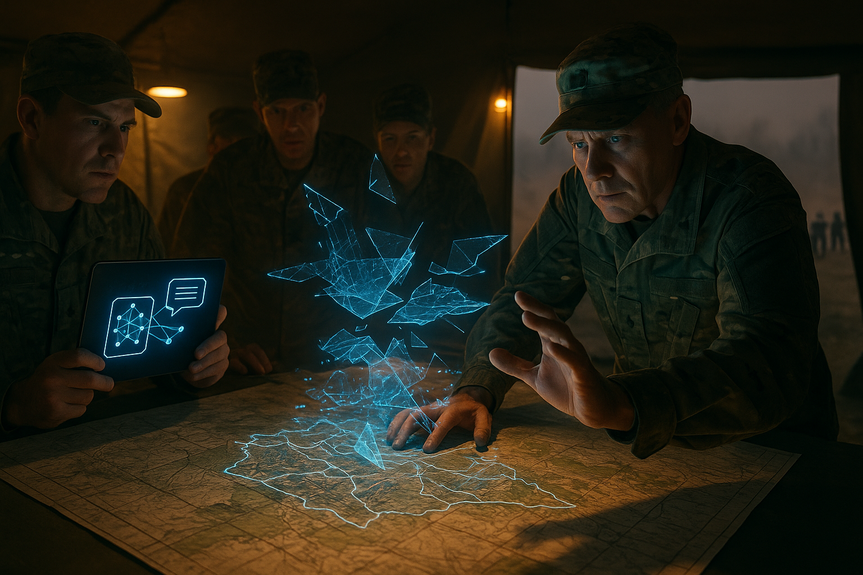
The 3rd Mobile Brigade Combat Team in the 101st Airborne tested AI across every staff section during a major training rotation. They fed models with doctrine and procedures. The unit learned fast. AI helped write warning orders in minutes and turned drone spot reports into useful cues. But the team also hit clear AI limitations in brigade tactical planning, especially when the mission needed true spatial judgment.
Faster orders: Staff turned division guidance into a brigade warning order in under 30 minutes.
More time to think: Speed in mission analysis and drafting orders let leaders focus on wargaming.
Earlier battalion plans: Subordinate units finished plans days sooner, rehearsed more, and improved defenses.
Higher tempo: Drones fed thousands of spot reports. AI sorted them so commanders could act first.
Course of action design: LLMs did not handle three-dimensional terrain, timing, and maneuver well.
Operational art: Staff judgment, experience, and context still drove the best plans.
Trust: Outputs need verification. Hallucinations and missed constraints can mislead under stress.
These gaps underline the core AI limitations in brigade tactical planning: text models alone cannot reason reliably about space, movement, and combat effects.
Use wargaming and physics-based simulation to test COAs that humans design.
Connect AI to digital maps, terrain, and line-of-sight tools so outputs respect ground truth.
Add constraints (time, fuel, obstacles, fires) that the model must satisfy, not ignore.
Assign COA development to staff. Use AI to draft products, gather facts, and propose checks.
Red-team with humans. Challenge AI assumptions before orders go out.
Use checklists for review: terrain, timing, logistics, fires, risk, and civilians.
Template the orders workflow so AI fills standard fields and flags missing items.
Standardize prompts and formats to cut errors and make outputs easy to scan.
Automate traceability: link each claim to a source report or map layer.
Use retrieval-augmented generation with approved doctrine, TTPs, and theater directives.
Curate a “truth library” for the brigade: maps, obstacles, bridges, routes, and named areas of interest.
Log decisions and model outputs for after-action review and learning.
Run compact models on rugged edge devices. Operate offline when needed.
Protect data with strict access, encryption, and audit trails.
Test resilience against jamming, deception, and adversary information ops.
Planning cycle time from order receipt to warning order and to op order.
Decision tempo: time from ISR cue to action.
Order accuracy: error rate and number of clarifications needed.
ISR-to-insight: percent of spot reports turned into validated targets or alerts.
Rehearsal depth: time spent rehearsing vs. drafting.
Survivability: obstacle completion, fratricide avoidance, and blue force preservation.
Define roles: AI drafts; humans decide. Keep COA design a human task.
Stand up an “orders copilot” that fills templates, cites sources, and flags gaps.
Adopt standard prompts for mission analysis, logistics checks, and intel summaries.
Fuse AI with maps and simulations to test, not author, courses of action.
Prioritize ISR triage: let AI group spot reports and surface anomalies.
Train the staff to question AI, verify facts, and use checklists under time pressure.
Run A/B drills and measure gains in speed, accuracy, and tempo.
The field test shows a clear path forward. AI can cut staff workload and raise tempo, but it cannot replace human judgment on terrain, timing, and risk. By recognizing AI limitations in brigade tactical planning, pairing text models with spatial tools, and measuring results, commanders can get faster without getting reckless.
(p(Source: https://breakingdefense.com/2026/06/army-air-assault-brigade-found-ai-tools-ill-suited-to-tactical-planning/)
What the Brigade Tried and Learned
Where AI Helped
Where AI Fell Short
AI limitations in brigade tactical planning: Why They Happen
Text models lack grounded geometry
LLMs predict words. They do not “see” terrain, distances, or elevation. Maneuver depends on geometry, timing, and physics that a pure text model cannot natively compute.Dynamic foes and constraints
The enemy adapts. Routes close. Jammers cut links. Fuel, ammo, weather, and civilian patterns change. Planning must account for live constraints that shift by the hour.Data quality and noise
ISR can flood analysts. If the data is late, mislabeled, or biased, AI scales the noise, not the insight.Disconnected and contested networks
Units fight at the edge with low bandwidth. Cloud-only tools fail. Models must work offline and degrade gracefully.How to Fix the Gaps
Pair LLMs with spatial engines
Keep humans in charge of decisions
Speed with guardrails
Better data, better outputs
Edge-ready and secure
Measure What Matters
Operational metrics to track
What Commanders Can Do Now
For more news: Click Here
FAQ
Q: What did the 101st Airborne brigade test regarding AI during the Fort Polk rotation?
A: The 3rd Mobile Brigade Combat Team trained large language models on joint, Army and division doctrine and gave each staff section bots to speed understanding and response. They found the tools useful for drafting orders and processing ISR but unsuitable for course of action development.
Q: Why did large language models struggle with developing courses of action?
A: LLMs predict text and do not natively reason about three-dimensional terrain, timing, or maneuver, so they struggle with the geometry and physics required for sound courses of action. These real-world constraints are central AI limitations in brigade tactical planning.
Q: How did AI speed the brigade’s orders process and planning tempo?
A: Using AI, the staff could turn division guidance into a brigade warning order in under 30 minutes, and battalions often completed plans about 72 hours earlier, which allowed more rehearsal and refinement. Drone sensors generated over 25,000 spot reports in ten days that AI helped process into actionable cues to increase decision tempo.
Q: What trust and data issues did the brigade encounter when using AI?
A: The brigade noted risks such as hallucinations, missed constraints, and scaling of noisy or biased ISR, which can mislead under operational stress. They emphasized the need to verify AI outputs and to use human red-teaming before publishing orders.
Q: What fixes did the article recommend to address these AI weaknesses?
A: The article recommended pairing LLMs with spatial engines, digital maps, and physics-based simulation so courses of action are tested against ground truth and constraints. It also advised keeping humans in charge of COA design, using templates and standardized prompts, and automating traceability to source reports and map layers.
Q: How should units prepare AI tools for contested, low-bandwidth environments at the tactical edge?
A: Units should run compact models on rugged edge devices that can operate offline and degrade gracefully, and protect data with strict access controls, encryption, and audit trails. They should also test resilience against jamming, deception, and adversary information operations.
Q: Which operational metrics did the article suggest tracking to measure AI’s impact?
A: Suggested metrics include planning cycle time from order receipt to warning and operation orders, decision tempo from ISR cue to action, order accuracy and number of clarifications, and ISR-to-insight rates. It also recommended tracking rehearsal depth and survivability measures like obstacle completion and fratricide avoidance.
Q: What immediate actions can commanders take now to gain speed without increasing risk?
A: Commanders should define roles so AI drafts and humans decide, stand up an orders copilot that fills templates and cites sources, and adopt standardized prompts and checklists for review. They should also fuse AI outputs with maps and simulations for testing, prioritize ISR triage, train staff to question AI, and run A/B drills to measure improvements.
Contents