Crypto
03 Oct 2026
Read 13 min
Best cryptocurrencies to hold 10 years How to allocate wisely *
best cryptocurrencies to hold 10 years: allocate 60% Bitcoin, 20% Ethereum, 20% Solana to grow wealth.
The best cryptocurrencies to hold 10 years share three traits: staying power, clear use cases, and improving supply or throughput. Bitcoin, Ethereum, and Solana check those boxes. Scarcity, tokenization, and speed form a strong base for a decade-long plan, with clear milestones and a simple allocation you can stick with through cycles.
Most crypto bets burn bright, then fade. A 10-year plan should do the opposite. It should lean on networks with the widest adoption and the clearest roadmaps. That is why many long-term investors focus on Bitcoin, Ethereum, and Solana. Each solves a different job. Each has near-term upgrades that reinforce its edge. And together, they can make a portfolio that rides waves but still points forward.
The best cryptocurrencies to hold 10 years: a simple, durable trio
Bitcoin: Scarcity that compounds through three halvings
Bitcoin is the anchor. Miners now add about 450 new coins per day, and roughly 95.7% of the 21 million cap already exists. Over the next decade, three halving events are expected: April 2028, then 2032, then early 2036. After that third cut, only about 56 coins will come out each day. That reduces new supply to a bit more than 12% of today’s level. Scarcity alone does not raise price. Demand must meet it. But the halving cycle keeps pushing buyers to compete for fewer new coins. If Bitcoin continues to act as a hedge when inflation runs hot, demand can grow as supply growth falls. That is a simple and strong long-term setup, and a key reason it often tops lists of the best cryptocurrencies to hold 10 years. What to watch: – The 2028, 2032, and 2036 halvings and how miners adjust – Institutional flows into spot products and custody services – Macro stress tests where Bitcoin’s “digital gold” story gets testedEthereum: A tokenization lead and a path to scale
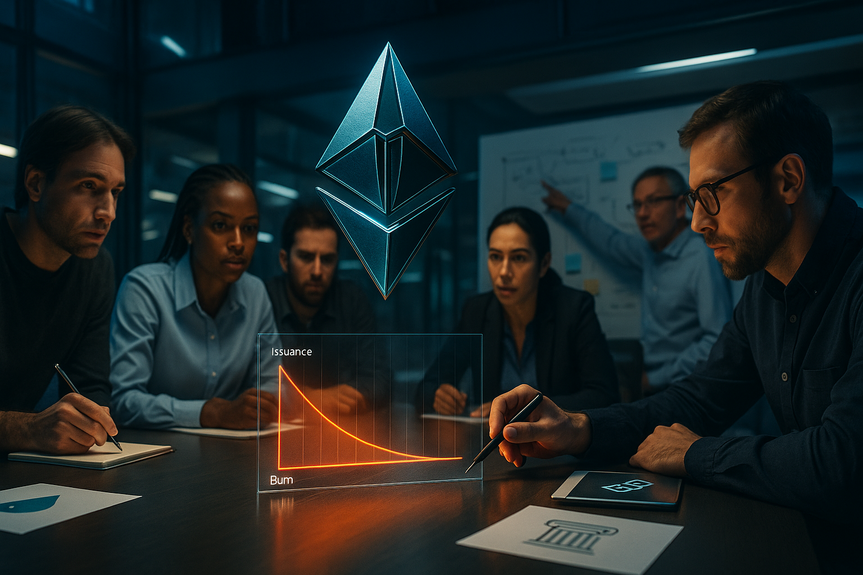
Tokenization is bringing real-world assets, like Treasury bonds and stocks, onto blockchains. On Sept. 30, Ethereum hosted about $16.6 billion of tokenized assets. That equals nearly 43% of a $38.7 billion total across chains. If tokenization grows toward the multi-trillion estimates by 2030, Ethereum’s share could be a major driver of network activity and relevance. The weak point is fees and value capture. After earlier scaling work made transactions cheaper, the value of burned fees (which can reduce ETH supply) fell from around $2 billion in 2024 to about $285 million in 2025. Users won, holders got less benefit. The planned “Glamsterdam” upgrade, expected in Q4 2026, aims to improve throughput and network economics so the base chain can handle more demand from tokenized assets while giving ETH holders better alignment. What to watch: – Uptake of tokenized Treasurys and securities on Ethereum – The Glamsterdam rollout and fee dynamics after the upgrade – Growth and consolidation of Layer 2 networks that settle to EthereumSolana: Near-instant finality with a tighter supply path
Solana focuses on speed and scale. “Alpenglow,” a new consensus system, targets a drop in transaction finality from about 13 seconds to roughly 0.15 seconds. That shift can strengthen Solana’s edge in real-time payments and high-throughput apps. Supply is also getting stricter. In August 2026, validators approved SIMD-0550 to speed up the path to Solana’s terminal issuance floor. New issuance now reaches 1.5% per year in 2029 instead of 2032. Faster supply discipline can reduce dilution for long-term holders and supports value if network usage keeps rising. What to watch: – Alpenglow performance in the wild and builder adoption – Fee markets and reliability during peak loads – Governance choices that align supply and network healthHow to allocate for a decade
A simple, set-it-and-review plan can help you stay the course when prices swing. Suggested split: – 60% Bitcoin: It is the clearest store-of-value play with known issuance and a strong holder base. – 20% Ethereum: It leads in tokenization and smart contracts, with upgrades aimed at scale and economics. – 20% Solana: It offers best-in-class speed and improving supply policy, with upside in payments and consumer apps. Why this works: – Differing roles: store of value (BTC), settlement and programmability (ETH), high-speed user-facing apps (SOL). – Different risk lines: BTC carries the least protocol risk; ETH and SOL add growth potential with more execution risk. – Clear review points tied to roadmaps and halving cycles. How to execute: – Use dollar-cost averaging to smooth entry price. – Hold a core position off exchanges using hardware or reputable custodial solutions. – Rebalance once or twice a year back to 60/20/20. – Keep taxes, fees, and security in view at all times.Key milestones to watch this decade
Network and market events can confirm or challenge your thesis about the best cryptocurrencies to hold 10 years.- Bitcoin halvings in 2028, 2032, and early 2036; miner health and network security after each cut
- Ethereum’s Glamsterdam upgrade (Q4 2026) and post-upgrade fee burn and throughput
- Growth of tokenized assets on Ethereum from ~$16.6B toward multi-trillion targets
- Solana’s Alpenglow rollout and realized finality near 0.15 seconds
- Solana issuance glide path to a 1.5% floor by 2029 under SIMD-0550
- Regulatory clarity on stablecoins, tokenized securities, and crypto market structure
- Institutional adoption: banks, asset managers, and payment firms integrating crypto rails
Risks and how to lower them
Volatility – Prices can swing 50% or more in a year. – Response: Use long time frames, DCA, and rebalance on a schedule, not on emotion. Protocol and technical risk – Upgrades can have bugs; congestion can cause delays or high fees. – Response: Diversify across chains. Wait for upgrades to stabilize before making large moves. Regulation – New rules can change market access or token status. – Response: Use compliant venues. Track policy changes in your region. Keep records for taxes. Liquidity and custody – Exchange failures or hacks can lead to losses. – Response: Prefer self-custody for core holdings. Use 2FA, hardware wallets, and backups. Economic alignment – Ethereum’s lower burn in 2025 showed how user gains can cut holder benefits. – Response: Watch fee markets, burn rates, and governance votes that impact token value.What a successful 10-year outcome could look like
By the mid-2030s, a strong case scenario might include: – Bitcoin retains “digital gold” status, with issuance near 56 coins per day and broader use in treasury and wealth products. – Ethereum anchors a large share of tokenized bonds, funds, and equities, supported by higher throughput and healthier burn dynamics. – Solana powers fast consumer payments, games, and social apps at scale, with sub-second finality and modest, predictable issuance. In that picture, these three chains each win in different lanes. They do not need to beat every rival in every category. They just need to keep their lead where it matters most to them.How to stay disciplined when markets get loud
– Write down your thesis for each asset in one sentence and post it where you see it. – Tie reviews to events, not prices: upgrades, halvings, or regulation, then reassess. – Keep cash or short-term Treasurys for life needs so you do not sell during drops. – Avoid leverage. A 10-year plan does not need it to work.Why this trio fits a 10-year plan
Bitcoin offers hard supply rules and a simple purpose. Ethereum leads in programmable finance and real-world assets. Solana pushes the frontier on speed for everyday use. Together, they cover value, settlement, and scale. That range, plus clear upgrades and supply paths, is why many investors see them as the best cryptocurrencies to hold 10 years. Markets will shift. Narratives will come and go. But a portfolio that blends scarcity, utility, and speed stands a better chance to compound across cycles. Set your split, secure your keys, track the key milestones, and let time do the heavy lifting. That is a practical path to ride crypto innovation for a decade and stay sane while you do it.(Source: https://www.fool.com/investing/2026/10/02/3-superior-cryptocurrencies-to-buy-and-hold-for-10/)
For more news: Click Here
FAQ
Q: Which cryptocurrencies does the article identify as the best cryptocurrencies to hold 10 years?
A: The article names Bitcoin, Ethereum, and Solana as the three cryptocurrencies to include in a decade-long portfolio because they show staying power, clear use cases, and improving supply or throughput. These three form a simple, durable trio for a long-term plan.
Q: How does the article recommend allocating investments among Bitcoin, Ethereum, and Solana for a 10-year hold?
A: The article suggests allocating about 60% to Bitcoin and splitting the remaining 40% equally with 20% to Ethereum and 20% to Solana, and it recommends rebalancing once or twice a year back to that split. It also advises dollar-cost averaging and keeping a core position off exchanges using hardware or reputable custodial solutions.
Q: What key milestones should investors track over the next decade for these coins?
A: Investors should watch Bitcoin halvings in 2028, 2032, and early 2036, Ethereum’s Glamsterdam upgrade expected in Q4 2026 and the growth of tokenized assets, and Solana’s Alpenglow rollout plus SIMD-0550’s issuance glide path. Regulatory clarity and institutional adoption are also listed as market-moving milestones to monitor.
Q: Why does the article call Bitcoin the “anchor” of a 10-year crypto allocation?
A: Bitcoin is described as the anchor because of its capped 21 million supply, with roughly 95.7% already in circulation and upcoming halvings that will sharply reduce new issuance over the decade. Those supply dynamics and its simple store-of-value role are cited as reasons to make it the largest holding in a long-term plan.
Q: What strengths and weaknesses of Ethereum are highlighted for a long-term hold?
A: Ethereum’s strength is its lead in tokenization, hosting about $16.6 billion of tokenized assets — nearly 43% of a $38.7 billion total — which could drive long-term relevance if tokenization scales. Its weakness is scaling and fee-economics, illustrated by burn fees falling from roughly $2 billion in 2024 to about $285 million in 2025, with the Glamsterdam upgrade intended to address throughput and network economics.
Q: How are Solana’s Alpenglow and SIMD-0550 changes expected to affect its long-term prospects?
A: Alpenglow aims to cut transaction finality from about 13 seconds to roughly 0.15 seconds, strengthening Solana’s position for real-time payments and high-throughput applications. SIMD-0550 accelerates the supply glide path so new issuance reaches a 1.5% annual floor in 2029 instead of 2032, which can reduce long-term dilution for holders.
Q: What practical steps does the article recommend to reduce risks when holding these assets for a decade?
A: The article recommends dollar-cost averaging to smooth entry, keeping a core position in self-custody or with reputable custodial solutions, rebalancing once or twice a year, and avoiding leverage to prevent forced selling during volatility. It also advises tying reviews to roadmap events like upgrades and halvings rather than reacting to short-term price noise.
Q: What would a successful 10-year outcome for this trio look like according to the article?
A: A successful outcome might see Bitcoin retain a “digital gold” role with issuance near 56 coins per day, Ethereum anchor a large share of tokenized bonds and securities supported by higher throughput and healthier burn dynamics, and Solana power fast consumer payments and apps with sub-second finality and modest, predictable issuance. In that scenario each chain wins in its primary lane without needing to dominate every category.
* The information provided on this website is based solely on my personal experience, research and technical knowledge. This content should not be construed as investment advice or a recommendation. Any investment decision must be made on the basis of your own independent judgement.
Contents