AI News
14 Oct 2026
Read 11 min
AI fraud detection for finance teams How to cut fraud by 90%
AI fraud detection for finance teams cuts losses by stopping 90% of attempts before payments clear.
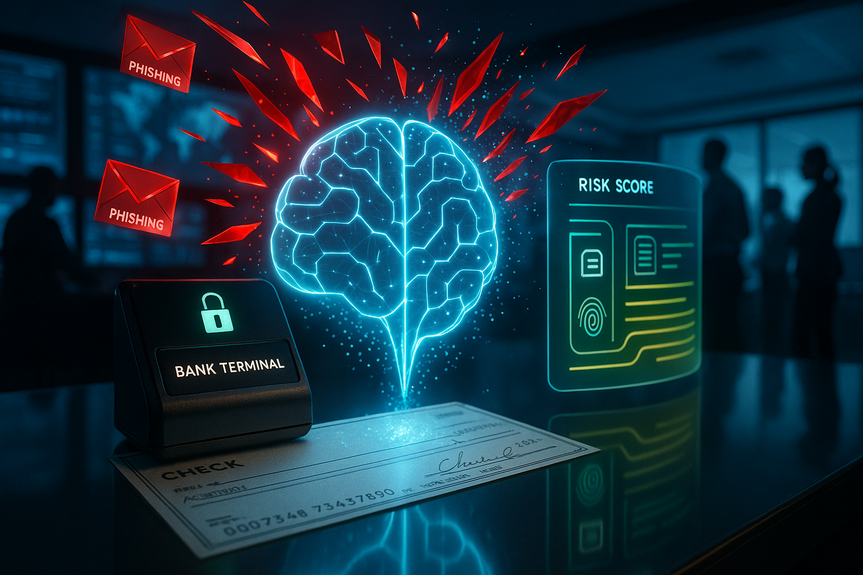
AI fraud detection for finance teams is now a proven win. Recent data shows 77% of adopters see better results than manual checks, and 59% stop at least 90% of attacks before money moves. Here’s how to use layered AI tools — from risk scoring to email scanning — to block fraud before payments go out.
Payments fraud has shifted from brute-force attacks to social and process tricks. Criminals now use AI to write fake vendor emails, alter invoices, and reroute funds. This change makes speed and timing key. If you can spot the risk between the request and the release of funds, you can stop losses without slowing the business.
Why Prevention Must Happen Before the Payment
Many schemes target a normal payment flow. Attackers send emails that look like real vendor notes. They ask your team to switch bank details or rush a wire. In surveys, half of firms say AI-written vendor emails are now the most common tactic they face. Eighty-eight percent see them at least a few times a year, and nearly one-third see business email compromise every month. If you wait to review after payment, you lose. The goal is to inspect the message, the documents, the account, and the transaction as it happens. The faster you score risk and verify details, the more attempts you stop before money leaves.AI fraud detection for finance teams: What Works Now
Among adopters, the most effective controls sit inside the payment path. When you deploy AI fraud detection for finance teams, focus on tools that run in real time and act on signals before funds move.- Scan emails and texts for AI patterns and sender spoofing. Flag urgent change requests and out-of-band messages.
- Verify documents automatically. Check invoices, W-9s, and change forms for edits, reuse, or mismatched data.
- Validate payee accounts. Match account and beneficiary to trusted supplier records and known bank data.
- Use predictive risk scoring at the transaction level. Score amount, timing, device, IP, and user behavior within seconds.
- Detect synthetic and mismatched identities. Cross-check tax IDs, addresses, and ownership ties in the background.
- Apply behavioral biometrics. Spot unusual typing, navigation, or session traits for step-up verification.
Layering Tools Beats One-Off Checks
Fraud rarely shows in one spot. An email can look fine, but the destination account can be wrong. A vendor may be trusted, but the timing and amount may be off. That is why 42% of firms run three or more AI tools together. Only 1% rely on one or two, and 57% still use none.What Real-World Catches Look Like
– A machine learning model flags a payee account in a “rush” wire request because it does not match the vendor’s history. The payment is paused, and loss is avoided. – Anomaly monitoring spots a change in ACH instructions that does not fit the vendor’s normal pattern. The system routes the case for review and stops the reroute. These are small moments with large payoffs. The AI does not just “detect.” It pauses, routes, or blocks the transaction before release.How to Measure ROI Without Waiting a Year
You can show value fast by tracking a few clear metrics. Share them weekly with finance and audit teams.- Pre-payment stop rate: Percent of attempts blocked before money leaves. Top performers report 59% stopping 90%+ of attempts.
- False positive rate: Share of clean payments that get flagged. Optimize to reduce noise without opening gaps.
- Time-to-release: Minutes from submission to approval. Risk-based flows keep most payments fast and safe.
- Loss per attempted fraud: Dollars lost divided by attempts. This falls as more attacks get blocked.
- Analyst hours saved: Hours shifted from manual checks to reviewing only high-risk cases.
Build a Practical Rollout Plan
Start where the risk and volume meet. For many firms, that means vendor payments in accounts payable. Checks still matter: 35% of firms report check fraud, and checks make up at least 10% of outbound losses for nearly half of them.- Map high-risk flows: vendor onboarding, change requests, wires, checks, and cross-border.
- Integrate with core systems: ERP, AP automation, treasury, and bank portals.
- Pilot with shadow scoring: Flag, but do not block. Tune models and thresholds.
- Turn on step-up controls: Pause or require a callback on high-risk scores.
- Train the front line: Teach staff to spot red flags and use the workflow.
- Review weekly: Track stop rate, false positives, and release times. Adjust.
- Expand by risk tier: Add to wires, then checks, then cross-border payments.
Common Objections and How to Address Them
“Our manual reviews work.”
More than half of non-users feel this way. Yet 77% of AI adopters report better results, and they stop more attempts before cash moves. AI reduces the time window criminals exploit.“AI will add friction.”
Use risk-based flows. Most payments pass with no delay. Only high-risk cases get a pause or callback. Measure the median release time to prove it.“Email filters are enough.”
Email is only one layer. Real wins come when you verify documents, validate accounts, and score the payment itself.“Checks are going away.”
Not yet. Nearly half of firms say checks cause at least 10% of outbound losses, and 15% say it is more than a quarter. Add positive pay, payee validation, and check anomaly checks now.Governance, Risk, and Controls That Hold Up
AI can be safe and auditable if you set the guardrails.- Data privacy: Minimize sensitive fields and use encryption in transit and at rest.
- Access control: Limit who can override, approve, or whitelist.
- Explainability: Keep reasons for each flag. Store risk scores and signals for audit.
- Model monitoring: Watch drift. Recalibrate with recent cases each quarter.
- Alert hygiene: Set clear thresholds. Route by risk and role to prevent fatigue.
- Vendor oversight: Review performance and SLAs quarterly. Test failover paths.
The Bottom Line
The case is clear: AI can stop more fraud, sooner, with less effort. Teams that use layered controls report sharper results than manual checks, with many blocking nine out of ten attempts before funds move. If you focus on fast, in-flow controls, AI fraud detection for finance teams will protect cash without slowing the business.For more news: Click Here
FAQ
Q: What proof shows AI fraud detection for finance teams improves outcomes?
A: AI fraud detection for finance teams has clear proof: 77% of firms using AI-powered fraud defenses report better results than manual methods, and 59% of adopters say they stop at least 90% of fraud attempts before money leaves the business. By comparison, 32% of firms without AI tools report the same prevention level.
Q: What are the most common AI-enabled fraud tactics finance teams face?
A: Criminals commonly use AI to write fake vendor emails, alter invoices and reroute funds; half of firms say AI-written vendor emails are the tactic they encounter most often and 88% see such messages at least a few times a year. Nearly one-third of firms (32%) report business email compromise at least monthly.
Q: Which AI tools should be deployed inside the payment flow?
A: When deploying AI fraud detection for finance teams, focus on real-time tools such as predictive risk scoring (used by 83% of adopters), automated document verification (82%) and inbound message scanning for signs of AI generation (78%). Complement those with account validation, synthetic identity detection, anomaly monitoring and behavioral biometrics so signals can act on transactions before funds are released.
Q: Why must prevention happen before a payment is released?
A: Many fraud schemes manipulate a legitimate payment flow, so waiting until after release means you can’t recover the loss. Scoring risk and verifying messages, documents and accounts in real time lets teams stop attempts before money leaves.
Q: How can finance teams measure ROI from AI fraud tools without waiting a year?
A: Track pre-payment stop rate, false positive rate, time-to-release, loss per attempted fraud and analyst hours saved, and set a one-month baseline to compare performance. Run controls in shadow mode to compare old versus new, report results weekly to finance and audit teams, then enable pause or block on high-risk scores to demonstrate immediate lift.
Q: What is a practical rollout plan for AI fraud detection for finance teams?
A: Start where risk and volume meet, typically vendor payments in accounts payable, and map high-risk flows such as onboarding, change requests, wires, checks and cross-border transactions. Integrate with ERP, AP automation and treasury systems, pilot with shadow scoring to tune models and thresholds, then enable step-up controls, train staff and review stop rates and false positives weekly as you expand by risk tier.
Q: What governance controls keep AI fraud systems safe and auditable?
A: Implement data privacy and encryption, strict access controls and explainability by storing risk scores and the reasons for flags for audit purposes. Monitor models for drift and recalibrate regularly, maintain alert hygiene with clear thresholds and role-based routing, and conduct periodic vendor oversight and failover testing.
Q: What common objections do finance teams raise about AI fraud tools and how should they be addressed?
A: Common objections include “our manual reviews work” and “AI will add friction,” but 55% of non-users say manual reviews suffice while 77% of adopters report better results and higher pre-payment prevention rates. Use risk-based flows so most payments pass without delay, treat email filters as only one layer, and remember checks still matter—35% of firms report check fraud and 48% say checks account for at least 10% of outbound losses.
Contents