AI News
16 Oct 2026
Read 8 min
Phoenix police AI incident report pilot cuts report time
Phoenix police AI incident report pilot halves officers' paperwork so they spend more time patrolling
Phoenix is testing a new way to speed up police paperwork. The Phoenix police AI incident report pilot uses Axon’s Draft One to turn body camera audio into draft reports. The city will study if this cuts report time, reduces overtime, and gets officers back on calls faster during a free 90-day trial.
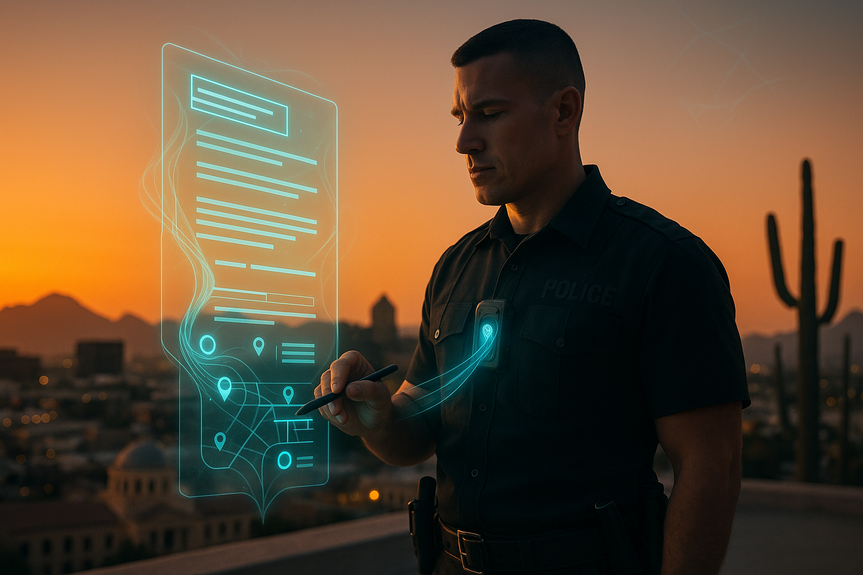
Phoenix leaders want officers spending more time with the public and less time behind a desk. A 90-day test now underway aims to do that. Axon Draft One listens to clear narration captured on body cameras and builds a first draft of the incident report. Officers then edit and approve it before filing. City officials will review data at year’s end to decide what comes next.
Officers narrate what they see and hear during a call, while wearing their body cameras.
Axon Draft One uses that audio to build a draft incident report.
The officer reviews the draft, corrects details, and finalizes the report.
This workflow helps move key facts from the scene into a usable format faster. It also builds a habit of clear narration, which can help with later recall.
Answer more calls without adding shifts
Cut overtime from long report-writing sessions
Shorten the time between an incident and the final report
According to Axon, agencies using Draft One can cut report-writing time by about half. Phoenix will use the pilot to see if that claim holds true locally.
Average time to complete a report, by call type
Change in calls handled per shift
Change in overtime linked to reports
Officer feedback on workload and stress
Error rates found during supervisor review
If results are positive, the city could expand the Phoenix police AI incident report pilot beyond the Mountain View Precinct and consider a longer-term contract.
Inside the Phoenix police AI incident report pilot
The Phoenix Police Department started the pilot in early October at select bureaus within the Mountain View Precinct. The Phoenix police AI incident report pilot runs through Dec. 31 and is free during this period. City staff will track call volume, report-writing time, and overtime to see if the tool makes a real difference.How the tool works: From body camera audio to draft reports
Step-by-step process
Why Phoenix is testing Axon’s tool
City leaders say officers spend many hours on reports. That time adds up and can keep units off the street. If the tool works, the department could:Training, oversight, and accuracy checks
Clear narration is key
Officers in the pilot received training to speak their observations out loud during calls. The AI depends on that narration. Strong, simple statements help the system draft reports that are easier to review.Human review remains required
Officers must verify and correct every draft before submission. The county attorney relies on reports to file charges and build cases, so accuracy matters. The process helps ensure the AI is a starting point, not the final word.What success looks like after 90 days
Phoenix will evaluate the pilot with data. Leaders plan to look at:Benefits the city hopes to see
Faster paperwork and more time for service
Faster drafts mean officers can return to patrol sooner. That could raise response capacity without adding staff.Cleaner reports and better case prep
Structured drafts may help officers capture key facts in the right order. Combined with human review, this can improve clarity for prosecutors.Officer wellness
Less time typing after a long shift can ease fatigue. Clear tools and training also build confidence during high-stress calls.Early questions to watch
Consistency across call types
Simple calls may benefit most. The city will want to see how the tool handles complex scenes that involve multiple people, locations, or timelines.Narration quality
Results depend on what officers say on scene. Training and practice will shape the quality of drafts.Measuring real-world impact
Leaders will compare saved minutes on reports against gains in calls answered. They will also check if overtime actually drops.What this means for community members
If the pilot works, residents could see faster response and more officer visibility. Reports might be finished sooner, which can help victims and witnesses who need updates. Most of the change happens behind the scenes, but the goal is simple: more time serving the public, less time typing.The road ahead
The Phoenix police AI incident report pilot is still in its early days. The department will collect and study data through the end of the year, then decide on next steps. Supporters hope this proves that smart tools can save time without lowering standards, and that careful training and review can keep reports accurate and useful. In short, the Phoenix police AI incident report pilot will rise or fall on results: faster, accurate reports that put officers back on the street to help more people.(Source: https://ktar.com/arizona-technology-news/phoenix-police-reports-ai-tool)
For more news: Click Here
FAQ
Q: What is the Phoenix police AI incident report pilot?
A: The Phoenix police AI incident report pilot is a 90-day test using Axon Draft One to generate draft incident reports from body-worn camera audio. The city is studying whether the tool speeds up paperwork and lets officers spend more time on the streets.
Q: How does Axon Draft One create draft reports from body camera audio?
A: Axon Draft One listens to clear officer narration captured on body-worn cameras and builds a first draft of the incident report. Officers then review, correct, and finalize the draft before submitting it.
Q: Where and when is the pilot taking place and how long will it run?
A: The pilot started in early October at select bureaus within the Mountain View Precinct and runs through Dec. 31 as a free 90-day trial. City staff will collect data during that period before deciding next steps.
Q: What training do participating officers receive for the pilot?
A: Officers participating in the pilot received training to narrate what they see and hear during calls so the AI can draft accurate reports. They are also required to review and correct every AI-generated draft before filing.
Q: What metrics will Phoenix use to evaluate success of the pilot?
A: City staff will track metrics such as average time to complete reports by call type, change in calls handled per shift, changes in overtime tied to report-writing, officer feedback on workload and stress, and error rates found during supervisor review. Officials plan to review that data at the end of the 90-day period to determine next steps.
Q: How much time could the tool save on report writing?
A: Axon has said agencies using Draft One can cut report-writing time by about half, which is one reason Phoenix launched the pilot. Phoenix will use the trial to see if those time savings hold true locally.
Q: What benefits do city leaders hope the Phoenix police AI incident report pilot will deliver?
A: City leaders hope the pilot will produce faster paperwork so officers can return to patrol sooner, potentially allowing the department to answer more calls without adding staff. They also expect cleaner, more structured drafts to aid case preparation and reduced overtime to help officer wellness.
Q: What concerns are officials monitoring during the trial?
A: Officials are watching how the tool handles complex scenes and different call types, the quality of officer narration, and whether time saved on reports translates into more calls answered or reduced overtime. The department will evaluate these issues when it reviews pilot data at the end of the year.
Contents