 AI-generated
AI News
25 Oct 2025
Read 15 min
How Tesla Optimus robots end poverty and create abundance
Tesla Optimus robots end poverty by scaling affordable care and work automation to create abundance.
Elon Musk says Tesla Optimus robots end poverty by driving “sustainable abundance.” The idea is simple: build millions of useful humanoids, cut labor costs, raise output, and spread services like healthcare. The reality is harder. This guide explains where Optimus is today, what must change to scale, and how to judge progress.
Can Tesla Optimus robots end poverty?
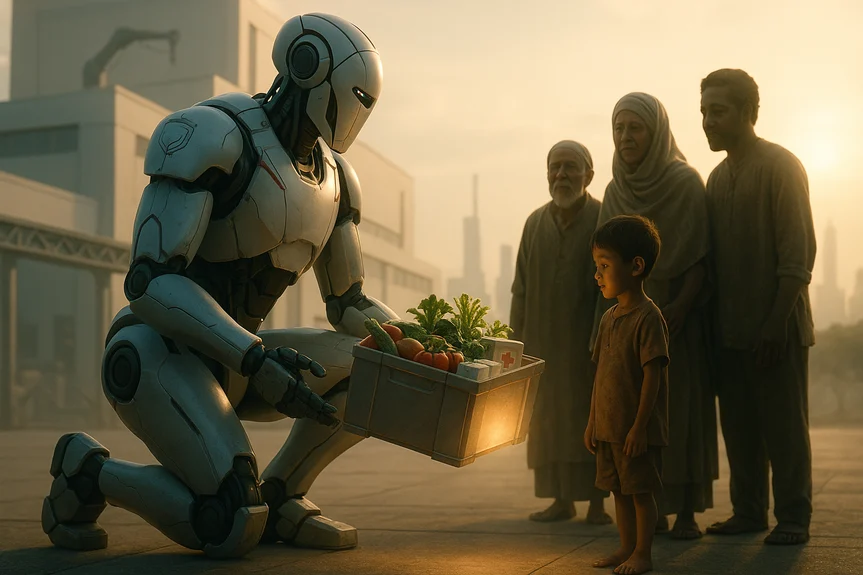
Musk believes robots and self-driving software can push costs down so far that basic goods and services become cheap for all. He calls this “sustainable abundance.” In short, make more with less energy and less human effort. If that happens at global scale, living standards could rise, and poverty rates could fall.
The vision sounds bold. It also raises key questions. Can a general-purpose robot do enough real work to move whole economies? Can Tesla build and deploy a million units per year? Can society share the gains fairly? These answers will decide whether the claim stays a headline or becomes a result.
What “sustainable abundance” means in plain words
Lower costs, higher output
Robots do repeat tasks with steady quality. They do not get tired. If a robot can work 20 hours a day and stay safe, a factory can run longer without adding staff. If many factories do this, goods get cheaper.
Energy matters, too
Tesla ties robots to clean energy and storage. Cheaper solar and batteries can power robots in warehouses, farms, and hospitals. If electricity is low-cost and steady, 24/7 robot work becomes realistic.
From factories to everyday life
The big leap is not one robot in one plant. It is millions of robots across logistics, retail, elder care, agriculture, and construction. That is the scale needed to shift prices in the broader economy.
Where the robot stands today
Public demos vs. real work
Most people have seen Optimus pour popcorn or walk carefully. These demos show progress in balance, dexterity, and control. They do not show full-job performance yet. A robot that can safely stock shelves, pack boxes, or assist a nurse must handle clutter, uneven floors, new tools, and frequent surprises.
Hardware and software gaps
A useful humanoid needs:
- Hands that grip many sizes and shapes without dropping items
- Arms and torso that lift safely without tipping
- Feet and ankles that adjust to slopes and gaps
- Vision that tracks objects and people in poor light and glare
- On-board compute that learns from new tasks and errors
Today, some of these parts look promising. Others still need work. Getting them to run together, 24/7, with low failure rates, is the hard part.
The road from demo to a million units
Version 3 and the scale promise
Musk says Version 3 arrives in early 2026 and aims for mass production at a million units per year. That is huge. Few products, even simple ones, reach that level fast. A humanoid is not simple.
Manufacturing challenges
To hit high volumes, Tesla must:
- Design parts that are strong, light, and cheap to assemble
- Standardize sensors, actuators, and controllers across models
- Automate its own assembly lines for robots (robots building robots)
- Build service networks and spare-part pipelines
- Cut unit costs each quarter while raising reliability
Even if the design is ready, supply chain issues can slow ramp. Actuators, high-torque gearboxes, and edge AI chips are tight markets.
Software at scale
Tesla wants to push over-the-air updates to Optimus, like it does with cars. This helps. But safe updates for machines that move among people need strict testing. One bug can cause a fall or accident. Tesla will need staged rollouts, simulations, and fast rollback tools.
Jobs, wages, and new skills
Who wins first
Early buyers are likely large firms with controlled sites:
- Automotive plants for parts handling and line loading
- Big warehouses for picking and packing
- Large farms for repetitive tasks like weeding or harvesting
These sites have low variety, clear safety rules, and trained staff to supervise.
New work will appear
As robots spread, new jobs grow in:
- Robot setup, calibration, and maintenance
- Task design: building routines for new tasks
- Safety and compliance audits
- Remote oversight and teleoperation for edge cases
Good policy can help workers shift into these roles with paid training and short courses. Clear ladders from “line worker” to “robot tech” keep people in the workforce and raise wages.
Will workers be replaced?
Some tasks will be automated. But history shows total jobs can still grow if new sectors rise. The key is pace. If adoption is too fast without training and safety nets, local pain will rise. If adoption pairs with reskilling and support, gains spread more widely.
Health care claims and limits
Robots as surgeons?
Musk said Optimus could be “an incredible surgeon.” That would be far off. Surgery needs extreme precision, fault tolerance, and strict approvals. Today, most surgical robots are specialized systems run by trained surgeons. A general-purpose humanoid in an operating room is not near-term.
Practical medical roles
More realistic roles in the next few years include:
- Patient lifting and transfer to reduce nurse injuries
- Room disinfection and supply restocking
- Simple vitals checks with human supervision
- Logistics inside hospitals and clinics
These tasks can free nurses and doctors to do more patient care. Even this would be a big win for access.
Economics: who pays and who gains
Unit cost and payback
For broad use, a robot must beat the total cost of a human for certain tasks. That includes purchase price, power, maintenance, downtime, insurance, and software fees. If an Optimus can do the work of 2–3 employees at less cost, adoption will be quick.
From firms to families
To move poverty rates, productivity gains must reach households. That can happen in several ways:
- Lower prices for goods and services
- Higher wages for workers who move to higher-skill roles
- Shared ownership plans or profit-sharing
- Tax policy that funds public goods like health and education
Without sharing, gains concentrate. With sharing, more people benefit, and standards rise.
Safety, control, and governance
Physical safety
Humanoids must meet strict safety standards. Key items include:
- Force limits and soft coverings to reduce injury risk
- Fall detection and safe-stop modes
- Geofencing and no-go zones
- Black-box logs for incident review
Clear labeling, training for on-site staff, and visible emergency stops are essential.
Data and privacy
Robots see and record. Hospitals, homes, and retail sites need privacy rules. Local processing should reduce data sharing. Where cloud services are used, encryption and access controls are a must.
Control and corporate governance
Musk tied the robot push to his level of control at Tesla, even linking it to a proposed pay package. Investors and the public will ask how decisions about deployment, pricing, and safety are made. Independent boards, open safety reports, and third-party audits can build trust.
How to measure progress in the next 24 months
Simple, public metrics
Watch for:
- Tasks per hour: number of useful actions a robot completes in a real site
- Mean time between failures: hours of safe operation without a stop
- Total cost per unit: trend down each quarter
- Number of sites with 10+ robots in daily use
- Safety incidents per 10,000 hours: trend down over time
If these numbers improve steadily, real value is forming beyond demos.
Software learning curves
Tesla’s edge is data. If robots learn from each other through updates, task success rates should rise across locations. Look for release notes that show reduced error rates and faster task completion over time.
Customer stories
Case studies from logistics, manufacturing, and hospitals are gold. Honest reports about what worked, what broke, and what saved time help everyone judge reality.
Paths that could make the vision real
Start narrow, then expand
Focus on a short list of high-value tasks, like box picking, cart loading, or machine tending. Nail those with high reliability. Then add new tasks one by one. This staged approach builds trust.
Partner with frontline workers
Workers know the pain points. Joint design with line staff, nurses, and warehouse leads often finds the best roles for robots and avoids friction.
Open safety and performance dashboards
Public dashboards that track uptime, incidents, and software improvements can set a standard for the industry. Openness wins hearts and reduces fear.
Training at scale
A free or low-cost certification for “Optimus Operator” could help thousands shift into better jobs. Pair it with employer incentives to upskill current staff.
What if progress is slower than promised?
Even partial wins matter
If Optimus cannot do everything soon, it can still help. Lifting, stocking, and cleaning are high-injury and high-turnover tasks. Reducing strain and filling gaps in night shifts help both workers and managers.
Competition will push the field
Other companies build humanoids and mobile manipulators. Healthy competition can spread best practices and lower costs. That is good for users—and for the goal of wider access.
What it would take to make the promise real
Poverty does not fall by speeches. It falls when basic goods get cheaper, when people keep or gain better work, and when services like health and transport reach more homes. Robots can support all three if they are safe, affordable, and widely deployed. Policy will matter. Business models will matter. Execution will matter most.
If Tesla Optimus robots end poverty, it will be because the company ships millions of reliable units, cuts the cost of everyday services, and shares the gains with workers and communities. The next two years will show whether this shift has started, or whether it remains a bold plan waiting on real proof.
The bottom line
Musk’s vision of “sustainable abundance” is clear: make more value with less cost, and spread it. Today, Optimus is still a work in progress. Strong engineering, open safety practices, worker training, and fair sharing of gains are the real tests. If those align, Tesla Optimus robots end poverty could move from slogan to outcome.
For more news: Click Here
FAQ
Keep reading, keep building
Three things from our own workshop that fit this topic:
- Diktly Free is our dictation app for Mac: speech becomes text entirely on your own machine, nothing goes to the cloud. Free version, Basic 14.99 €.
- 1000+ Prompts to Level Up Your Life is our most downloaded pack. Pay what you want, including 0.
- OpenAI Agent Mode for Beginners walks you through letting AI agents handle tasks for you. 19.99 $.
Our own products. Tech Moments is our newsletter on AI and tech in plain language, one email, no noise. Subscribe below.
Contents