 AI-generated
AI News
21 Nov 2026
Read 12 min
AI scent technology for fragrance design: Create new scents
AI scent technology for fragrance design helps brands create precise new scents from chemical data.
AI scent technology for fragrance design turns chemical data and human smell descriptions into new fragrance formulas. Startup Osmo combines trained sniffers, AI models, and a mixing robot to create scents from written prompts. Its tools already serve fragrance customers, but claims of human-level smell intelligence still face questions.
Key takeaways
- Osmo uses human smell descriptions and chemical measurements to train its AI model.
- Osmo says its dataset contains more than 10 million human labels and 800 million scent tokens.
- Osmo’s system can turn a written fragrance brief into scent profiles and ingredient formulas.
- Experts say better sensors and stronger models are needed for uses such as disease detection.
Near Newark Airport in New Jersey, around 30 experienced sniffers describe odors with words such as “nutty,” “peachy,” and “marine.” Their notes help connect the chemicals in a sample with the smell a person experiences. That link sits at the heart of Osmo’s effort to give computers a sense of smell.
How does AI scent technology for fragrance design work?
AI scent technology for fragrance design links chemical measurements with human descriptions, then uses those patterns to propose fragrance formulas.
Osmo founder Alex Wiltschko launched the company in 2023 after working on smell research at Google Brain. His stated goal is “to give computers a sense of smell.” The company calls its system the world’s first foundation model for smell: a model meant to support several scent-related tasks.
The process starts with physical samples. Osmo runs spectrometers and other chemical sensors around the clock to measure the molecular makeup of fruit, flowers, pantry staples, organs, and other materials.
People provide the other half of the training data. Across the US and overseas, around 70 trained data labelers sniff samples and describe them using a standard fragrance vocabulary. Their judgments teach the system how chemical measurements relate to human perception.
Why does the dataset matter?
Wiltschko says earlier databases contained fewer than 200,000 human descriptions of smells. Osmo says it has built a dataset with more than 10 million human labels and 800 million “scent tokens.” These tokens describe the molecules and concentrations that create particular odors.
That scale matters because an ingredient list alone does not explain how a mixture will smell. Changing the proportions can change the result, much as moving words can change a sentence’s meaning.
Wiltschko offers a striking example: the scent tokens for a newborn baby overlap heavily with those for freshly cooked Barilla spaghetti. Shared molecules, however, do not mean two things smell identical.
How can a written prompt become a fragrance?
A written prompt gives Osmo’s model a brief, which it turns into proposed scent profiles and formulas for physical samples.
During a demonstration described in the source report, a request asked for a fragrance inspired by a Portuguese custard tart, aimed at 18- to 23-year-old men. The model took a few minutes to produce three possible profiles, including creamy, coconutty, and fruity notes, along with the molecules needed to make them.
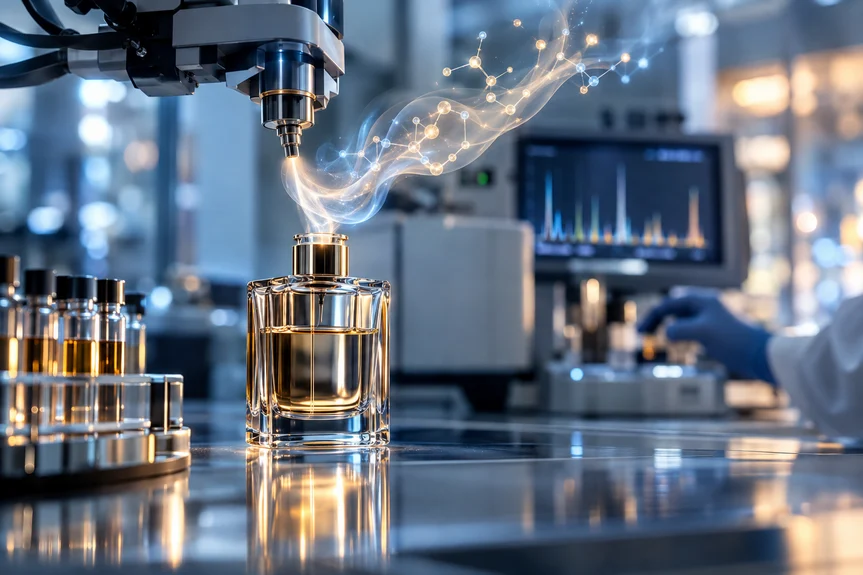
Osmo then has a way to turn those digital instructions into something people can smell. Its scent-mixing robot, roughly the size of a school bus, combines ingredients according to precise formulas.
The company uses the robot for research samples and customer fragrances. In the custard-tart example, a physical order would have been ready about a week later.
For brands, AI scent technology for fragrance design creates a path from an idea to testable samples. A written brief does not prove that customers will like the result, but it gives teams concrete options to evaluate.
What has Osmo achieved so far?
Osmo says its technology has already helped create retail fragrances, including work for Procter & Gamble.
Wiltschko also claims the model has reached “human-level olfactory intelligence.” Osmo defines that as matching an average person at detecting and distinguishing smells, while matching a junior perfume designer at creating them.
The company further says its model outperformed in-house perfumers at one of the world’s largest consumer goods companies. The source report does not provide enough detail about that comparison to judge how broadly the result applies.
Osmo’s work extends beyond perfume:
- The Gates Foundation invested $5 million when Osmo launched and later provided a $3.5 million grant for insect-repellent research.
- Osmo says that research identified eight substances that were more repellent than DEET.
- Osmo worked with StockX on detecting counterfeit sneakers through chemical differences in shoe materials.
These projects show the range of possible uses. They do not establish that the system can handle every odor, product, or setting with equal success.
Why are experts questioning the human-level claim?
Experts question the claim because the reported results leave gaps, and human smell perception depends on more than molecular data.
Avery Gilbert, a smell scientist and author of What the Nose Knows, has criticized Osmo’s marketing on his Substack. He argues that some claims lack documentation and that the company’s patent filings still rely on human sensory panels and perfumers.
Human involvement alone does not settle whether the model works. It does make it important to distinguish what the AI can do independently from what the wider team achieves.
Michael Schmuker, a former professor of neural computation at the University of Hertfordshire who previously consulted for Osmo, sees the technology as an achievement. With colleagues, he created an open-source, reverse-engineered version of Osmo’s 2023 model, though it lacks the company’s newer data.
Schmuker also stresses context. Camembert and used nappies partly share an odor molecule, yet people do not confuse them. The setting helps shape what a smell means.
What stands between fragrance tools and medical detection?
Better sensors and stronger models are needed before scent AI can reliably move into demanding tasks such as medical detection.
A controlled fragrance lab differs from an airport, food production line, or clinical setting. Osmo’s proposed future uses include threat detection, identifying food spoilage, and detecting disease through odor.
Dogs have detected tumors through smell in pilot studies, but that does not establish the same ability in Osmo’s system. Wiltschko acknowledges that medical diagnostics is difficult and expensive, and that earlier companies have failed while pursuing it.
The current fragrance business offers a narrower starting point: create formulas, make samples, and let people judge the results.
Our take
The clearest advance is Osmo’s combination of a larger reported dataset, fragrance software, and physical sample production. Compared with its 2023 model, the company now describes a system that supports paying fragrance customers, not just research.
For fragrance companies, this could change how teams develop and compare early ideas. Developers may gain a route to scent-based tools, although sensors remain a hurdle. For consumers, including readers in Germany and the EU, the practical question is whether these tools produce appealing products—not whether the model earns a human-level label.
One open question is whose preferences the training labels represent. A standardized vocabulary helps organize data, but the source does not establish whether the panel reflects different markets and audiences.
In the coming weeks, watch for published comparison methods and clearer customer results. Those would help separate useful progress from claims that remain hard to assess.
AI scent technology for fragrance design already offers brands a way to turn written ideas into physical samples. For readers and buyers, the strongest evidence remains the resulting products; claims about human-level smell and medical uses need more proof.
(Source: https://www.technologyreview.com/2026/11/18/1148816/smell-startup-osmo-ai-nose-good-as-humans/)
For more news: Click Here
FAQ
Keep reading, keep building
Three things from our own workshop that fit this topic:
- Diktly Free is our dictation app for Mac: speech becomes text entirely on your own machine, nothing goes to the cloud. Free version, Basic 14.99 €.
- 1000+ Prompts to Level Up Your Life is our most downloaded pack. Pay what you want, including 0.
- OpenAI Agent Mode for Beginners walks you through letting AI agents handle tasks for you. 19.99 $.
Our own products. Tech Moments is our newsletter on AI and tech in plain language, one email, no noise. Subscribe below.
Contents