
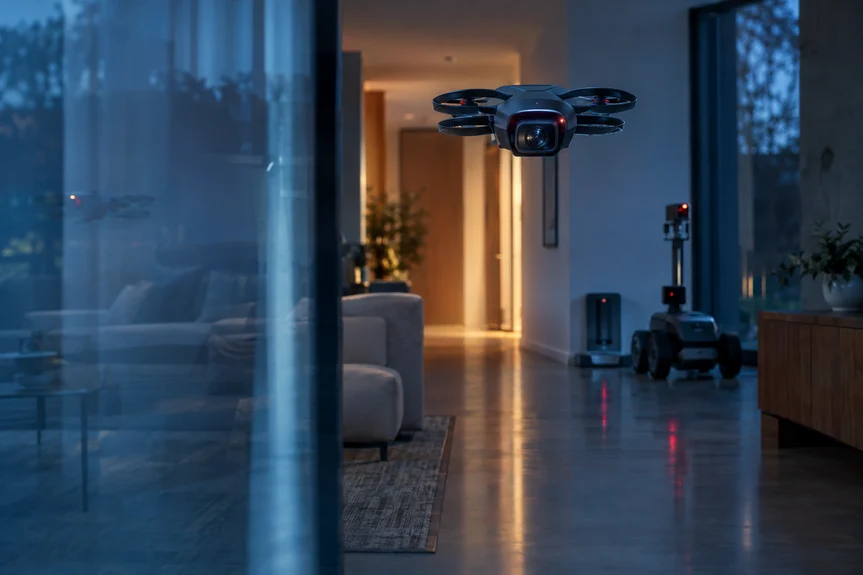
 AI-generated
AI News
20 Nov 2026
Read 12 min
Ring security drone privacy concerns: How to stay safe
Ring security drone privacy concerns call for safeguards before autonomous cameras patrol your home.
Ring security drone privacy concerns center on cameras that can move through rooms, map indoor spaces, and use cloud processing. Amazon’s planned Ring Drone Cam and Ring Rover Cam could expand security coverage, but buyers should check recording controls, account protection, data storage, and patrol boundaries before bringing either device inside.
Key takeaways
- Amazon plans to ship the $1,000 Ring Rover Cam starting December 16, 2026.
- The $250 Ring Drone Cam targets January 27, 2027, pending Federal Communications Commission authorization.
- Both devices use cameras, sensors, and cloud processing to map spaces and plan patrol routes.
- The Electronic Frontier Foundation says Ring’s newer encryption falls short of end-to-end encryption.
What are Amazon’s new mobile Ring cameras?
Amazon’s Ring Drone Cam and Ring Rover Cam are autonomous indoor security devices that move between patrol points rather than watch one fixed area.
According to Amazon’s November 10 announcement, both products use an AI Pilot system. It combines cameras, specialized vision models, on-device sensors, and cloud processing to navigate around furniture and other obstacles.
Setup also creates a digital floor plan. Owners carry the drone through indoor spaces, while the Rover can explore on its own. The system then identifies rooms and suggests patrol points near windows, side doors, or sensitive business locations such as cash registers.
This gives buyers a different kind of security tool: a camera that can check several locations. It also raises a practical question about how much access a moving camera should have.
The Ring Drone Cam has short flights and operating limits
The $250 drone appears to succeed the Ring Always Home Cam, which was temporarily available by invitation in September 2021. Amazon targets January 27, 2027, for the new model, but it still needs Federal Communications Commission authorization.
The drone offers 2K video, a 148-degree field of view, 360-degree rotation, and two lights for dim conditions. Ring Protect subscribers can use scheduled routes, and the drone can follow routes in response to connected Ring alerts.
Battery life is limited to 8 minutes under controlled conditions with a new, fully charged battery. Amazon also warns that reflective floors, featureless walls, glass, and mirrors can reduce navigation performance.
The Ring Rover Cam targets businesses
The $1,000 Rover is available for preorder, with shipping scheduled to begin December 16, 2026. Amazon describes it as a business security robot inspired by feedback about its invite-only Amazon Astro home-monitoring robot.
The Rover records up to 4K video and uses an adjustable mast to see over counters or shelving. Amazon says it can cover up to 5,000 square feet, but only on one indoor floor. It cannot climb stairs and has restrictions involving floor transitions, sunken areas, and black glossy floors.
A siren, light tower, and two-way audio let owners announce its presence or speak to someone nearby.
Why do Ring security drone privacy concerns go beyond fixed cameras?
Moving cameras can capture private spaces and details that a fixed doorbell or corner-mounted camera might never see.
A patrol route could pass desks, family photos, paperwork, or screens. The concern is not simply whether the device records an intruder. It is also what else enters the frame during routine checks.
Law and technology researcher Ryan Calo of the University of Washington previously warned that flying security cameras could create new ways to watch people indoors. He also raised concerns about companies gaining greater access to sensitive or identifying details of homes and businesses.
Ring security drone privacy concerns also reflect the company’s history. In 2023, the Federal Trade Commission charged Ring with allowing employees and contractors to watch recordings of customers’ private spaces. The FTC also said weak safeguards allowed hackers to access 55,000 US customers’ accounts.
These findings do not establish that the new robots have the same weaknesses. They do make clear why buyers should examine access controls rather than rely only on privacy promises.
What protection does Amazon promise for recordings?
Amazon promises recording indicators and its Throw Away the Key Encryption, but those measures do not answer every question about data access.
The company says LED indicators and screen notifications will show when video and audio recording are active. Its announcement also says videos from both devices will use the encryption system introduced in September 2026.
The Electronic Frontier Foundation describes that encryption as an improvement over Ring’s former default settings, but still short of end-to-end encryption. Buyers should not assume the two offer the same protection.
For the Rover, Amazon says recordings triggered by doorbell rings, motion, and Live View events can remain in the cloud for sharing and replay for up to 180 days. The supplied report does not explain how long floor maps remain stored or who can access all mapping data.
The EFF has also criticized Ring’s return of features that let law enforcement request footage or live-stream access from users. Such requests should not be confused with unrestricted police access, but owners should understand what they authorize.
How can buyers reduce privacy risks before the first patrol?
Buyers can reduce exposure by limiting patrol coverage, securing accounts, and checking the available data controls before recording begins.
The safest response to Ring security drone privacy concerns is to make deliberate choices about where the camera goes and what it captures. Do not assume that every privacy setting you want will be available.
- Choose patrol points carefully. Keep routes away from bedrooms, bathrooms, private desks, and areas where people expect privacy.
- Check account security. Use a unique password, enable available multifactor authentication, and review everyone with account access.
- Review storage settings. Check whether you can shorten retention periods and delete recordings or maps you no longer need.
- Ask about cloud processing. Seek clear answers about which images, sensor readings, and floor-plan details leave the device.
- Explain recording to others. Tell household members, workers, and visitors where patrols occur and how recordings may be used.
- Check sharing permissions. Understand footage-sharing and live-stream options before approving requests or granting access.
Also check the physical environment. Navigation warnings matter because a robot that struggles with glass or floor transitions may not reliably follow the coverage plan you expected.
Neither new product is described as using facial recognition. Ring’s optional Familiar Faces feature for fixed doorbell cameras, available since December 2025 and already facing a class action lawsuit, should not be treated as a confirmed robot feature.
Our take
Our assessment is that automated mapping and suggested patrol points make this launch more significant than simply putting an existing Ring camera on wheels.
The earlier Always Home Cam and Astro already explored mobile monitoring. These products bring that idea back with AI Pilot, cloud processing, and planned shipping dates. Consumers face choices about private rooms; businesses must consider workers, customers, and sensitive work areas. Developers working on connected security tools should treat clear permissions and predictable movement as priorities.
For readers in Germany and the EU, the source does not establish local availability or explain how regional privacy requirements will be handled.
One open question is whether a mobile camera could replace several fixed cameras, rather than add surveillance. That might change the privacy balance, depending on routes and recording habits. In the coming weeks, watch for FCC authorization, clearer mapping-data policies, and updates ahead of the Rover’s December 16 shipping target.
Ring security drone privacy concerns should shape your buying decision as much as video quality or price. Before ordering, make sure the device’s coverage, cloud use, and privacy controls fit the people and spaces you need to protect.
For more news: Click Here
FAQ
Keep reading, keep building
Three things from our own workshop that fit this topic:
- Diktly Free is our dictation app for Mac: speech becomes text entirely on your own machine, nothing goes to the cloud. Free version, Basic 14.99 €.
- 1000+ Prompts to Level Up Your Life is our most downloaded pack. Pay what you want, including 0.
- OpenAI Agent Mode for Beginners walks you through letting AI agents handle tasks for you. 19.99 $.
Our own products. Tech Moments is our newsletter on AI and tech in plain language, one email, no noise. Subscribe below.
Contents