AI News
27 Apr 2026
Read 14 min
AI-powered early heart disease detection: How to spot risks
AI-powered early heart disease detection gives clear 3D scans so you can spot plaque and act early.
AI-powered early heart disease detection turns a quick, non-invasive scan into a clear 3D map of your heart. Doctors can spot early plaque, gauge risk, and plan next steps before symptoms start. A Super Bowl champion used this tech to check his family risk—and walked away with peace of mind.
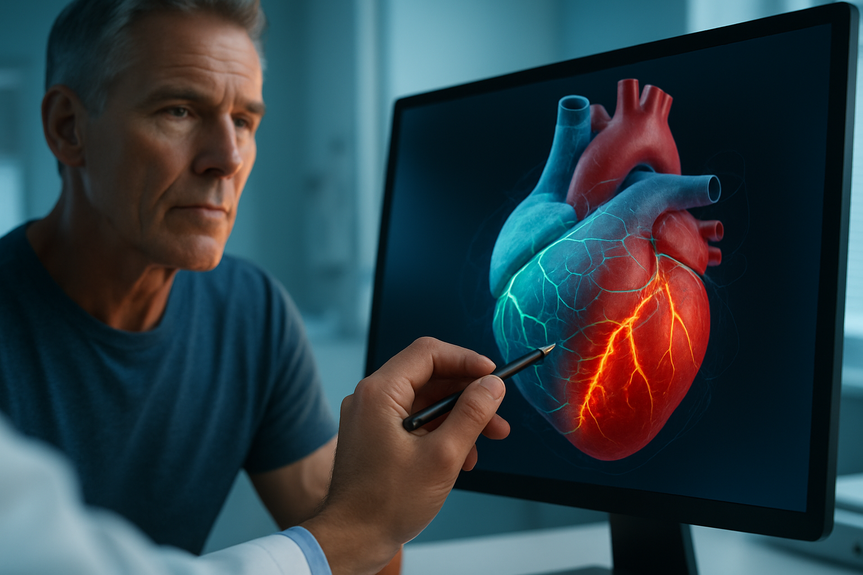
Former NFL quarterback Steve Beuerlein spent years reading defenses. At 61, he decided to read his own heart. With a family history of cardiovascular disease, he enrolled in a program that uses advanced imaging and artificial intelligence to map plaque inside coronary arteries. The scan took little time. The results were easy to understand. He viewed a rotating 3D image of his heart, color-coded to show where soft and hard plaque might be building up. The appointment gave him a baseline, a plan, and reassurance—without invasive procedures.
This story is not only about an athlete. It is about a new way to catch trouble before it becomes a crisis. Many people have no warning signs before a first heart event. Early insight can change that. With a non-invasive scan and a smart analysis, patients and doctors get a clear view, act sooner, and track changes over time.
Family history of heart disease, especially at a younger age
High blood pressure or high LDL (“bad”) cholesterol
Diabetes or prediabetes
Smoking or exposure to secondhand smoke
Obesity and inactivity
Chronic stress and poor sleep
It highlights subtle plaque that a basic report might miss, so doctors can spot risk earlier.
It simplifies complex data into visuals and scores, so patients can understand and act.
This is not a replacement for a doctor. It is a strong assist. The software reads thousands of data points fast, but the clinician weighs your symptoms, history, and lab results to form a plan.
Referral and prep: Your clinician reviews your risk and symptoms to see if a coronary CT scan makes sense. You get basic prep instructions.
Imaging: A CT scanner takes detailed pictures of your heart and arteries in a few minutes.
AI analysis: Software helps reconstruct a 3D model and flags likely plaque and narrowing.
Review visit: You and your doctor view the model, discuss next steps, and set a follow-up plan.
Action: You adjust lifestyle, medications, or testing based on your specific results.
Green or low-risk areas suggest open vessels and minimal plaque.
Yellow or moderate zones may reflect soft plaque that deserves closer watch.
Orange or red zones can point to tighter spots or more calcified plaque that may need prompt action.
Only your clinician can explain what each color means for you. Image quality, motion, and other factors matter. Your overall risk profile matters too.
Strong family history of early heart disease
High blood pressure, high LDL cholesterol, or diabetes
Smoking history
Persistent high stress, poor sleep, or low activity
Obesity or a growing waistline
Men over 45 or women over 55, especially with other risks
Screening is not one-size-fits-all. Your doctor can weigh benefits and timing for you.
Speeds up analysis: AI can process images quickly and consistently.
Improves clarity: 3D visuals help patients and doctors communicate.
Guides triage: Doctors can decide who needs medication, closer follow-up, or invasive testing.
Supports prevention: A clear baseline helps track change year to year.
It does not replace clinical judgment: Doctors interpret images in context.
It is not a final diagnosis: Findings need correlation with symptoms and tests.
Image quality matters: Motion, calcium, and body factors can affect readings.
Access and cost vary: Availability depends on region, partners, and insurance.
AI-powered early heart disease detection is a strong step, but it works best as part of a full care plan that includes labs, blood pressure checks, and lifestyle changes.
Given my history, do you recommend a coronary CT scan with advanced analysis?
How will these results change my care plan if plaque is present—or if it is not?
What are the benefits and risks for me compared to other tests?
How accurate are the results in people like me?
How often should I repeat imaging to track changes?
Will my insurance cover this test and the AI analysis?
Know your numbers: blood pressure, LDL cholesterol, A1C if diabetic, waist size.
Move most days: aim for brisk walking, cycling, or swimming.
Eat heart-smart foods: vegetables, fruits, beans, whole grains, nuts, and fish; cut added sugars and ultra-processed snacks.
Do not smoke: if you smoke, get help to quit.
Sleep 7–9 hours and manage stress with breathing, nature, or short breaks.
Take prescribed medications as directed and keep follow-up visits.
Why catching heart risk early still matters
The silent progress of plaque
Heart disease often grows quietly. Soft plaque can build inside coronary arteries without causing pain or shortness of breath. Blood still flows, so you feel fine—until one day, a piece breaks off or a blockage narrows the vessel too much. Many first-time heart attacks arrive as a shock. People say, “I had no idea.” This is why a visual check, even when you feel well, can be a strong move if you have risk factors.Family history and age still count
If a parent or sibling had heart disease, your risk rises. As we age, arteries stiffen and plaque can form more easily. You cannot change your genes or your age, but you can spot problems early and adjust what you can control. Common risk drivers include:What AI-powered early heart disease detection does today
Modern scanners create detailed images of your heart and coronary arteries in minutes. Software then helps turn those images into a 3D model. Doctors can rotate the model, zoom in on each artery, and view color scales that suggest where plaque is soft (newer, more unstable) or hard (calcified and more advanced). This gives a clear picture of what is happening now and where to watch later. AI-powered early heart disease detection helps in two big ways:From scan to simple visual
Here is how it feels for patients like Beuerlein: the scan is non-invasive and painless. There are no catheters and no long recovery. After the scan, you sit with your doctor. Together, you look at a screen that shows your heart in 3D. You see colors—often green, yellow, orange, or red—marking areas to watch. You can ask direct questions as you look at the same image. The process turns a frightening “what if” into a clear, shared view.Inside a modern non-invasive heart check
Step-by-step at a glance
What the colors can mean
Color scales vary by system, but the idea is consistent: clear visuals focus attention.Who should consider getting screened
Classic risk factors that should prompt a talk with your doctor
Consider asking about non-invasive imaging if you have:Early red flags you should not ignore
Seek urgent medical help if you have chest pressure, shortness of breath, sudden sweating, jaw or arm pain, fainting, or new confusion. These can be signs of a heart event. Do not wait for a scheduled scan if you feel acute symptoms.Benefits and limits of AI in cardiology
What it does well
What it cannot do alone
How athletes and active adults can use this tech
A quarterback’s proactive play
Steve Beuerlein, a Super Bowl champion and former Pro Bowl quarterback, chose to act before symptoms. With a parent who battled cardiovascular disease, he joined a registry program that leverages advanced imaging and AI analysis. His scan was quick and non-invasive. The 3D view made his results easy to grasp. He left with relief and a concrete baseline for the future. Active people often assume their fitness protects them fully. Fitness helps a lot, but it does not erase genetic risk or hidden plaque. A clear picture can reveal where performance and prevention need to meet—especially after age 50 or with strong family history.Preparing for your appointment
Questions to ask your clinician
After screening: simple steps that matter
Imaging shows the map. Your daily habits move the needle.Costs, access, and privacy basics
Finding a center
Advanced heart imaging and analysis are available through hospitals, cardiology groups, and partner clinics. Some companies list partner sites on their websites. Your primary care doctor or cardiologist can guide you to local options and explain insurance coverage in your plan.Your data, your questions
Ask how your images and reports are stored, who can see them, and how they are protected. Many systems use de-identified data to improve their tools. You can ask about consent options and data retention. Clear answers build trust and help you feel confident in your choice.Turning insight into action
The real power of this approach is simple: see early, act early, and track progress. For many people, the biggest barrier is not technology—it is the unknown. When you can see your heart, in color and in 3D, the unknown fades. You and your doctor can choose steady, practical steps that protect your future. AI-powered early heart disease detection is not magic. It is a helpful tool that turns a brief scan into a clear plan. If you have risk factors, a family history, or growing concern as you age, talk with your clinician about whether this option fits your situation. The goal is not just to avoid a crisis. It is to live with confidence, guided by facts, and supported by a plan you can follow.(Source: https://www.foxnews.com/sports/super-bowl-champion-uses-ai-help-detect-cardiovascular-issues-early)
For more news: Click Here
FAQ
Q: What is AI-powered early heart disease detection and how does it work?
A: AI-powered early heart disease detection uses a CT scanner to create detailed images that software reconstructs into a rotating 3D model of the heart, highlighting plaque and narrowing. Doctors review these color-coded visuals to spot areas of soft or hard plaque and to plan next steps.
Q: Who should consider getting screened with AI-powered early heart disease detection?
A: People with a strong family history of heart disease, high blood pressure, high LDL cholesterol, diabetes, a smoking history, obesity, or advancing age should discuss screening with their clinician. Men over 45 and women over 55 with other risk factors are specifically mentioned as groups to consider.
Q: What happens during a typical scan and follow‑up for AI-powered early heart disease detection?
A: For AI-powered early heart disease detection the process usually involves a short, non-invasive CT imaging session that takes a few minutes, followed by AI analysis that builds a 3D model of your coronary arteries. After the analysis you meet with your doctor to review the color-coded images, ask questions, and set a follow-up or treatment plan.
Q: What do the 3D images and color scales show in AI-powered early heart disease detection?
A: The 3D images are rotatable and color-coded to indicate areas from minimal plaque up to zones with more calcified narrowing, often shown on a green-to-red scale. They can help distinguish softer, potentially unstable plaque from harder calcified plaque, but a clinician must explain what the findings mean for your care.
Q: Can AI replace a doctor in diagnosing heart disease found by this method?
A: No; AI-powered analysis assists by processing images quickly and highlighting subtle plaque, but it does not replace clinical judgment. Clinicians interpret the images alongside symptoms, lab results, and medical history to form a diagnosis and care plan.
Q: How can results from AI-powered early heart disease detection change my care?
A: Results from AI-powered early heart disease detection provide a clear baseline that can prompt lifestyle changes, medication adjustments, closer follow-up, or further testing if plaque or narrowing is found. The visual, color-coded report helps patients and doctors understand risk and make earlier, practical decisions rather than waiting for symptoms.
Q: Is the scan invasive or painful, and are there limits to the test?
A: The scan is non-invasive and painless, with no catheters or long recovery, and many patients find the process quick and efficient. Limitations include image quality issues from motion or body factors, and the software is an aid rather than a final diagnosis, so results must be interpreted in context.
Q: Has any notable person used AI-powered early heart disease detection?
A: Steve Beuerlein, a Super Bowl champion and former Pro Bowl quarterback, enrolled in Heartflow’s Gamefilm registry and reported a painless, non-invasive scan that produced a thorough, color-coded 3D report and left him with reassurance. His family history of cardiovascular disease motivated him to get checked and to have a baseline for future monitoring.
Contents