AI News
08 Jan 2026
Read 9 min
Air Force battle management AI experiment speeds planning
Air Force battle management AI experiment cut planning time 90% and improved decision accuracy too.
An Air Force battle management AI experiment showed that AI planning tools beat human teams on speed and accuracy. In tests run with U.S., Canadian, and UK personnel, one system produced more valid courses of action up to 90 percent faster, with no observed hallucinations, according to officials.
The Air Force ran its third DASH (Decision Advantage Sprint for Human-Machine Teaming) event to see how AI supports battle planning. The results show promise: AI tools built by six companies proposed more options in less time than human planners and made fewer mistakes on key tasks.
Why speed and accuracy mattered
The test focused on “battle management” problems that real staffs face under pressure. Scenarios included planning an airstrike, rerouting aircraft after base damage, investigating a strange electromagnetic signal, and protecting a disabled Navy ship. Officials said one AI solution delivered plans up to 90 percent faster than standard methods. Its courses of action were judged 97 percent viable and tactically sound. Human teams, by comparison, took about 19 minutes and had 48 percent of their options rated viable. Evaluators also reported no AI hallucinations during the event. These numbers do not mean AI can replace people. They do suggest AI can serve as a strong starting point when time is short and options matter.Inside the Air Force battle management AI experiment
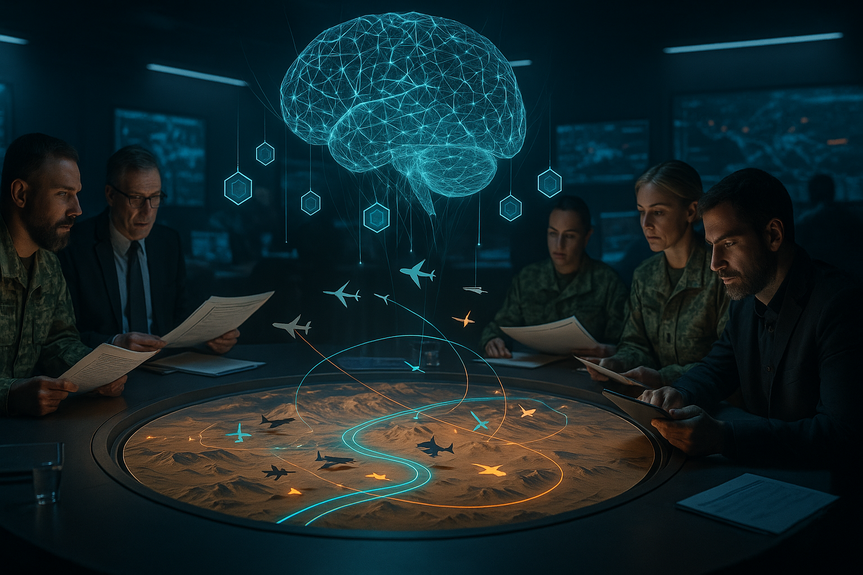
The Air Force battle management AI experiment placed humans and machines under the same constraints. Both sides received a 20-page brief with commander’s intent, threat data, and performance tables for missiles, jammers, and sensors. Everyone worked from the same unclassified information because the real networks and data are classified.What the AI got right
AI thrived on clear, structured inputs. One team had prepped its model well. They normalized spreadsheets, translated narrative notes, and aligned units and terms. That care let the model parse everything quickly and stick to the facts it was given. – AI did not forget details from the brief. – AI kept track of probabilities and ranges with consistency. – AI generated multiple options fast, not just one plan. This data discipline likely helped prevent hallucinations. The models were grounded in a bounded, human-verified dataset rather than free-form internet text.Why humans struggled
The scenario pushed people outside their comfort zone. Most participants were trained for air operations, not multi-domain problem sets spanning air, sea, space, cyber, and electronic warfare. They also faced time pressure by design to mimic a real operations center. – Unfamiliar tasks forced extra mental load. – Unclassified tools and layouts differed from daily systems. – Stress made it easier to miss or misremember data. When the clock was ticking, AI had an advantage: it stayed calm, recalled every detail, and compared options faster.What this means for command and control
This event fits into the Advanced Battle Management System (ABMS), which aims to link forces across services and domains. The Air Force plans to turn these planning functions into small “microservices” that plug into a larger command-and-control ecosystem. In the Air Force’s Transformational Model (a 13-step framework to move from guidance to executable plans), the AI in this event handled one core step: generating courses of action. More AI microservices could assist with the other steps, such as assessing risk, allocating assets, and sequencing tasks, while humans oversee priorities and accept risk.Next steps and safeguards
Officials stressed that none of the six AI tools is ready for operational use today. Several things must happen first:- Data curation: Keep inputs clean, normalized, and traceable.
- Human oversight: Keep commanders in the loop for judgment and accountability.
- Security approvals: Earn authorization to operate on classified networks.
- Training: Teach operators how to task, interpret, and question AI outputs.
- Metrics: Track validity, latency, and error types across realistic scenarios.
Key takeaways for defense planners
- Ground AI in structured, verified data to cut errors and prevent hallucinations.
- Focus on time-critical tasks where speed and breadth of options matter most.
- Design scenarios that reflect real stress, but measure human-machine teams, not just machines.
- Build modular microservices to support each step of planning, not one monolithic tool.
- Invest in operator training and trust-building through transparent performance metrics.
Why this matters beyond the lab
Modern operations move across domains and evolve by the minute. The Air Force battle management AI experiment suggests that AI can help staffs handle this pace by offering many viable options fast, grounded in the commander’s intent and the data at hand. As integration, security, and training improve, the payoff could be faster, better decisions when they matter most. In short, the Air Force battle management AI experiment shows how human judgment and algorithmic speed can work together. With careful data prep, strong oversight, and clear roles, AI can boost planning speed and quality—without replacing the people who lead and decide.For more news: Click Here
FAQ
Q: What was the Air Force battle management AI experiment and what did it find?
A: The Air Force battle management AI experiment was the third DASH event that compared AI tools from six companies with military planners from the U.S., Canada and UK. It found at least one AI algorithm produced more courses of action faster and made fewer errors than human teams in the tested scenarios.
Q: How were the tests structured and what scenarios did participants face?
A: Both humans and AI received the same pre-wargame 20-page brief with commander’s intent, threat data, and performance tables, and they worked from unclassified approximations because the real networks and data are classified. Scenarios included planning an airstrike, rerouting aircraft after base damage, investigating a strange electromagnetic signal, and protecting a disabled and drifting Navy vessel.
Q: How much faster and more accurate were the AI tools compared to human planners?
A: Officials reported machine-generated recommendations were up to 90 percent faster than traditional methods, with the best machine-class solution showing 97 percent viability and tactical validity. Human-generated courses of action averaged about 19 minutes and had roughly 48 percent of options judged viable.
Q: Why did AI perform better and avoid hallucinations in the Air Force battle management AI experiment?
A: Evaluators reported no AI hallucinations during the experiment, and organizers attributed that result to disciplined, human-verified data and explicit model preparation. One software team normalized spreadsheets, translated narratives and aligned terminology so the model could parse the briefing package, and the AI retained all brief details without being affected by stress.
Q: Are the AI tools ready for operational use by planning staffs today?
A: None of the six AI tools is ready for operational use by planning staffs today, and they are not standalone replacements for human planners; rather they are intended to evolve into microservices that plug into a larger command-and-control system. Before operational use the Air Force says steps like security approvals, data curation, operator training, human oversight and performance metrics must be addressed.
Q: What limitations affected human performance during the experiment?
A: Humans were pushed outside their comfort zones with time-critical, multi-domain problems and unfamiliar tools, which increased cognitive load and led to misremembering or errors. Many participants were trained primarily in air operations and the exercise used unclassified formats different from their everyday classified command-and-control networks.
Q: How will AI functions be integrated into command-and-control systems like ABMS?
A: The Air Force plans to convert planning functions into microservices for the Advanced Battle Management System (ABMS), and in the Transformational Model generating courses of action is just one of 13 steps toward an executable plan. Additional AI microservices could be developed to handle other steps such as assessing risk, allocating assets, and sequencing tasks while humans retain oversight and accept risk.
Q: What should operators and planners take away from the Air Force battle management AI experiment?
A: The experiment suggests AI can provide a fast, viable starting point for time-critical planning without replacing human judgment, but that requires strong data curation and human oversight. Operators should focus on training to task and interpret AI outputs, securing approvals to use tools on classified networks, and tracking metrics to build trust and reliable performance.
Contents