Crypto
16 Oct 2026
Read 12 min
Bank of America money laundering fine: What investors need *
Bank of America money laundering fine forces investors to reassess risk and adjust portfolios swiftly
The Bank of America money laundering fine, totaling more than $1.21 billion, spotlights growing risks in traditional banking and a shifting regulatory mood. Regulators say the bank failed to report over $5 billion in suspicious activity. For investors, the key issues are compliance costs, earnings impact, and broader oversight trends across finance and crypto.
Regulators sent a loud message on Oct. 13: even the biggest banks can fall short on basic anti-money-laundering rules. U.S. authorities penalized Bank of America for missing and mishandling reports on suspicious transactions, including activity tied to national security risks and sanctions. The action lands at a time when lawmakers debate how to police crypto, yet the case shows that old-school finance can carry serious blind spots too.
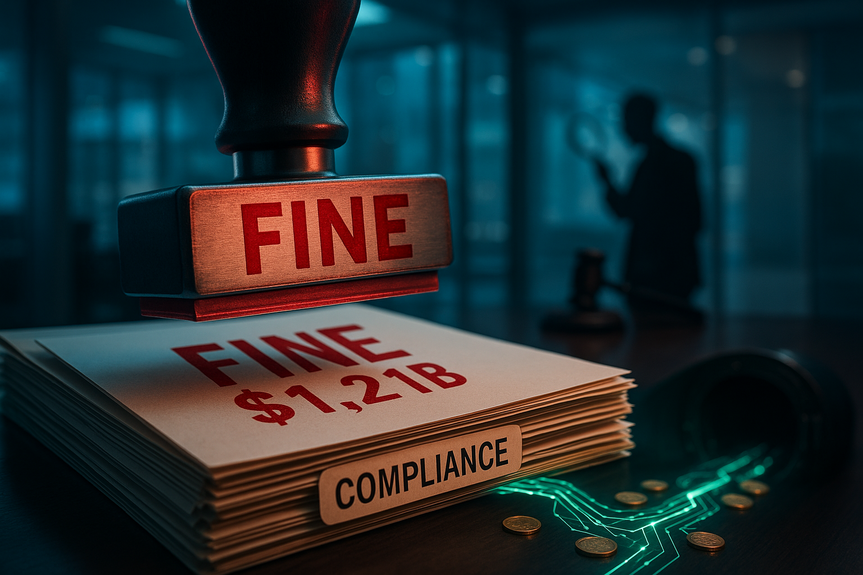
Total penalties exceed $1.21 billion, led by a FinCEN assessment that incorporates a record $750 million penalty from the Office of the Comptroller of the Currency (OCC).
Regulators say Bank of America failed to report more than $5 billion in suspicious transactions to FinCEN, the Treasury unit that tracks financial crimes.
Over $1 billion of that activity involved national security and other priority risks, including suspected Chinese money-laundering networks, fraud, and possible trade-based schemes.
Authorities also cited sanctions compliance failures tied to Russia, Iran, and other restricted jurisdictions.
The bank admitted to willful violations of the Bank Secrecy Act (BSA), the main U.S. anti-money-laundering law.
Bank of America must undergo independent reviews and identify suspicious transactions it previously missed.
Large, one-time fines.
Higher, ongoing compliance costs to fix systems and staffing.
Limits or conditions in consent orders that can affect operations.
Reputational risk that may weigh on valuation for a time.
Management guidance on the total financial impact, including fines and any added legal or consulting costs.
Timing of remediation spending, which can pressure expenses and margins.
Progress updates on technology upgrades, model tuning, and data quality fixes tied to transaction monitoring.
Common Equity Tier 1 (CET1) ratios after the penalty and spending flows through.
Any change to dividend plans or stock buybacks, especially if there are supervisory limits.
Stress test results and how regulators assess operational and compliance risk going forward.
Independent reviews: Watch for the scope, timelines, and milestones the bank must meet.
Backlog reduction: The speed at which the bank clears delayed alerts and files overdue SARs.
Sanctions screening: Improvements to list management, payment filtering, and interdiction logic.
Governance: Board oversight, audit findings, and staffing growth in financial-crimes teams.
Changes in account openings in higher-risk segments or geographies.
Shift in mix toward lower-risk, higher-quality deposits and payments.
Feedback from corporate clients on cross-border payment speed and screening accuracy.
More surveillance: Expect more data requests, model validation checks, and testing of sanctions controls.
Higher costs: AML and sanctions compliance is a long-term expense line, not a temporary fix.
Technology spend: Banks will keep investing in machine learning, entity resolution, and network analytics to spot bad patterns faster.
For diversified bank investors, this may favor firms with strong operations, cleaner control histories, and modern data stacks. Those banks can spread compliance costs over large customer bases and may face fewer disruptions.
Sharper guidance on SAR quality and timeliness.
More focus on trade-based money laundering and cross-border correspondent banking.
Tighter expectations for sanctions screening and beneficial ownership data.
Clear accounting of the total penalty and related expenses.
Defined remediation plan with milestones and board oversight.
Data on SAR timeliness, alert backlog, and model performance.
Sanctions screening metrics, including match quality and case resolution speed.
Capital ratios post-penalty and any changes to capital return plans.
Updates from regulators on progress and remaining gaps.
Investors are now gauging how the Bank of America money laundering fine will shape earnings, capital return, and operating discipline. The broader lesson is simple: compliance is core to the business model. Strong monitoring protects customers, reduces tail risks, and supports steady growth.
In the end, this Bank of America money laundering fine reminds markets that risk is not only in new technology. It lives where controls fail, data is weak, and incentives drift. If the bank fixes those points and proves it, the path back is clear—earn trust, then earn returns.
(Source: https://finance.yahoo.com/markets/crypto/articles/bank-america-1-2b-money-121542791.html)
For more news: Click Here
Inside the Bank of America money laundering fine
The core facts
Why this matters
The BSA requires banks to know their customers, monitor transactions, and file Suspicious Activity Reports (SARs). FinCEN and the OCC say Bank of America did not do that well enough. The agencies argue the bank put revenue before fixing gaps in its monitoring systems. That can let bad actors move money and avoid detection. For investors, lapses like these can lead to:The crypto debate meets a banking reality check
Warren’s push on digital assets
Senator Elizabeth Warren has pushed for tighter anti-money-laundering rules on crypto firms. She argues digital assets can help criminals move funds across borders without banks. She wants to close sanctions loopholes and expand oversight so that risky platforms face the same scrutiny as banks.Traditional finance is not off the hook
This case shows why the policy debate cannot focus on just one corner of finance. Banks sit at the center of the payment system. When a large bank misses red flags, the risks can spread. The take-away for investors: compliance risk is system-wide. Whether assets move through a bank or a blockchain, the rule is the same—regulators want visibility.What investors should watch now
Near-term earnings impact
A penalty of this size can dent near-term results. Investors should listen for:Capital and dividends
Large fines can affect capital, but big banks often have buffers. Key items to monitor include:Regulatory follow-through
Enforcement rarely ends with a check. The hard part is the clean-up:Revenue and customer effects
Better controls can slow some onboarding and transaction flows. That is normal in a fix-it phase. The question is whether higher friction reduces high-risk, low-margin activity without hurting core customer growth. Investors should track:Peer read-through and sector risk
This is not a one-off story. Regulators have targeted weak monitoring across banks and non-banks for years. The message is clear:Context for the market narrative
Crypto versus banks: a false choice
The crypto debate will stay hot. But the facts here show that crime risk is about weak controls and hidden flows, not just the technology used to move money. Good rules and good data matter in both places. For markets, that means a steady push toward transparency—on-chain and off-chain.What could change policy next
As Congress weighs crypto rules, this case may shift the tone. Lawmakers may ask whether banks’ monitoring tech and staffing are keeping up with faster payment rails and more complex sanctions. We could see:How the story could evolve for shareholders
Short term
Volatility is common after large fines. News flow on monitors, remediation costs, and any consent order details can swing sentiment. Investors often wait for clear timelines and proof that the backlog is shrinking and false positives are falling.Medium term
If the bank shows real progress—fewer misses, better models, faster filing—confidence can return. Stronger controls can lower future risk and reduce the chance of repeat penalties. Over time, that can support a more stable multiple.Long term
Banks that build robust compliance can win corporate clients who value clean payments and predictable sanctions outcomes. In a world of stricter rules, strong monitoring can be a moat, not just a cost.Investor checklist for the next two quarters
FAQ
Q: What penalties did regulators impose on Bank of America?
A: Regulators imposed more than $1.21 billion in penalties, including a FinCEN assessment that incorporated a record $750 million penalty from the Office of the Comptroller of the Currency. The Bank of America money laundering fine followed findings that the bank failed to report over $5 billion in suspicious transactions to FinCEN.
Q: Why was the Bank of America fined for anti-money-laundering failures?
A: U.S. authorities concluded the bank failed to report more than $5 billion in suspicious transactions and admitted willful violations of the Bank Secrecy Act, with over $1 billion tied to national-security and priority illicit-finance risks. The Bank of America money laundering fine also cited sanctions compliance failures involving Russia, Iran and other restricted jurisdictions.
Q: How could the Bank of America money laundering fine affect the bank’s near-term earnings and capital plans?
A: A penalty of this size can dent near-term results, increase remediation and compliance spending that pressures expenses and margins, and potentially influence capital-return plans like dividends or buybacks. Investors should watch management guidance on the total financial impact and any supervisory limits tied to capital ratios.
Q: What remediation and oversight measures will Bank of America need to take after the enforcement action?
A: Regulators require independent compliance reviews and steps to identify previously overlooked suspicious transactions, along with upgrades to transaction-monitoring models, data quality, and sanctions screening. The Bank of America money laundering fine also imposes expectations for board oversight, backlogged alert reduction, and clearer remediation timelines.
Q: What does the fine mean for the debate over crypto regulation?
A: The case shows that traditional banks can have serious compliance blind spots, underscoring that the policy debate should not focus solely on digital assets but on weak controls across the financial system. The Bank of America money laundering fine strengthens arguments that both on-chain and off-chain platforms need robust rules and enforcement.
Q: What kinds of illicit activity were identified in the unreported transactions?
A: Regulators said more than $1 billion of the unreported activity involved national security-related and other priority illicit-finance risks, including suspected Chinese money-laundering networks, fraud, and possible trade-based money laundering. The enforcement also highlighted sanctions compliance failures tied to countries such as Russia and Iran, which contributed to the Bank of America money laundering fine.
Q: What specific investor metrics should be monitored in the next two quarters?
A: Investors should monitor the bank’s accounting of the total penalty and related expenses, progress on remediation milestones and SAR timeliness, and changes to CET1 ratios or capital-return plans. They should also track sanctions-screening metrics, alert-backlog reduction, and regulator updates tied to the Bank of America money laundering fine.
Q: Could this enforcement action change how regulators approach banks and non-banks going forward?
A: Policymakers may press for sharper guidance on SAR quality and timeliness, more scrutiny of trade-based money laundering and correspondent banking, and increased expectations for sanctions screening and beneficial-ownership data. The Bank of America money laundering fine signals that regulators will likely demand stronger monitoring, more testing, and sustained investment in technology and staffing.
* The information provided on this website is based solely on my personal experience, research and technical knowledge. This content should not be construed as investment advice or a recommendation. Any investment decision must be made on the basis of your own independent judgement.
Contents