Crypto
16 May 2026
Read 11 min
Best altcoins to buy May 2026: How to pick 3 winners *
Best altcoins to buy May 2026 can boost long-term returns by targeting Solana, Chainlink, and Cardano.
Looking for the best altcoins to buy May 2026? Focus on real utility, strong developer activity, and links to traditional finance. Solana, Chainlink, and Cardano check those boxes today, with speed, data infrastructure, and cautious design. Balance risk, size positions modestly, and think in multi‑year timelines.
Bitcoin has pushed back above $80,000 this spring, and many altcoins have edged higher with it. But price alone is not a plan. Inflation and world events can swing crypto fast. The better signal is real adoption. Banks, payment firms, and asset managers are testing and using blockchains for payments, data, and tokenized assets. That shift can move trillions in value onto public networks over time. If you want exposure now, it helps to pick coins that serve clear roles in that build-out.
Utility: Does it speed up payments, secure data, or cut costs for real users?
Adoption: Are banks, fintechs, or major apps testing or integrating it?
Developers: Is the builder community active and shipping upgrades?
Economics: Are fees, throughput, and incentives set for long-term use?
Risk: Is there a clear plan for outages, security, and regulation?
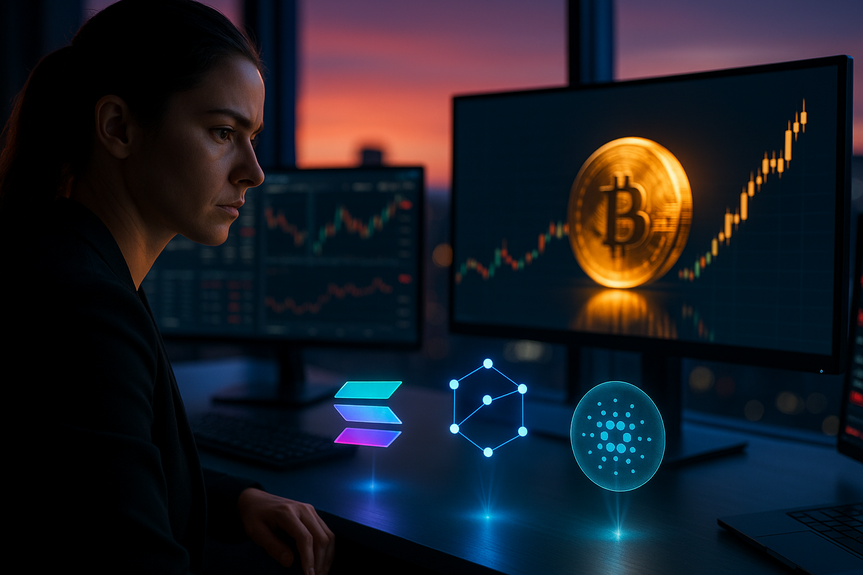
With that lens, three names stand out today: Solana, Chainlink, and Cardano. Each tackles a different job the market needs.
Past outages: The team has worked on fixes, but uptime must stay strong.
Competition: Ethereum’s scaling tools and rival high-speed chains are improving.
Regulation: Rules for stablecoins and crypto payments could shift costs or demand.
Fee design: The value capture from services to the token must remain strong.
Competition: Other oracle networks and in-house data pipes could chip away.
Market cycles: DeFi demand can fall in risk-off periods, slowing growth.
Pace of delivery: Features often ship later than faster-moving rivals.
Developer pull: Without a standout niche, app growth can lag.
Narrative risk: If markets chase speed and memes, Cardano may trail again.
Use small positions: Keep altcoins a minority slice of your total portfolio.
Diversify: Hold a mix of Bitcoin, Ethereum, and a few alt names with distinct roles.
Stage entries: Add in parts over weeks or months to smooth volatility.
Set time horizons: Give theses 3–5 years to play out, not 3–5 weeks.
Know your sell rules: Revisit if a project loses key partners, breaks token economics, or suffers repeated outages.
Institutions are piloting blockchain tools for settlement, collateral, and data.
Stablecoin volumes are growing as payment firms test on-chain rails.
Tokenization pilots for funds and bonds are expanding across regions.
There are also real risks:
Inflation and rate changes can drain risk appetite.
Security breaches or major bugs can pause growth.
Regulatory shifts can alter costs and access across markets.
How to spot the best altcoins to buy May 2026
You want more than hype. Look for signs that a project solves a problem and can scale. Use this simple checklist when you shortlist the best altcoins to buy May 2026:Solana: a fast lane for payments and stablecoins
Why it stands out
Solana is known for speed and low fees. It can process many more transactions per second than Ethereum, and it does so at a fraction of the cost. That makes it a strong fit for stablecoin transfers and small payments. Big payment brands, including Western Union, have explored using stablecoins on faster rails, and Solana is in that mix. The network also has a lively developer scene that keeps shipping tools and apps. A key upgrade, called Alpenglow, is near. It aims to cut latency and improve reliability. If successful, Solana gets closer to the feel of a traditional card network, but on-chain.Where it fits in a portfolio
Solana offers growth exposure to payments and consumer apps. As of mid-May, the token trades near $90, which is still about 70% below its all-time high near $293. The price has lagged at times, but on-chain activity has held up. If stablecoin volume grows and more partners integrate, Solana could set new highs over a 5–10 year window.Key risks to watch
Chainlink: the data, compliance, and tokenization toolkit
Why it stands out
Blockchains cannot read the world on their own. They need secure data feeds and services to trigger smart contracts. Chainlink provides those “oracles” and automation tools. Around 70% of decentralized finance apps rely on Chainlink services today. That reach also extends to banks and asset platforms that test tokenized funds, bonds, and collateral. Chainlink’s tools can help verify stablecoin reserves, run identity checks for security tokens, and settle events on-chain. This behind-the-scenes role is vital if institutions move more assets onto public networks.Where it fits in a portfolio
Chainlink offers diversified exposure to DeFi, tokenization, and enterprise adoption without betting on one single chain. The token trades near $10, more than 80% under its 2021 peak around $53. It approached $30 in late 2024 and again in August 2025. If mainstream use keeps growing, a move back toward those levels would not be surprising, and long-term upside remains if Chainlink stays the default data layer.Key risks to watch
Cardano: a cautious builder with long-term aims
Why it stands out
Cardano takes a research-first path. It focuses on peer-reviewed design and formal methods. The goal is resilience, governance, and fairness. The project was early to test real-world pilots in developing nations, even if results so far have been mixed. That careful pace can be a drawback in fast bull runs, but it may help as large users look for stability and security.Where it fits in a portfolio
Cardano can serve as a steady core alt holding if you value caution over speed. The token has underperformed Solana and Chainlink recently, up about 6% in the last month versus 9% and 13% for those peers. It is also down more than 90% from its peak. That drawdown sets a low base, but conviction depends on your belief that slow, steady networks will gain favor as institutions come in.Key risks to watch
Why these three map to real adoption
Stablecoins and payments
Stablecoins are the clearest product-market fit in crypto today. They settle global transfers fast, often for pennies. Solana’s performance and partner interest position it well as payment firms test new rails.Tokenization and data integrity
Banks and asset managers are exploring how to put funds, treasuries, and collateral on-chain. These systems need reliable data, audit trails, and compliance checks. Chainlink is already the default for many of these jobs.Security and governance
As larger users plug in, resilience and clear governance matter. Cardano’s research culture and methodical updates aim to meet those needs, even if hype fades.Risk management and sizing for altcoins
Crypto cycles can swing hard. A practical plan helps you stay in the game.Market backdrop to keep in mind
Prices move on headlines, but fundamentals are shifting below the surface:The bottom line on the best altcoins to buy May 2026
If you want exposure to real crypto use cases, Solana, Chainlink, and Cardano cover speed, data, and resilience. They line up with where adoption is headed: payments, tokenization, and institutional-grade networks. Keep positions modest, diversify, and think long term. That is how to approach the best altcoins to buy May 2026. This is not financial advice.(Source: https://www.fool.com/investing/2026/05/14/my-top-3-altcoins-for-may-2026/)
For more news: Click Here
FAQ
Q: Which altcoins does the article recommend as the best altcoins to buy May 2026?
A: The article’s top three picks are Solana, Chainlink, and Cardano, which the author presents as the best altcoins to buy May 2026. They are highlighted for speed, data infrastructure, and cautious, research-driven design respectively.
Q: What checklist should I use to evaluate altcoins?
A: Use five signals: clear utility, adoption by banks or major apps, an active developer community, sound token economics, and a plan for outages, security and regulation. The article recommends applying this checklist to shortlist the most promising projects.
Q: Why is Solana on the list of top altcoins?
A: Solana is known for high transaction speed and low fees, making it well suited to stablecoins and payment rails. The article notes a lively developer community, partnerships with payment firms like Western Union, and an upcoming Alpenglow upgrade intended to cut latency and improve reliability.
Q: What are the main risks associated with investing in Solana?
A: Primary risks include past network outages that require continued fixes, competition from Ethereum scaling solutions and other high-speed chains, and potential regulatory changes affecting stablecoins and crypto payments. These factors could affect uptime, demand, and costs for Solana over time.
Q: How does Chainlink serve both DeFi and institutional use cases?
A: Chainlink provides secure data feeds and automation (“oracles”) that about 70% of DeFi apps rely on, and it supports functions like verifying stablecoin reserves and running on-chain identity checks. The article highlights Chainlink’s role in tokenization pilots and enterprise testing by banks and asset managers.
Q: What is Chainlink’s current price context and key investment risks?
A: Chainlink trades near $10, more than 80% below its 2021 high near $53, though it approached $30 in late 2024 and August 2025. Investment risks include fee design and value capture for the token, competition from other oracle networks or in-house data pipes, and cyclical drops in DeFi demand.
Q: Why does the article include Cardano among its top picks despite underperformance?
A: Cardano follows a research-first, formal-methods approach focused on resilience, governance, and fairness, which may appeal to larger, risk-averse users. The article notes mixed results from early real-world pilots and that Cardano is up about 6% in the past month while remaining over 90% below its all-time high.
Q: How should investors size and manage positions in altcoins according to the article?
A: Keep altcoins a minority slice of your total portfolio and diversify across Bitcoin, Ethereum, and a few alt names with distinct roles, adding positions in stages to smooth volatility. The article also recommends multi-year time horizons (3–5 years) and clear sell rules if a project loses partners, breaks token economics, or suffers repeated outages.
* The information provided on this website is based solely on my personal experience, research and technical knowledge. This content should not be construed as investment advice or a recommendation. Any investment decision must be made on the basis of your own independent judgement.
Contents