AI News
13 Jan 2026
Read 8 min
How AI-assisted ultrasonic aircraft inspections cut time
AI-assisted ultrasonic aircraft inspections accelerate fuselage checks by 7% and cut energy use by 3%
New tools from Argonne and partners speed up safety checks on airplanes. AI-assisted ultrasonic aircraft inspections flag likely defects fast and keep strict quality standards. Early results show 7% faster reviews and 3% energy savings per aircraft, while expert inspectors stay in control of final decisions.
A new wave of industrial AI is changing how factories check airplane parts. Researchers at Argonne National Laboratory, Spirit AeroSystems, Northern Illinois University, and TRI Austin built an AI system that helps inspectors find issues in composite structures faster. The system learns from thousands of real inspection scans and points experts to the areas that matter most.
Faster reviews: 7% time reduction in early deployments
Lower energy use: about 3% savings per aircraft at the facility level
Higher focus: inspectors spend time on the riskiest regions first
Quality preserved: tool meets strict safety and performance standards
Scalable design: adaptable to new parts with additional training data
AI-assisted ultrasonic aircraft inspections: how they work
Turning sound into clear signals
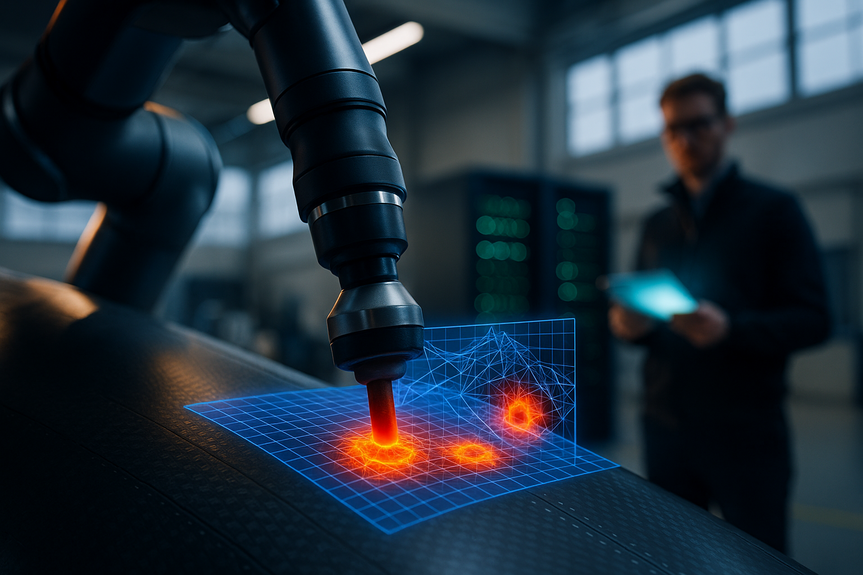
Ultrasonic testing sends high-frequency sound into a part and reads the echoes. The AI looks at the scan images and flags regions that may hold defects. It uses a convolutional neural network, a model that is strong at spotting patterns in images. The team trained it on Spirit’s annotated scans so it learns what true defects look like.Training with supercomputers
Argonne used its Leadership Computing Facility to train and validate the model. The team tuned it to avoid two problems: missing true defects and raising too many false alarms. They checked the AI’s calls against cases already reviewed by expert inspectors. This gave high confidence in accuracy and consistency.Human oversight stays in place
The AI does not replace inspectors. It focuses their attention. Instead of scanning huge datasets line by line, inspectors jump to the flagged zones, verify findings, and make final decisions. This workflow is faster and still meets strict aerospace safety standards.What the early results show
Speed, safety, and energy gains
In early use, the system cut inspection time by about 7% compared to current human-only review. That time saving also reduced energy use by roughly 3% per aircraft at the facility level. Shorter production flow means less time with lights, HVAC, test gear, and other equipment running.Built for real factory conditions
Spirit AeroSystems brought deep knowledge of defects, materials, and inspection steps. NIU helped refine the model and confirm performance. TRI Austin led the software integration, drawing on its experience in ultrasonic automation. Together, they made a tool that fits real workflows and standards on the factory floor.From one part to many
The first rollout targets all ultrasonic checks on the forward fuselage section for an active commercial program at Spirit. Tests on other composite parts show the approach can generalize, as long as teams supply the right training data. This helps scale AI-assisted ultrasonic aircraft inspections across different geometries and material systems with minimal retraining.Why this matters for manufacturers
Practical gains you can measure
Inside the model’s edge
Pattern recognition that learns
The CNN learned from thousands of labeled scans, not from synthetic or generic data. This real-world base helps it pick out subtle patterns, such as delaminations or inclusions in composite materials, that are easy to overlook in large datasets. It highlights areas rather than making final calls, which keeps human judgment central.HPC power for reliable AI
High-performance computing was key to training quickly and testing many options. Teams explored model settings to balance sensitivity and false alarms. The result is a stable tool that is fast enough for production and precise enough for safety-critical work.Industry impact beyond one factory
Collaboration as a blueprint
This project shows how national labs, universities, and industry can deliver practical tools. Argonne provided AI and supercomputing expertise. Spirit supplied data, standards, and use cases. NIU and TRI Austin helped make the system robust and ready for real inspections. The underlying AI methods are available for research and may be licensed, opening paths for broader adoption.From composites to the wider shop floor
Composites are growing in aviation, and they are hard to inspect by eye. AI-assisted ultrasonic aircraft inspections help manage this workload without lowering the bar for safety. The same playbook—trusted data, HPC training, human oversight—can extend to other nondestructive testing tasks across aerospace and beyond. In short, AI-assisted ultrasonic aircraft inspections help experts work faster and smarter while keeping safety first. With proven time and energy gains, a scalable design, and human-in-the-loop control, this approach is ready to improve quality assurance across modern aircraft production. (p(Source: https://www.hpcwire.com/aiwire/2026/01/09/argonne-ai-tools-power-safer-faster-aerospace-inspections/)For more news: Click Here
FAQ
Q: What is the AI tool developed for aerospace inspections, and who built it?
A: The AI-assisted ultrasonic aircraft inspections tool was developed in a collaboration among Spirit AeroSystems, Argonne National Laboratory, Northern Illinois University (NIU), and TRI Austin. The project used Spirit’s annotated ultrasonic scans and Argonne’s high-performance computing resources to build and validate the system.
Q: How does the AI identify potential defects in ultrasonic scan data?
A: It uses a convolutional neural network trained on thousands of Spirit-annotated ultrasonic scans to recognize patterns in scan images and flag regions that may contain defects. The AI highlights likely problem areas for further review rather than making final calls, keeping human inspectors in control.
Q: What performance improvements have been observed with the new system?
A: In early use the tool reduced inspection time by about 7% compared to current human-only review and shortened production flow, which lowered facility-level energy use by roughly 3% per aircraft. These gains were reported while meeting strict safety and performance standards.
Q: Does the AI replace human inspectors during inspections?
A: No, the system is designed to assist inspectors by pointing them to the riskiest regions in the scan so they can verify findings and make final decisions. Human oversight and existing aerospace safety standards remain central to the inspection workflow.
Q: How was the model trained and validated to ensure reliability?
A: Argonne used its Leadership Computing Facility to train and validate the convolutional neural network, tuning it to avoid missing true defects and to limit false alarms. The team confirmed accuracy by comparing AI results to scans previously reviewed by expert human inspectors.
Q: Can this approach be applied to other aircraft components beyond the initial program?
A: Tests on ultrasonic scans from other composite parts showed the approach can generalize to additional components provided the necessary training data are available, and its integration into a portable inspection tool enables adaptation with minimal retraining. Deployment is underway for all ultrasonic inspections of the forward fuselage section of an active commercial program at Spirit, demonstrating practical factory use.
Q: What roles did the different partners play in developing the AI-assisted ultrasonic aircraft inspections system?
A: Spirit AeroSystems supplied annotated inspection data, production expertise, and defect knowledge, Argonne led AI development and used HPC resources for training, NIU helped refine and validate model performance, and TRI Austin handled software integration and automation experience. The collaboration combined domain knowledge and computing expertise to produce a tool fit for real factory workflows.
Q: Will the underlying AI technology be available for other researchers or companies?
A: The article states the underlying AI techniques are being made available for academic research and may be licensed for commercial use, supporting broader innovation while proprietary inspection data remain with Spirit AeroSystems. That availability is intended to help extend AI-assisted ultrasonic aircraft inspections and related nondestructive testing applications across sectors.
Contents