AI News
29 Jul 2026
Read 9 min
How AI clinical decision support trial Kenya aided care
AI clinical decision support trial Kenya helped clinicians catch missed diagnoses and prompt referrals
The AI clinical decision support trial Kenya tested a simple traffic-light assistant powered by GPT-4o across 16 primary clinics. It flagged gaps in care, improved diagnoses and plans, and cost about four cents per visit. Patient outcomes did not significantly improve, but clinicians reported safer decisions and better recall of guidelines in busy settings.
A 4-month-old with a fever arrived at a Nairobi clinic. The clinician thought it was a cold—until a yellow prompt urged a heart check. A telltale “whoosh” in the chest pointed to a possible congenital defect, later confirmed by a specialist. Moments like this show how a light-touch AI can act as a quiet safety net. In the AI clinical decision support trial Kenya, that safety net ran in the background as clinicians typed notes, nudging them to double-check vital signs, reconsider diagnoses, or escalate care.
Inside the AI clinical decision support trial Kenya
Where and how it ran
– 16 Penda Health primary care clinics in Kenya – Nearly 10,000 patient encounters – Randomized setup: half used the AI assistant; half did not – AI engine: OpenAI’s GPT-4o reviewing electronic notes in real time – Cost: about $0.04 per patientThe traffic-light system
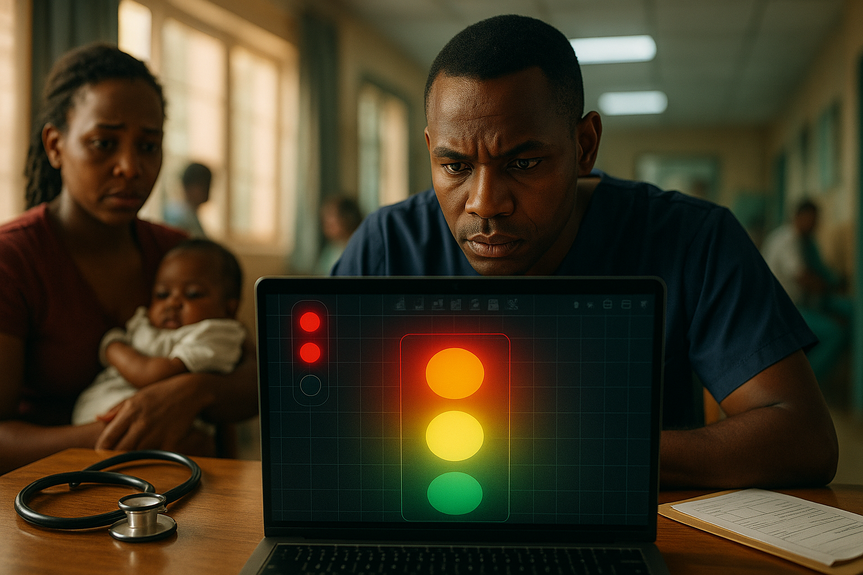
– Green: no issues detected – Yellow: small gaps or suggestions (“click to review”) – Red: urgent concern flagged for quick action These nudges served as a “second set of eyes,” with an independent panel of six Kenyan family physicians rating AI-supported notes as higher quality, with stronger diagnoses and treatment plans.What the study showed—and what it did not
Quality gains, not outcomes (yet)
The AI improved documentation and care plans. However, the study did not find a statistically significant improvement in patient outcomes. Treatment failures (such as unresolved symptoms or death) dropped by 23% in the AI arm, but these events were rare in primary care, making the decrease not statistically significant. Researchers estimate a much larger study—about 139,000 patients—would be needed to confirm a meaningful difference.Why this still matters
Primary care is fast and varied. Clinicians may see five to six patients an hour with few specialists on hand. Subtle safety checks can help them remember guidelines, verify vitals, and consider red flags. In the AI clinical decision support trial Kenya, many prompts were simply helpful reminders; expert reviewers deemed most recommendations safe and appropriate.How the tool affected daily work
Real-time reassurance and learning
Clinicians said about half the prompts were directly helpful, and the rest were rarely wrong. Even when advice did not change a plan, it offered a quick confidence check—“you’re on track,” or “look again at this sign.” Over time, these micro-feedback loops reinforce protocols without long trainings.Speed, notes, and potential access gains
AI can also draft or clean up notes, which may free minutes per visit. If scaled, saved minutes can translate into more appointments and faster follow-ups. While the paper did not test access directly, experts suggest this is where clinical AI might deliver the biggest impact—consistent, timely care.Safety, oversight, and equity
Active guardrails are essential
Supporters point to “information as intervention” as a low-cost way to raise the floor of care. Skeptics warn that even approved AI can make harmful mistakes if left unchecked. Strong governance is non-negotiable: – Keep a clear human-in-the-loop workflow – Log and audit AI prompts and clinician actions – Measure disparities and unintended effects – Update models and guidelines frequentlyLow-cost, high-reach design
At four cents per patient, the approach fits constrained budgets. The tool reviews what clinicians already write; it does not require new hardware or complex integrations. That design makes the AI clinical decision support trial Kenya a practical blueprint for other health systems that need better quality control without new staff or major infrastructure.Key takeaways from the AI clinical decision support trial Kenya
– It made notes, diagnoses, and plans better, according to independent reviewers. – It did not significantly improve outcomes in this sample size, though trends were positive. – It cost very little and fit busy clinics without slowing care. – It showed promise to save time and potentially expand access as note-drafting matures. – It requires ongoing oversight to prevent errors and bias.What comes next
– Larger trials to measure patient outcomes with enough statistical power – Head-to-head tests of different prompt styles, thresholds, and escalation rules – Workflow studies to quantify time saved and visits added – Clear regulatory pathways and continuous monitoring in real deployments – Localization of guidelines to match national protocols and language The trial’s funders included the Gates Foundation (which also supports NPR’s global health team), and PATH helped lead the work. Independent experts praised the randomized, real-world setting, moving beyond lab demos to measure impact where it counts: primary care clinics. The bottom line: this study showed that small, smart nudges can lift clinical quality at scale and at very low cost. The next step is to prove, with larger numbers, that these improvements turn into better health outcomes—while keeping patients safe and data protected. In closing, the AI clinical decision support trial Kenya signals a practical path forward: simple prompts that help busy clinicians make safer, faster decisions. With stronger evidence, careful oversight, and smart deployment, this approach could quietly raise the standard of care for millions. (Source: https://www.npr.org/2026/07/23/g-s1-134929/ai-artificial-intelligence-healthcare) For more news: Click HereFAQ
Q: What was the AI clinical decision support trial in Kenya and what did it test?
A: The AI clinical decision support trial Kenya tested a traffic‑light assistant called AI Consult that ran GPT‑4o in the background of clinicians’ electronic notes across 16 Penda Health primary clinics and nearly 10,000 patient encounters. The study randomized clinicians so half used the AI tool and half used standard note‑taking without the AI.
Q: How did the AI traffic‑light assistant work in clinic notes?
A: The tool provided three traffic‑light prompts—green for no issues, yellow for small gaps or suggestions that invited the clinician to click and review, and red for urgent concerns that required prompt action. It scanned clinicians’ electronic notes in real time and nudged them to double‑check vitals, reconsider diagnoses, or escalate care.
Q: What did the trial find about diagnoses and patient outcomes?
A: In the AI clinical decision support trial Kenya independent reviewers judged AI‑supported notes to have better diagnoses and treatment plans, and clinicians reported safer decisions and better recall of guidelines. However, the study did not find a statistically significant improvement in patient outcomes, although there was a non‑significant 23% decrease in treatment failures.
Q: How much did the AI tool cost per patient and what made it low cost?
A: The tool cost about four cents ($0.04) per patient. Its low‑cost design reviewed clinicians’ existing notes and did not require new hardware or complex integrations, making it practical for constrained budgets.
Q: Did the trial show the AI improved patient outcomes?
A: No; the study did not show a statistically significant improvement in patient outcomes within the trial’s sample, even though treatment failures fell by 23% in the AI arm. Researchers estimated a much larger trial of roughly 139,000 patients would be needed to detect a meaningful difference in outcomes.
Q: How did clinicians respond to the AI prompts in practice?
A: Clinicians generally welcomed the AI as a “second pair of eyes,” saying about half the prompts were directly helpful and the rest were seldom wrong. An independent panel found most recommendations to be safe and appropriate, and clinicians reported better recall of guidelines in busy settings.
Q: What safety and oversight concerns did experts raise about the AI?
A: Experts warned that even approved AI can still make harmful errors, so active oversight and human‑in‑the‑loop workflows are essential to prevent mistakes. The trial’s authors and commentators recommended logging and auditing prompts, measuring disparities, and frequently updating models and guidelines.
Q: What are the next research and implementation steps after this trial?
A: Researchers recommended larger trials to measure patient outcomes with sufficient statistical power, head‑to‑head tests of prompt styles and escalation rules, and workflow studies to quantify time saved and visits added. They also stressed the need for clear regulatory pathways, continuous monitoring in real deployments, and localization of guidelines to national protocols.
Contents