AI News
27 Jan 2026
Read 15 min
How GPT-5.2 Pro FrontierMath results reveal math wins
GPT-5.2 Pro FrontierMath results show a 31% Tier 4 breakthrough, enabling faster math discovery now.
OpenAI’s latest math push just set a new mark. The GPT-5.2 Pro FrontierMath results show 31 percent on the toughest Tier 4, beating past leaders. Epoch AI tested the model manually via ChatGPT. Mathematicians praised many solutions, while noting some fuzzy explanations. This score signals real progress, not hype.
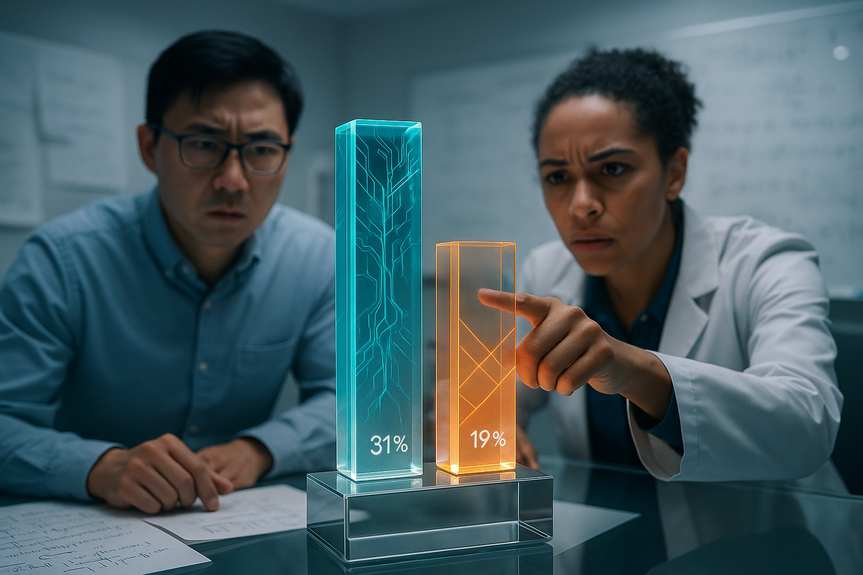
OpenAI has a new data point in its favor, and it is a strong one. Epoch AI reports that GPT-5.2 Pro scored 31 percent on the hardest FrontierMath tier. That beats Gemini 3 Pro at 19 percent and an internal GPT-5.2 xhigh variant at 17 percent. The testers ran the evaluation manually on the ChatGPT website because of API issues. Even with that caveat, the gap is wide and hard to ignore.
The model solved 15 out of 48 tasks and handled four problems no previous model had solved. Several mathematicians reviewed the outputs and gave mostly positive feedback. Some pointed to unclear steps or imprecise wording. That mix—new wins plus critique on rigor—matches how progress in math AI usually looks: promising, but not finished.
GPT-5.2 Pro: 31 percent on FrontierMath Tier 4
Gemini 3 Pro: 19 percent
GPT-5.2 xhigh: 17 percent
We should remember that benchmarks are snapshots. They can shift as prompts, settings, or dataset versions evolve. But a gap this large is unlikely to come from prompt styling alone. It points to training and inference improvements, perhaps in how the model reasons and checks its steps.
Brainstorming proof strategies from different angles
Checking algebraic manipulations and rewriting steps
Generating counterexamples or edge cases to test a claim
Turning a sketch into a cleaned-up write-up, once you verify it
Trusting a neat proof that hides a gap in a key step
Over-fitting to benchmark styles that do not match real tasks
Assuming speed equals depth; fast output is not the same as a sound argument
Relying on one pass; even strong models benefit from multiple attempts
Ask for step-by-step reasoning, then ask it to self-check each step
Request a second solution method and compare conclusions
Probe the weakest step; ask “why is this inference valid?”
Use symbolic tools or a second model to verify critical calculations
Keep a human-in-the-loop review before you accept any proof
Data curation: better math-focused training material and higher-quality supervision can raise reasoning skill.
Search and verification: improved internal checks, or better routing to specialized heads, can reduce errors.
Long-form planning: models that can hold a plan in context do better on deep problems.
Human review loops: stronger feedback from mathematicians can shape how the model writes and defends steps.
These ideas fit what we see: more solved tasks, better coverage of hard items, and critiques that center on explanation clarity rather than total failure.
What the GPT-5.2 Pro FrontierMath results actually show
Tier 4 performance: why it matters
FrontierMath is known as a hard benchmark. It aims to test reasoning across multiple steps, not just short answers. Tier 4 is the top level and is considered the hardest part of the suite. Hitting 31 percent there is not a small edge; it is a breakout result. These tasks push a model to plan, prove, and check. They are not simple arithmetic. The fact that GPT-5.2 Pro solved four previously unsolved tasks hints at new capabilities, or at least better search and verification strategies inside the model. This is why the headline number matters. It suggests a qualitative shift, not just marginal gains.Scores in context
The most meaningful comparisons in Epoch AI’s report are simple:How the tests were run and why it matters
Epoch AI ran the tests through the ChatGPT website. They chose this route due to API issues at the time. Manual testing is not ideal for strict reproducibility, but it can still be useful, especially when prompt formatting and long outputs matter. It also reflects how many people actually use these models—interactively, not just through code. The upside of manual runs is that evaluators can nudge the model to show steps or rethink a path when it stalls. The downside is that small changes in wording can move results. Because of that, replication by other labs will be important. Even so, the difference in scores here is large enough that independent teams will likely see a similar ordering, even if their exact numbers differ.Did the model do new math—or just better benchmark math?
Four first-time solves
According to Epoch AI, GPT-5.2 Pro solved four benchmark tasks that no other model had solved before. That matters, but we should parse it carefully. “First-time” in a benchmark context means first-time on those items as defined and scored. It does not mean the model created a new theorem or proof that changes the field. Still, it shows better coverage of hard cases, which is exactly what Tier 4 is designed to test.Reviewer feedback from mathematicians
Mathematicians who looked at the model’s work saw real value. They said many solutions were useful and mostly correct. At the same time, they flagged explanations that lacked precision. This is a familiar pattern. Models can reach the right idea, but they may skip a justification or use loose language. That gap is where human oversight remains key.From benchmark gains to real research
Recent reports say GPT-5 variants helped with real math work. Some posts claim the system solved Erdős problems on its own, and helped researchers with others. These claims come with cautions from the community. Renowned mathematician Terence Tao, for example, warns against quick conclusions. He suggests that the apparent difficulty of a problem can shrink when you apply enough speed and search, which modern models can do. The truth likely sits in the middle. Models can be very useful in exploration. They can try many approaches fast, spot patterns, and produce drafts. But they still need a strong human in the loop to check logic and fill gaps. The GPT-5.2 Pro FrontierMath results support this view. The system is getting better at the “try many paths and refine” loop. It still struggles with complete rigor at every step.How this changes day-to-day math work
For students
If you are a student, this result means you can lean on the tool for harder problem sets, but with care. The model can outline approaches and show common strategies. You should still do the checking. Ask the model to justify each step, not just give a final answer. When possible, verify with a second method.For teachers
Teachers can use the model to generate varied practice problems and worked solutions. They can also use it to show common errors and why they fail. The reported lack of precision in some explanations is a feature here. It creates teachable moments. Students can learn to critique, not copy.For research teams
Teams exploring proofs or conjectures can use the model for search. Let it suggest lemmas, outline structures, or test special cases. Then apply human review. Keep a log of prompts and outputs so you can reproduce useful lines of thought. This practice makes collaboration and later verification easier.Good uses and pitfalls to watch
Strong use cases
Pitfalls
Simple workflow tips
Where this sits among other math benchmarks
FrontierMath is known as a tough yardstick. It differs from lighter problem sets that focus on short answers. The Tier 4 slice is especially demanding. A 31 percent score there indicates the system can handle a fair share of long, multi-step problems under test conditions. No single benchmark tells the whole story. Scores can depend on prompt style, temperature, and evaluation rules. But when one model opens a double-digit lead over strong peers, it is a sign that the training recipe and inference process improved in a meaningful way. In that sense, this result is more than a number. It is a signal of a working approach that other labs will try to match.Why the model might be improving now
We can only speculate about the causes, but a few factors are likely:What to watch next
Replication will matter. Other teams should run FrontierMath with careful, fixed prompts and public logs. We also need cross-benchmark checks. If gains appear on several hard math tests, not just one, the case grows stronger. Another key step is blind review by independent mathematicians, who can grade proofs without knowing which model wrote them. On the product side, we should watch for stable API access to the exact model Epoch AI tested. That will allow larger-scale, automated evaluations with less variance. We should also watch for improved “Thinking” variants. The community already reports that GPT-5-Thinking and GPT-5-Pro can be useful for real problems. If those lines keep improving, research workflows will change fast.What this means for the AI race
Benchmark gains tend to come in waves. One lab opens a lead. Others respond with new training tricks, more compute, or better data. The reported 31 percent score gives OpenAI a strong talking point. It will push rivals to focus on math reasoning and proof reliability. That competition should help users. Better math ability often spills into other domains, like code, science, and data analysis. The same skills—planning, checking, and revising—drive quality in those areas too. If this result holds up, we can expect a general lift in tools that handle long, careful reasoning.Limits we should keep in mind
Benchmarks do not capture all real-world messiness. In practice, problem statements can be vague, data can be noisy, and goals can shift. Models that do well on fixed tasks may still stumble when context changes. Also, as the mathematician feedback shows, even good solutions can carry small gaps. Those gaps matter when you publish or ship. For now, the best approach is mix-and-match. Use the model for speed and breadth. Use humans for depth and final judgment. This hybrid approach is not a crutch; it is the strongest way to turn raw model power into reliable outcomes.Bottom line on GPT-5.2 Pro FrontierMath results
The GPT-5.2 Pro FrontierMath results point to real progress in hard math reasoning. A 31 percent Tier 4 score, four first-time solves, and positive expert reviews make a clear case. The work is not perfect. Some explanations need sharper detail, and replication is important. But the direction is strong. For students, teachers, and researchers, this means faster exploration and better draft solutions—when paired with careful human checks. In short, the GPT-5.2 Pro FrontierMath results are a milestone worth noting, and a sign that math-capable AI is moving from promise to practice. (Source: https://the-decoder.com/openais-gpt-5-2-pro-solves-math-problems-that-stumped-every-ai-model-before-it/) For more news: Click HereFAQ
Q: What do the GPT-5.2 Pro FrontierMath results show?
A: The GPT-5.2 Pro FrontierMath results show the model scored 31 percent on the hardest Tier 4, outperforming Gemini 3 Pro at 19 percent and GPT-5.2 xhigh at 17 percent. Epoch AI ran the evaluation manually through the ChatGPT website and reported that GPT-5.2 Pro solved 15 of 48 tasks, including four problems no prior model had solved.
Q: How were the FrontierMath tests run on GPT-5.2 Pro?
A: Epoch AI ran the FrontierMath tests manually via the ChatGPT website because of API issues, which allowed interactive prompting but reduced strict reproducibility. The article notes manual runs can help nudge the model to show steps or rethink a path, yet replication with fixed prompts and automated tests is still important.
Q: How many problems did GPT-5.2 Pro solve and were any first-time solves?
A: GPT-5.2 Pro solved 15 out of 48 tasks on the FrontierMath suite and reportedly handled four problems that no previous model had solved. Those first-time solves were highlighted as notable, though reviewers also pointed out issues with explanation precision.
Q: What did mathematicians say about GPT-5.2 Pro’s solutions?
A: Mathematicians who reviewed the outputs generally found the solutions useful and mostly correct, praising several advances while noting shortcomings. They specifically flagged unclear steps or imprecise wording in some explanations, emphasizing the need for human verification.
Q: Why does a 31 percent score on Tier 4 matter?
A: The GPT-5.2 Pro FrontierMath results matter because Tier 4 focuses on long, multi-step reasoning and planning rather than short answers, so a 31 percent score on that hardest slice indicates a meaningful improvement. The article suggests the gap likely reflects training and inference improvements, such as better planning, search, or verification strategies.
Q: Does this mean GPT-5.2 Pro can do original mathematical research or proofs without humans?
A: No — while some reports say GPT-5 variants have reportedly solved Erdős problems and helped researchers, the article relays experts like Terence Tao cautioning against drawing premature conclusions. Models can rapidly explore approaches and draft ideas, but they still require human review for rigor and complete justification.
Q: How should students, teachers, or researchers use GPT-5.2 Pro given these results?
A: Students can use the model to outline approaches and common strategies but should request step-by-step reasoning and verify answers independently. Teachers and research teams can use it to generate practice problems, brainstorm proof strategies, or test cases, while keeping a human-in-the-loop and logging prompts and outputs for reproducibility.
Q: What are the limitations and next steps to validate the GPT-5.2 Pro FrontierMath results?
A: The main limitations are the manual testing method and the need for independent replication, so other teams should run FrontierMath with fixed prompts, public logs, and automated evaluations to confirm the reported gains. Blind independent mathematician review, cross-benchmark checks, and stable API access to the tested model are key next steps to validate the GPT-5.2 Pro FrontierMath results.
Contents