AI News
27 Jun 2026
Read 8 min
How pigeon-trained AI for cancer detection spots tumors
pigeon-trained AI for cancer detection helps doctors spot subtle lung anomalies earlier and cut misses
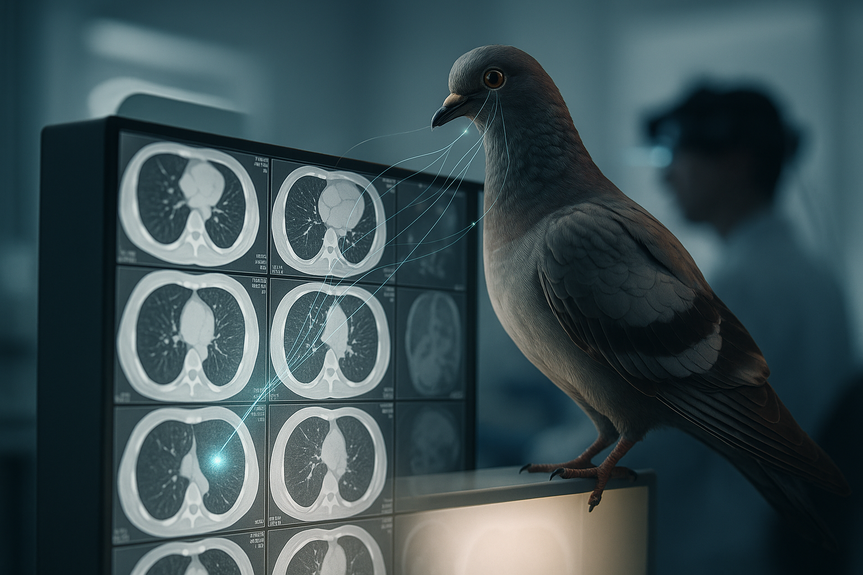
US scientists are studying pigeons’ sharp vision to teach machines what radiologists can miss. This pigeon-trained AI for cancer detection learns from bird choices and doctors’ eye-tracking data to flag faint lung nodules early, turning subtle, non-conscious visual signals into alerts that help catch tumors before they spread.
Radiologists sometimes look right at a problem on a scan and still call it normal. That gap between seeing and deciding can cost time. A research team led by Dr Gregory DiGirolamo at the College of the Holy Cross asked a bold question: can humble pigeons, which excel at spotting patterns, help train AI to notice what humans sense but overlook?
Collect gaze paths, fixation points, and pupil size while radiologists review CT images.
Tag image regions that trigger strong, non-conscious responses, even if the final read is “normal.”
Train AI to link those regions with image features associated with early disease.
Deploy the model as a supportive “second look” that highlights areas at risk.
Let the radiologist make the final call, with focused prompts instead of generic alerts.
This pigeon-trained AI for cancer detection idea starts with a simple truth: attention and decision are not the same. By learning from where experts look and from the patterns pigeons can reliably pick out, models can surface small, early signs that deserve a closer read.
Earlier flags for subtle nodules may lead to faster follow-up and treatment.
More targeted prompts could reduce alert fatigue compared with broad, noisy warnings.
Models rooted in human gaze may align better with real clinical workflows.
However, the study used only six pigeons; broader validation is needed.
Any assistive AI must be tested for bias, safety, and reliability across scanners and patient groups.
The system is designed to support clinicians, not replace them, and should keep the radiologist in control.
Why pigeon-trained AI for cancer detection matters
Early lung cancer can appear as tiny nodules or hazy “ground-glass” spots. These are easy to miss during busy reading sessions. Researchers found that when radiologists viewed suspicious areas, their eyes paused and their pupils widened, even when they later judged the scan as normal. That means the brain may register a red flag before a conscious decision forms. The pigeon-trained AI for cancer detection approach aims to capture those hidden cues and turn them into timely, helpful prompts.Inside the study: pigeons, scans, and patterns
Six pigeons watched short CT videos and learned to choose whether lung nodules were present. The birds earned food when they were right. Some were rewarded for picking scans with nodules; others for recognizing normal scans. Over time, they generalized their learning to new images they had not seen. Surprisingly, the birds also recognized emphysema and ground-glass nodules, even without specific training for those. To a human, these patterns look different. The birds’ success suggests a shared visual signature that a simple visual system can detect. That is a useful clue for building models that focus on texture, contrast changes, and shape hints that predict disease earlier.From human gaze to machine help
Dr DiGirolamo’s group wants to combine two streams of insight: the birds’ knack for pattern detection and the human body’s subtle visual signals. The plan is to gather radiologists’ eye-tracking data and physiological responses while they read scans and use that to guide machine learning models.How the pipeline could work
Benefits and watch-outs
What comes next
The team is focused on healthcare use first, with possible future extensions to cardiology, security screening, and even art authentication. The near-term goal is clear: turn non-conscious visual signals into practical tools that help doctors spot what matters sooner and miss less. In short, when paired with expert eye-tracking and careful model design, pigeon-trained AI for cancer detection could become a quiet, reliable backstop in lung imaging—one that converts fleeting glances and faint patterns into timely nudges that help save lives.For more news: Click Here
FAQ
Q: What is pigeon-trained AI for cancer detection?
A: Pigeon-trained AI for cancer detection is an approach where researchers study pigeons’ visual abilities and radiologists’ eye movements to train AI to flag subtle signs of lung disease on CT scans. Led by Dr Gregory DiGirolamo at the College of the Holy Cross, the method uses bird choices and human gaze data to highlight areas that might be missed during routine reads.
Q: How were pigeons trained to identify lung nodules?
A: Researchers trained six pigeons to watch short CT scan videos and rewarded them when they correctly identified scans with nodules or normal scans, depending on the training group. Over time the birds generalized their learning to new images and even recognised emphysema and ground-glass nodules without specific training.
Q: Why do pigeons help researchers understand non-conscious visual detection in radiology?
A: The pigeons’ success at spotting different lung abnormalities suggested there may be shared visual patterns that simple visual systems can detect, mirroring non-conscious cues seen when radiologists’ eyes linger or their pupils widen. Those findings inspired the pigeon-trained AI for cancer detection concept, which aims to convert such subtle signals into prompts for closer review.
Q: How would radiologists’ eye-tracking data be incorporated into the AI pipeline?
A: The proposed pipeline collects gaze paths, fixation points, and pupil size while radiologists review CT images and tags regions that trigger strong non-conscious responses even when the final read is “normal.” That tagged information would then guide machine learning models to link those regions with image features associated with early disease, forming a supportive “second look” tool.
Q: What potential benefits could pigeon-trained AI for cancer detection provide in clinical practice?
A: The approach could provide earlier flags for subtle nodules and ground-glass changes, prompting faster follow-up and potential treatment when appropriate. Because models would focus on regions indicated by human gaze and pigeon-derived patterns, they may deliver more targeted prompts and reduce generic alert fatigue compared with broad warnings.
Q: What are the main limitations or safety concerns mentioned about this research?
A: The study used only six pigeons, so the findings require broader validation across more animals, images, and settings. The team also notes the need to test any assistive AI for bias, safety, and reliability across different scanners and patient groups before clinical use.
Q: Will pigeon-trained AI for cancer detection replace radiologists?
A: No; the researchers say the technology is intended to support rather than replace medical professionals and to leave the final decision to the radiologist. The design aims to provide focused prompts that help clinicians identify areas that deserve closer inspection.
Q: What future applications do the researchers foresee beyond lung imaging?
A: While the current focus remains on healthcare and reducing medical misses, the researcher believes similar methods could eventually be applied to cardiology, security screening, and even art authentication. Near-term work prioritizes validating the method in medical imaging before exploring those other fields.
Contents