
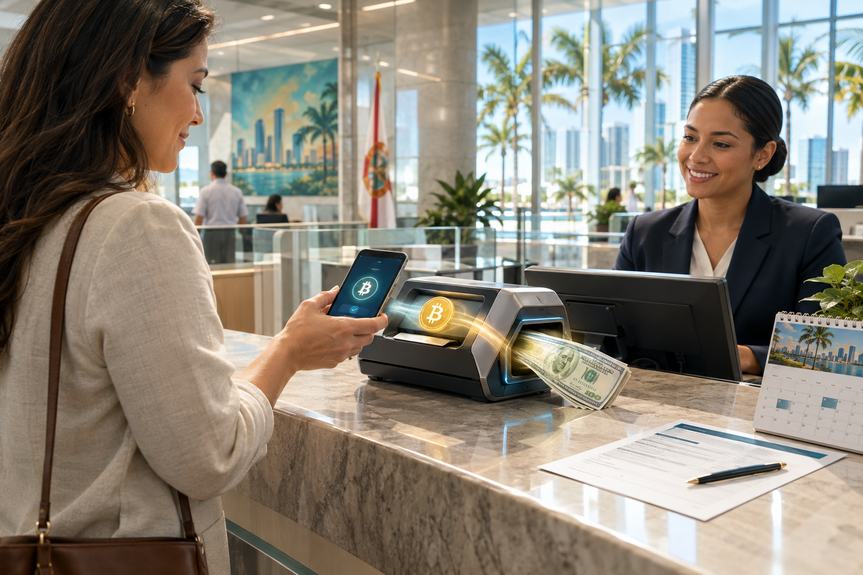
 AI-generated
Crypto
11 Nov 2026
Read 11 min
Miami-Dade Bitcoin property tax payments: How to pay with Bitcoin *
Miami-Dade Bitcoin property tax payments let owners pay their way, while the county gets dollars.
Miami-Dade Bitcoin property tax payments let property owners pay online or in person while the county receives U.S. dollars. Tax Collector Dariel Fernandez says a third-party system converts each payment before funds reach the county. The option is voluntary, traditional methods remain available, and bitcoin processing fees have not been disclosed.
Key takeaways
- Miami-Dade property owners can now pay property taxes with bitcoin online or in person.
- A third-party system converts bitcoin payments into U.S. dollars before the county receives them.
- The Tax Collector’s office did not identify the processor or disclose whether bitcoin payments carry a convenience fee.
- Property owners who pay by Nov. 30 can receive Florida’s 4% early-payment discount.
Fernandez announced the change Monday in a statement on the Tax Collector’s website. For property owners, it adds another way to settle a tax bill during the 2026 collection season. It does not change the amount owed, replace existing payment methods or put cryptocurrency into county accounts.
How do Miami-Dade Bitcoin property tax payments work?
Miami-Dade Bitcoin property tax payments use a cryptocurrency checkout option that connects a supported exchange account or digital wallet to a third-party conversion system.
The office described two ways to start: select cryptocurrency during online checkout or ask for it at the counter. In either case, the payer authorizes the payment, and the system converts the bitcoin into dollars at the time of payment.
Paying online
- Visit mdctaxcollector.gov and open the property tax payment service.
- Select the cryptocurrency option during checkout.
- Connect a supported exchange account or digital wallet.
- Authorize the payment so the third-party system can convert it into U.S. dollars.
The announcement does not identify which exchange accounts or wallets the system supports. Owners should check compatibility before relying on this method near a payment deadline. Online tax payments are available around the clock.
Paying in person
Ask for the cryptocurrency payment option at the counter, then follow the process to connect a supported account or wallet and authorize payment. County employees do not maintain digital wallets to receive the funds.
The office lists 13 locations and T-Connect mobile units among its payment channels. The announcement does not separately explain how the bitcoin option works at mobile units, so owners planning to use one should confirm availability first.
Does the county keep any bitcoin?
The county keeps no bitcoin because the third-party system converts every payment before the money reaches county accounts.
The Tax Collector’s office said it does not hold, invest in or manage cryptocurrency. It receives the full dollar amount owed and includes these transactions in its standard payment reports.
That distinction matters. Accepting bitcoin as a payment method is not the same as buying it with public funds or holding it as a reserve. Here, bitcoin is the payer’s funding source, while dollars remain the county’s settlement currency.
“Government must keep up with the times and the needs of the people we serve,” Fernandez said. He described the change as “embracing new technology without compromising our responsibility to protect taxpayer dollars.”
His statement also made the settlement rule explicit: “our office receives the full amount owed in U.S. dollars.”
What fees apply to bitcoin tax payments?
The office has not said whether bitcoin tax payments carry a convenience fee, so their total cost remains unclear.
The announcement also leaves the payment processor unnamed. Those gaps limit what owners can compare before choosing between bitcoin and a conventional payment method.
The office’s payment-methods page lists a nonrefundable 2.50% fee for online card and mobile-wallet payments, with a $2.50 minimum. That published rate should not be treated as the bitcoin fee: the announcement does not say it applies to cryptocurrency transactions.
Traditional options remain available, including checks, cards, cash and fee-free eChecks. Owners therefore do not need a cryptocurrency account or wallet to pay their bill.
Before authorizing Miami-Dade Bitcoin property tax payments, check any fee information presented during checkout. The county receiving the full tax amount does not, by itself, establish that the payer faces no additional charge.
How does the November property tax discount work?
Property owners can receive a 4% early-payment discount by paying by Nov. 30 under Florida’s property tax calendar.
Miami-Dade opened the 2026 tax roll on Oct. 30. Fernandez’s “Save the Max” campaign encourages owners to use the largest available discount rather than wait until later in the collection season.
The discount schedule reduces the savings each month:
- November payments receive a 4% discount.
- December payments receive a 3% discount.
- January payments receive a 2% discount.
- February payments receive a 1% discount.
- The full amount is due in March.
Unpaid bills generally become delinquent April 1. Under the office’s existing rules, discounts depend on the date a payment is submitted online or in person.
Fernandez noted that an eligible $5,000 tax bill would save $200 if paid in November. For an owner weighing payment methods, that makes timing important alongside any processing charge. The new bitcoin option does not replace the existing discount calendar.
How does this differ from Miami’s earlier crypto efforts?
This change provides an active property tax payment option after earlier local efforts focused on studying or proposing cryptocurrency use.
In 2021, Miami-Dade Commissioner Danielle Cohen Higgins proposed a resolution to study bitcoin payments for county taxes and fees. Miami Mayor Francis Suarez separately pushed for bitcoin payments for city fees and taxes and explored paying city workers in it. The city also launched MiamiCoin, a token tied to the Stacks protocol.
Fernandez, elected in November 2024, previously served on Miami-Dade’s Cryptocurrency Task Force, according to his official biography.
Other governments have pursued dollar-settled crypto payments. Colorado has accepted cryptocurrency for state taxes since 2022, and Utah later introduced an option for individual income taxes. Detroit announced in 2024 that it planned to accept cryptocurrency for city taxes and fees in mid-2025; that announcement alone does not confirm its launch.
Florida’s proposed state Strategic Cryptocurrency Reserve was a different approach. The 2026 Senate measure, CS/SB 1038, died in an appropriations committee in March and never became law.
Our take
Our assessment is that Miami-Dade’s change offers payment choice rather than public investment in bitcoin. Unlike the earlier county study proposal, owners now have an announced route to pay a property tax bill.
The direct users are property owners, including consumers and companies with county tax obligations. For payment companies and developers, the relevant feature is the conversion model, not a county-run wallet. Readers in Germany and the EU should view this as a local U.S. payment option; the announcement establishes no tax payment service in their own jurisdictions.
Dollar settlement addresses the county’s exposure to holding bitcoin, but it does not answer every payer concern. One additional open question is how refunds or mistaken payments would be handled. In the coming weeks, watch for processor details, supported wallets, fee disclosures and clearer payment instructions. Those details will help owners judge whether the added choice is practical before the November discount deadline.
Miami-Dade Bitcoin property tax payments give owners another way to pay without requiring the county to hold cryptocurrency. Check wallet support and any charges before authorizing a payment, and keep the Nov. 30 discount deadline in mind whichever method you choose.
(Source: https://bitcoinmagazine.com/news/miami-dade-takes-bitcoin-property-taxes)
For more news: Click Here
FAQ
Keep reading, keep building
Three things from our own workshop that fit this topic:
- Diktly Free is our dictation app for Mac: speech becomes text entirely on your own machine, nothing goes to the cloud. Free version, Basic 14.99 €.
- 1000+ Prompts to Level Up Your Life is our most downloaded pack. Pay what you want, including 0.
- OpenAI Agent Mode for Beginners walks you through letting AI agents handle tasks for you. 19.99 $.
Our own products. Tech Moments is our newsletter on AI and tech in plain language, one email, no noise. Subscribe below.
* The information provided on this website is based solely on my personal experience, research and technical knowledge. This content should not be construed as investment advice or a recommendation. Any investment decision must be made on the basis of your own independent judgement.
Contents