AI News
08 Oct 2026
Read 9 min
Why AI for physical therapy and rehabilitation matters
AI for physical therapy and rehabilitation speeds tailored treatment by analyzing movement, records.
AI for physical therapy and rehabilitation is turning clinic data into action. A new National Science Foundation institute at the University of Delaware will help therapists read movement patterns faster, match care to each patient’s needs, and keep people moving after stroke, Parkinson’s, and injury—while keeping clinicians in charge of every decision.
A small shift can change a life when walking, standing, or reaching becomes hard. That is why University of Delaware researchers opened a human-centered AI institute to study motion, test new tools, and help therapists make quicker, smarter choices. Backed by $21.5 million over five years, the center sits inside UD’s Data Science Institute and works with Delaware State University, the University of Pennsylvania, and Princeton University. Labs sit next to active clinics, so ideas can move from test to treatment in the same hallway. It is the 30th institute in NSF’s program and focuses on safe, supportive tech that helps people return to work, sports, and daily life.
Quicker assessments: AI summarizes gait or range-of-motion data so the session can focus on action.
Consistent tracking: It compares today’s steps with last month’s, so progress and setbacks are easy to see.
Safer practice: Smarter treadmills and training setups support effort while lowering fall risk.
More motivation: Interactive feedback can turn slow rehab drills into small wins that keep people going.
Better use of time: AI handles the back-end analysis, so therapists spend more minutes coaching and fewer minutes crunching numbers.
How AI for physical therapy and rehabilitation works
It learns from movement and medical records
Therapists watch how a person walks, turns, or lifts. Now AI can analyze video, sensor data, and charts in the background. It spots small changes that the eye may miss. It flags stride issues, balance risks, or fatigue trends. Then the therapist uses those insights to plan the next step.It keeps the clinician in control
This institute stresses support, not replacement. AI does the heavy math. The therapist makes the call. That means stronger care in the same visit time, with better follow-up between visits.It bridges research and care in one space
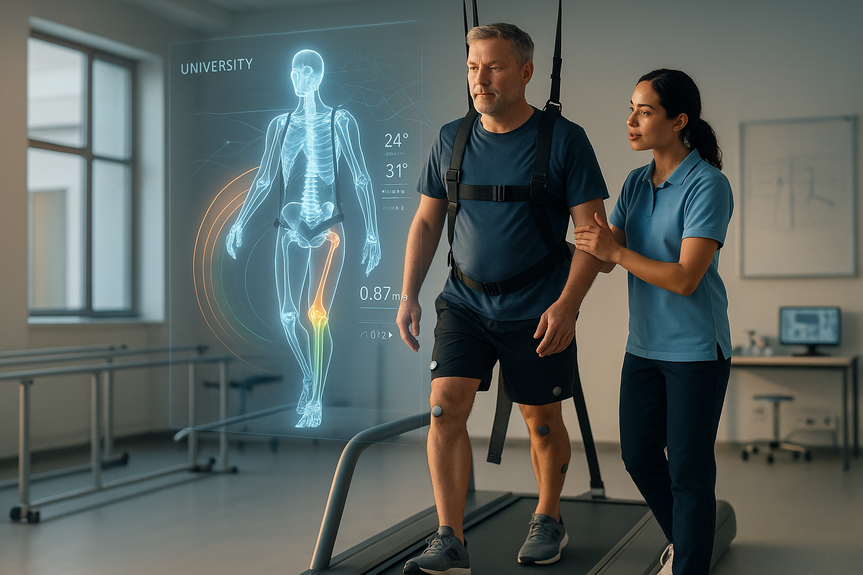
At UD, the clinical physical therapy lab sits next to research spaces and prototyping rooms. Teams can test new features and walk a patient over to try a safer treadmill session that keeps them engaged in ways not seen before.What patients and providers gain
Faster answers, clearer goals
Real needs this institute targets
After a stroke
A stroke can change balance, speed, and arm use. With AI for physical therapy and rehabilitation, a therapist can measure asymmetry in steps, spot foot drag, and adjust drills in the same visit. Clear data helps set goals that match the patient’s daily life.With Parkinson’s disease
Parkinson’s often brings shuffling steps and “freezing.” AI can track stride length, rhythm, and turning speed over time. It can alert the team when patterns shift, so care plans change before falls happen.Return to work and sports
Injury recovery needs steady loading and skill work. AI highlights when movement quality is strong enough for a harder drill, or when fatigue suggests a lighter day. That helps people get back to the job site or field with more confidence.Safeguards, ethics, and teamwork
Human-centered by design
The institute’s mission is simple: help people move. That requires tools that earn trust. Therapists lead the process. Patients see and understand the feedback. AI suggests; people decide.Privacy and fairness
Movement data and records are sensitive. Secure systems, strict access, and clear consent matter. Teams also need broad, diverse data so models work well for many bodies, ages, and conditions.Power of a regional network
UD leads the effort with Delaware State University, the University of Pennsylvania, and Princeton University. This network blends clinical skill, engineering, and data science. It trains students, supports clinicians, and speeds safe ideas from lab to clinic.Why this moment matters
Care that meets real-world speed
Therapists have limited time with each patient. The new institute shows how AI can do deep analysis in the background and surface the right insight at the right time. That means fewer wasted minutes and more active practice in every visit.From pilot to practice
Because the research labs sit next to the clinic, new methods can be tested, improved, and used with real patients sooner. Smart treadmills and interactive tools can keep people engaged as they rebuild strength, balance, and confidence.Impact that reaches beyond campus
As the 30th NSF AI institute, this center signals a national push to use data for health gains. The work in Newark can inform clinics across the country that want stronger outcomes without losing the human touch. In short, this launch is good news for anyone who wants to move with less pain and more freedom. With careful design and close clinician oversight, AI for physical therapy and rehabilitation can speed insight, support safer practice, and help more people return to the lives they love. (p Source: https://6abc.com/post/university-delaware-launches-ai-institute-focused-mobility-rehabilitation-care/19918404/)For more news: Click Here
FAQ
Q: What is the new AI institute at the University of Delaware focused on?
A: The University of Delaware launched a National Science Foundation AI Institute housed at UD’s Data Science Institute to develop human-centered AI for physical therapy and rehabilitation that assists clinicians and physical therapists in delivering more personalized care. The initiative focuses on analyzing movement and medical records to tailor treatment for stroke, Parkinson’s disease, and other mobility-related conditions.
Q: How will AI help therapists read movement patterns faster?
A: AI analyzes video, sensor data, and medical charts in the background to spot small changes like stride issues, balance risks, or fatigue trends that the eye may miss. Those insights are summarized so a therapist can plan the next step more quickly while remaining in control.
Q: Which conditions will the institute target with its AI tools?
A: The institute targets stroke, Parkinson’s disease, injuries, and other mobility-related conditions where walking, balance, or arm use is affected. Using AI for physical therapy and rehabilitation, clinicians can measure step asymmetry, track stride length and rhythm, and adjust drills to better match patients’ daily life goals.
Q: How does the institute ensure clinicians stay in control of patient decisions?
A: The institute designs AI for physical therapy and rehabilitation to support clinicians rather than replace them, with AI doing back-end analysis while therapists make clinical decisions. This approach aims to strengthen care during limited visit time and improve follow-up between sessions.
Q: How does the institute bridge research and clinical care on the same campus?
A: At UD the clinical physical therapy lab sits next to research and prototyping spaces so patients can move directly from testing to treatment in the same hallway. That layout lets teams rapidly test features like smarter treadmills and try AI for physical therapy and rehabilitation tools with patients soon after prototyping.
Q: What benefits do patients and providers gain from these AI tools?
A: AI for physical therapy and rehabilitation can provide quicker assessments, consistent tracking of progress over time, and smarter training setups that reduce fall risk while boosting patient motivation. It also handles back-end analysis so therapists spend more session time coaching and less time crunching numbers.
Q: What privacy and fairness safeguards does the institute emphasize?
A: The institute stresses secure systems, strict access controls, and clear consent because movement data and medical records are sensitive. Researchers also seek broad, diverse datasets so models work well across different bodies, ages, and conditions.
Q: Who is funding and partnering on the AI institute?
A: The five-year, $21.5 million initiative is led by the University of Delaware in collaboration with Delaware State University, the University of Pennsylvania, and Princeton University. It is the 30th institute established under the National Science Foundation program and focuses on human-centered AI research aimed at keeping people mobile and returning to work, sports, and daily activities.
Contents