Crypto
20 Feb 2026
Read 11 min
XRP vs Bitcoin 2026 comparison: How $10K Should Split *
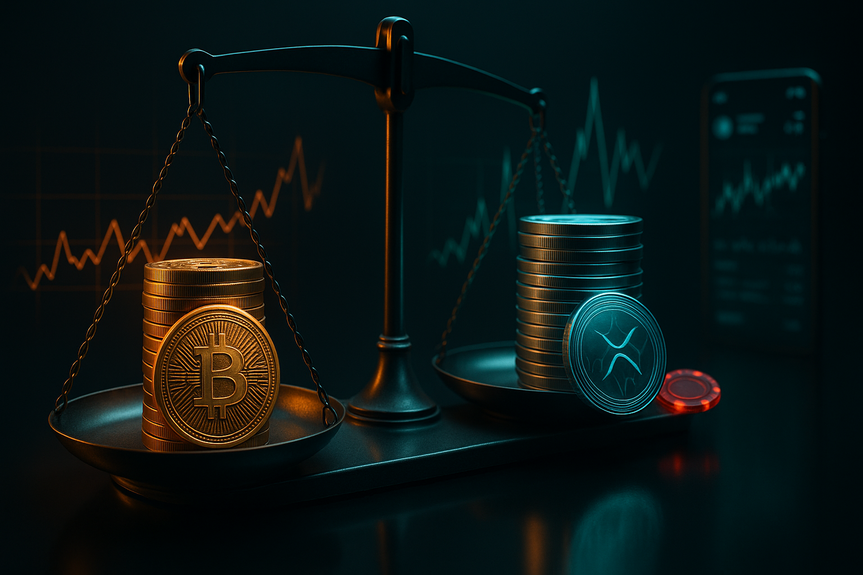
XRP vs Bitcoin 2026 comparison helps you decide how to split $10,000 between upside and stability.
If you have $10,000 to invest, this XRP vs Bitcoin 2026 comparison shows how three AI models see risk and reward. One favors XRP for upside, one picks Bitcoin for steadier growth, and one says it depends on your risk level. Here’s what $10K buys, what could drive each coin, and how to split your bet.
You want gains, but you also want sleep. Bitcoin trades near $68,000 after a sharp pullback from its 2025 peak. XRP sits near $1.50, much lower than its last cycle high. Three AI models reviewed the same setup and came back with different calls. ChatGPT leans XRP for bigger upside. Grok picks Bitcoin for stability. Claude says pick based on your risk tolerance—or split it. This XRP vs Bitcoin 2026 comparison stacks the facts, the drivers, and practical split ideas so you can decide.
Price used: about $1.50
Approximate tokens for $10,000: ~6,667 XRP
Drawdown from cycle high ($3.65): ~60%
Meaning: More room to bounce, but sharper drops if the market turns
Price used: about $68,000
Approximate coins for $10,000: ~0.147 BTC
Drawdown from peak ($126,000): ~46%
Meaning: Less rebound potential, but stronger history of holding value in downturns
The numbers tell a simple story. XRP gives you more units and a deeper discount from its high. Bitcoin gives you a smaller piece of a larger, steadier asset with heavier institutional demand.
ETF momentum: About $1.3 billion in XRP ETF inflows signals persistent demand from regulated channels.
Real usage growth: RLUSD’s market cap near $1.52 billion adds utility to the ecosystem beyond speculation.
Institutional buildout: Ripple’s >$3 billion in acquisitions aims to deepen infrastructure and onboarding.
Higher beta: XRP often drops faster than Bitcoin in risk-off moves.
Sentiment drag: XRP still tracks crypto-wide mood, so broad selling can overwhelm company news.
Execution risk: Utility needs to keep growing for price to sustain higher levels.
In short, this part of the XRP vs Bitcoin 2026 comparison comes down to whether you believe today’s utility and ETF demand can carry XRP through the next leg of the cycle.
Institutional anchor: Bitcoin ETFs hold over $90 billion, providing deep liquidity and broad market access.
Holder profile: Long-term holders tend to sell less in stress, which smooths price action versus smaller caps.
Market role: Bitcoin often leads recoveries and sets the tone for the rest of crypto.
Macro sensitivity: Rates, liquidity, and geopolitics still drive risk appetite.
Flow swings: ETF outflows can weigh on price during weak months.
Return ceiling: After a strong run, upside may trail higher-volatility coins.
Within the XRP vs Bitcoin 2026 comparison, Grok’s view is clear: most investors do better with the asset that wobbles less and bounces back more often.
XRP: About $1.50–$2.00 in weak markets, $2.50–$4.00 in a normal recovery, >$5 if the cycle heats up.
Bitcoin: About $60,000–$75,000 in weak conditions, $100,000–$150,000 in stronger markets.
Claude’s core lesson is behavioral. It is hard to hold through steep drawdowns. A split makes it easier to stay invested when fear spikes.
ETF flows lead the story: Regulated products now move supply and demand more than social buzz. XRP’s inflows help. Bitcoin’s ETF base is huge, but flows can flip month to month.
Macro rules the range: Fed policy, global liquidity, and geopolitics can widen outcomes. Either coin can double or even triple with loose conditions, or lose another 50% in stress.
Nothing is “safe”: Correlations rise in panic. Holding both helps, but it does not remove downside risk. Position sizing matters more than perfect timing.
This section of the XRP vs Bitcoin 2026 comparison underlines one thing: process beats prediction. Flows, macro, and risk controls will matter as much as your coin pick.
70% BTC ($7,000) + 30% XRP ($3,000)
Approximate units: ~0.103 BTC and ~2,000 XRP
Why: You anchor in the deeper market and still keep some upside pop from XRP.
60% BTC ($6,000) + 40% XRP ($4,000) or a clean 50% / 50%
Approximate units (60/40): ~0.088 BTC and ~2,667 XRP
Why: You split the difference so either winner boosts the total.
30% BTC ($3,000) + 70% XRP ($7,000)
Approximate units: ~0.044 BTC and ~4,667 XRP
Why: You lean into XRP catalysts, knowing volatility will be higher.
Rebalance on 20% gaps: If one side outperforms by 20% versus the other, trim the winner and add to the laggard back to your target split.
Use a 12–18 month window: Give your thesis time; avoid day-to-day noise.
Consider dollar-cost averaging: Split your $10,000 into 3–5 buys over several weeks to cut entry risk.
Set a max drawdown line: Decide in advance how much red you can handle (for example, 35%). Size positions to live through it.
These steps keep emotion in check. In a fast market, your process is your edge.
XRP vs Bitcoin 2026 comparison: What $10,000 buys today
XRP math
Bitcoin math
Why one AI leans XRP: upside drivers
ChatGPT favors XRP through 2026 because it sees more catalysts already in motion. The model’s rough targets put XRP between $2.50 and $3.50 in a base case, which could lift a $10,000 stake to around $15,600–$21,900 if those levels land.Key bullish points for XRP
Main risks to watch
Why another model chooses Bitcoin: resilience first
Grok prefers Bitcoin for investors who want steadier progress. Its base case points to $75,000–$150,000 by late 2026, with a stronger scenario stretching higher. A $10,000 position could become roughly $11,000–$22,000 in that range.Why Bitcoin gets the “defense” label
Main risks to watch
Claude’s middle path: match coin to investor type
Claude avoids a single winner and focuses on fit. If you want higher upside and can handle big swings, it points to XRP. If you value steadier moves and a narrower forecast band, it points to Bitcoin. Claude also suggests a simple answer if you are unsure: split your $10,000 and reduce regret risk.Scenario bands (summarized)
Shared signals the models agree on
How to split $10K in 2026
You do not need a perfect forecast. You need a plan you can hold. Here are sample splits based on risk level. The price math uses the rough levels above for easy estimates.Cautious: prioritize capital stability
Balanced: accept swings for more upside
Aggressive: chase the bigger move
Simple rules that help you hold
What the next two quarters could decide
The near term will likely center on ETF flows, policy signals, and whether crypto liquidity improves. If XRP ETF inflows stay steady and RLUSD use grows, XRP can close its gap faster. If Bitcoin ETFs attract strong net buying and macro risk eases, BTC can grind up and lead the pack again. Either path can work, which is why a split often beats an all-or-nothing bet. In the end, the best choice is the one you can hold. If you want the most potential upside, tilt to XRP. If you want steadier ground, tilt to Bitcoin. If you want both outcomes, split and rebalance. That is the real lesson from this XRP vs Bitcoin 2026 comparison—and the one most likely to keep you invested long enough to win. (Source: https://247wallst.com/investing/2026/02/18/10000-in-xrp-or-bitcoin-for-2026-3-ai-models-pick-the-winner/) For more news: Click HereFAQ
Q: What did the three AI models conclude in the XRP vs Bitcoin 2026 comparison?
A: ChatGPT favored XRP for upside, Grok chose Bitcoin for stability, and Claude stayed neutral, saying the choice depends on investor risk tolerance. They reached differing views using price projections and factors like ETF flows, usage growth, and institutional activity.
Q: How many XRP or Bitcoin would a $10,000 investment buy according to the article?
A: At about $1.50 per XRP, $10,000 would buy roughly 6,667 XRP, and at about $68,000 per Bitcoin it would buy about 0.147 BTC. The article notes XRP is down roughly 60% from its $3.65 cycle high while Bitcoin is down about 46% from its October 2025 peak of $126,000.
Q: Why does ChatGPT favor XRP for a $10,000 position through 2026?
A: ChatGPT projects XRP trading between $2.50 and $3.50, implying a potential return that would turn $10,000 into roughly $15,600–$21,900. It cites catalysts such as about $1.3 billion in XRP ETF inflows, RLUSD’s roughly $1.52 billion market cap, and Ripple’s acquisitions of over $3 billion.
Q: Why did Grok pick Bitcoin instead of XRP in the comparison?
A: Grok favors Bitcoin for steadier returns and projects a range of about $75,000 to $150,000 by late 2026, which would turn $10,000 into roughly $11,000–$22,000. Its case rests on Bitcoin’s deeper liquidity, more than $90 billion held in Bitcoin ETFs, and a holder profile that tends to sell less aggressively during downturns.
Q: What does Claude recommend for investors undecided between XRP and Bitcoin?
A: Claude stays neutral and recommends choosing based on risk tolerance, outlining scenario bands where XRP could be $1.50–$2.00 in weak markets up to over $5 in a strong cycle while Bitcoin could be $60,000–$75,000 in weak conditions up to $100,000–$150,000 in stronger markets. It also suggests a split allocation for investors who want exposure to both upside and stability.
Q: What common conclusions do the three AI models share in this XRP vs Bitcoin 2026 comparison?
A: All three models agree that ETF flows will be a major driver in 2026 and that macro factors like Fed policy, liquidity, and geopolitics create wide price ranges. They also agree that neither asset is safe, crypto is high risk, correlations rise in panic, and a $10,000 position can easily fall to about $5,000 before recovery.
Q: How does the article suggest splitting $10,000 between XRP and Bitcoin based on risk tolerance?
A: The article gives sample allocations: cautious 70% BTC/30% XRP (~0.103 BTC and ~2,000 XRP), balanced 60% BTC/40% XRP (~0.088 BTC and ~2,667 XRP) or 50/50, and aggressive 30% BTC/70% XRP (~0.044 BTC and ~4,667 XRP). These splits aim to balance stability from Bitcoin with upside exposure from XRP depending on investor goals.
Q: What practical rules did the article recommend to help investors stick with a split strategy?
A: It recommends rebalancing when one side outperforms by 20%, using a 12–18 month time horizon, dollar-cost averaging $10,000 into 3–5 buys, and setting a maximum drawdown threshold (the article gives 35% as an example). These steps are intended to keep emotion in check and give your investment thesis time to play out.
* The information provided on this website is based solely on my personal experience, research and technical knowledge. This content should not be construed as investment advice or a recommendation. Any investment decision must be made on the basis of your own independent judgement.
Contents