AI News
08 Oct 2026
Read 9 min
How AI for enhanced geothermal systems reduces project risk
AI for enhanced geothermal systems gives teams real-time models to cut costs and reduce seismic risk.
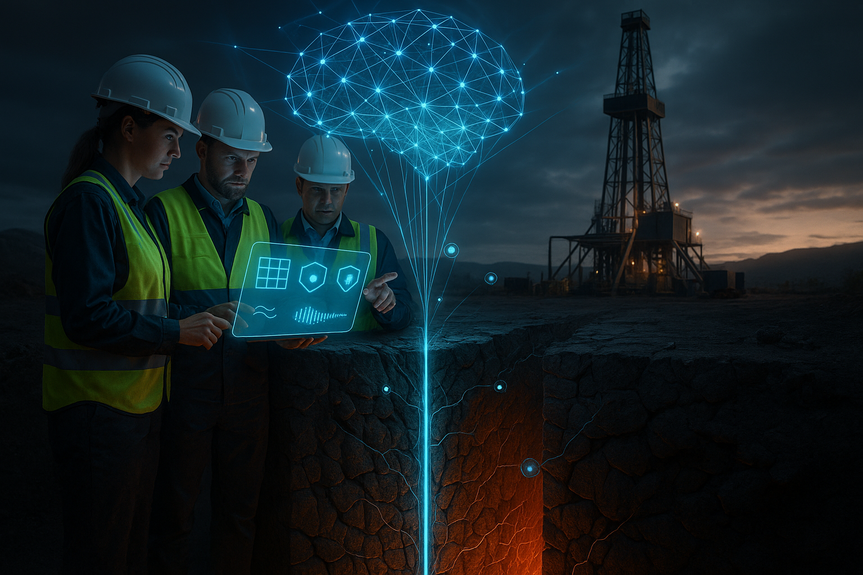
AI for enhanced geothermal systems reduces project risk by predicting where to drill, how rock will fracture, and when operations might trigger earthquakes. UC Irvine’s MAESTRO team, funded by the U.S. Department of Energy, blends real-time data, physics, and simulations to guide safer, cheaper geothermal power from deep, hot rock.
Geothermal energy holds vast promise. The heat is steady, clean, and always on. But the hard part is finding and managing the right rock at the right depth without raising costs or safety risks. A UC Irvine-led project called MAESTRO, now in DOE’s Genesis Phase 2, is building AI tools to do exactly that. The team unites five UC campuses, four national labs, and private partners to turn subsurface data into clear, actionable guidance for developers and communities.
Remote sensing and field measurements (stress, rock type, microseismic signals, and more)
Past outcomes from similar fields and wells
High-fidelity simulations that test “what if” plans
This loop gets smarter with use. When the system sees uncertainty, it launches targeted simulations to sharpen predictions. Engineers then get clear guidance with confidence ranges, so they can choose a safer and cheaper path forward.
Reduce the number of test injections and re-drills
Shorten the path from exploration to power-on
Cut insurance and financing costs tied to uncertainty
Improve regulatory confidence with transparent, physics-based plans
Developers using AI for enhanced geothermal systems gain real-time guidance that supports safer operations, clearer budgets, and stronger investor trust.
Multi-agent AI: Specialized “experts” handle geophysics, geochemistry, geomechanics, and operations, then combine their insights into one plan.
Simulation in the loop: The AI does not just predict; it runs new simulations to test ideas and reduce uncertainty.
Physics-checked outputs: Safety rules ensure that recommendations make sense in the real world.
Nationwide team: UC Irvine leads a coalition with UC Berkeley, UC Riverside, UC San Diego, UC Santa Cruz, and the Los Alamos, Lawrence Livermore, Lawrence Berkeley, and Pacific Northwest national labs, plus industry partners.
Open-source access: The project will deliver a free, browser-based tool so researchers, policymakers, companies, and the public can explore geothermal potential and risk.
Developers: Better site picks, safer stimulation plans, and fewer delays
Communities: Continuous monitoring, clear risk communication, and improved seismic safety
Regulators: Transparent, data-backed decisions that streamline permitting
Researchers: Shared data and models that speed innovation
Pre-drill screening: Rank candidate sites by success probability before spending on rigs.
Injection planning: Choose injection rates and schedules that balance heat extraction and seismic safety.
Adaptive operations: Update plans as new microseismic and flow data arrive during stimulation.
Portfolio planning: Compare fields using common metrics to spread risk and allocate capital.
AI for enhanced geothermal systems: how it lowers risk
Enhanced geothermal systems (EGS) move fluid through tight rock, often more than two miles deep, to carry heat to the surface. This needs strong evidence that the rock will fracture as planned, that water will circulate well, and that seismic risk stays low. The old way relied on sparse measurements and trial-and-error. MAESTRO’s approach uses learning systems that constantly compare models with new data, flag uncertainty, and run fresh simulations to close gaps. A built-in safety layer checks that every AI suggestion follows the laws of physics.From data to decisions
MAESTRO blends three inputs:Smarter site selection
Picking the wrong site is the costliest risk in EGS. By using AI for enhanced geothermal systems, teams can quickly screen large regions for the right stress state, rock properties, fracture networks, and access for drilling and water. The output is not a vague score but a probability of success, backed by data and physics. This helps companies avoid “dry” wells and focus resources where success is most likely.Safer stimulation and seismicity control
EGS needs controlled fracturing to open flow paths. Operators must avoid runaway crack growth or unwanted quakes. MAESTRO predicts how and where fractures will form and how fluids will move, in near real time. The system can recommend flow rates, pause points, and monitoring thresholds. The same tools that track induced seismicity may also support early warning for natural earthquakes, improving community safety.Lower costs and faster timelines
Time is money in geothermal. Drilling, testing, and troubleshooting add up. With better forecasts and fewer surprises, projects can:What makes MAESTRO different
Benefits for key stakeholders
Real-world use cases
Why now
The U.S. wants more firm, clean power. Wind and solar are growing, but they are variable. Geothermal can run 24/7. The problem has been risk. The MAESTRO project, supported by the DOE’s Genesis Mission, aims to turn today’s scattered data and models into one reliable system. That can help geothermal scale faster and support grid stability, national security, and local economies.Credible science, practical tools
The team’s strength is depth and breadth: geophysicists, geochemists, engineers, applied mathematicians, and computer scientists working together. Their shared goal is practical: reduce risk in the field, not just in theory. The result should be decisions that are easier to explain, defend, and improve over time. The path to wide geothermal adoption runs through better decisions under the surface. With AI for enhanced geothermal systems, MAESTRO shows how to cut risk, protect communities, and speed clean power to the grid—one data-driven, physics-checked step at a time.For more news: Click Here
FAQ
Q: What challenge does AI for enhanced geothermal systems address?
A: AI for enhanced geothermal systems addresses the difficulty of finding and managing suitable deep hot rock by predicting where to drill, how rock will fracture, and when operations might trigger earthquakes. The MAESTRO project combines real-time data, physics and simulations to provide actionable guidance that aims to make geothermal projects safer and more economical.
Q: How does MAESTRO improve site selection for enhanced geothermal systems?
A: MAESTRO quickly screens large regions by combining remote sensing and field measurements, past outcomes, and high-fidelity simulations to assess stress state, rock properties and fracture networks. Rather than a vague score, the system outputs probabilities of success so developers can avoid dry wells and focus resources where success is most likely.
Q: What types of data feed MAESTRO’s AI models?
A: The system uses remote sensing and field measurements (stress, rock type, microseismic signals), historical outcomes from similar fields and wells, and high-fidelity simulations. It runs targeted simulations when uncertainty is identified and updates models with real-time geophysical observational data.
Q: In what ways can MAESTRO help manage induced seismicity during stimulation?
A: MAESTRO predicts how and where fractures will form and how fluids will move, allowing operators to choose injection rates, pause points and monitoring thresholds to reduce seismic risk. The project’s tools may also serve as the basis for early warning of naturally occurring earthquakes, which could improve community safety.
Q: Who are the partners and lead institution on the MAESTRO project?
A: UC Irvine leads the MAESTRO project, which was selected by the U.S. Department of Energy for a three-year Genesis Phase 2 award. The team includes researchers from five UC campuses, four national laboratories and three private-industry partners spanning geophysics, geomechanics, geochemistry, applied math and AI.
Q: What technological features distinguish MAESTRO from earlier geothermal tools?
A: AI for enhanced geothermal systems within MAESTRO uses multi-agent models that specialize in geophysics, geochemistry, geomechanics and operations, runs simulation-in-the-loop learning, and enforces a safety mechanism so outputs remain physically consistent. These features let the system identify predictive uncertainty, run targeted simulations to close knowledge gaps, and produce physics-checked recommendations for operators.
Q: How will MAESTRO’s open-source tools be made available and who can use them?
A: MAESTRO will be open-source and packaged into a free, browser-based tool that anyone can use to explore geothermal potential, assess risk and review data across the country. This accessibility aims to support researchers, policymakers, companies and the public with transparent data and models.
Q: What practical benefits do stakeholders gain from using AI for enhanced geothermal systems like MAESTRO?
A: AI for enhanced geothermal systems like MAESTRO can provide developers with better site selection, fewer test injections and re-drills, shorter timelines and clearer budgets. Regulators gain transparent, data-backed plans that can streamline permitting, while communities benefit from continuous monitoring, clearer risk communication and improved seismic safety.
Contents