
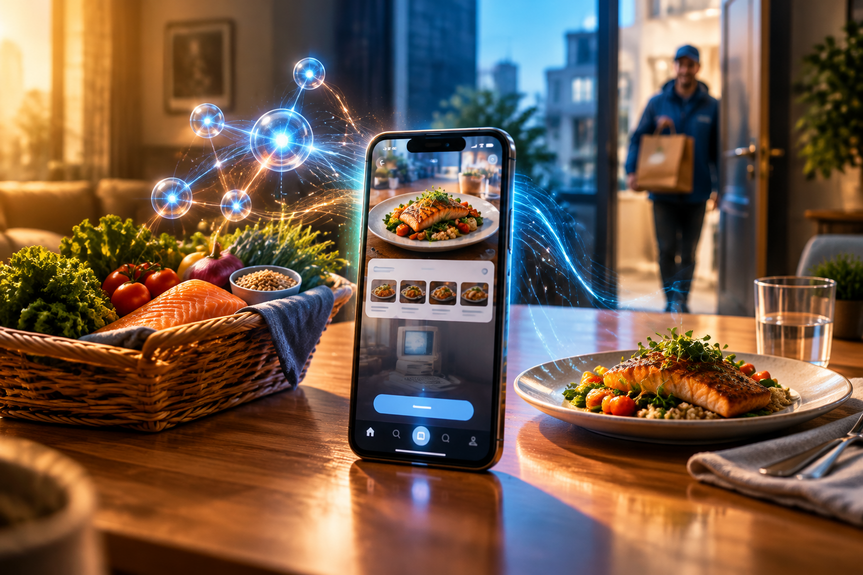
 AI-generated
AI News
05 Nov 2026
Read 9 min
AI Agents for DoorDash Food Ordering: Why Usage Is Low
AI agents for DoorDash food ordering remain rare, but new connectors could soon change the picture.
AI agents for DoorDash food ordering have generated only several hundred orders, according to CEO Tony Xu. Limited access to a new connector helps explain the small total. But Xu also points to a simpler reason: when people want food, they tend to go straight to DoorDash.
Key takeaways
- Tony Xu said outside AI agents had generated several hundred DoorDash orders since they began operating.
- DoorDash handled just shy of 1 billion total orders in the third quarter of 2026.
- DoorDash’s Model Context Protocol connector remains limited to a small number of early beta partners.
- DoorDash’s internal Ask DoorDash feature is separate from the third-party agent orders Xu discussed.
Why are AI agents for DoorDash food ordering seeing low use?
Early access limits and customers’ preference for ordering directly help explain the low use. During a third-quarter earnings call Thursday, DoorDash co-founder and CEO Tony Xu described outside agent ordering as a “very low use case.”
Xu said “AI agents are generating several hundred orders [on DoorDash] across the time that they’ve been up and running.” That is a tiny number beside the company’s just shy of 1 billion orders in the third quarter of 2026 alone.
The figures cover different periods, so they do not establish an exact quarterly market share. Still, they show that outside agents account for very little of DoorDash’s ordering activity so far.
Xu drew a line between tasks that need research and tasks people can finish quickly. He sees promise in agents handling “long consideration purchases” and “doing work on your behalf proactively in the background.”
Food ordering appears different. As Xu put it, “when it comes to a task that’s as simple as ordering food, we tend to see that come directly to DoorDash.”
Limited connector access makes this an early test
DoorDash’s main connection for outside AI tools was still new and restricted when Xu discussed the results.
The company had rolled out its Model Context Protocol, or MCP, connector less than a month earlier. This open-standard connection gives third-party AI tools a more direct way to order through DoorDash.
Access, however, was available only to a small number of “early beta partners.” Its main use was streamlining corporate lunch orders, rather than serving a broad consumer audience.
Without that connector, an outside agent may need to work through DoorDash’s web interface. That adds steps compared with using a direct connection.
These limits matter when judging AI agents for DoorDash food ordering. Several hundred orders show little activity, but a restricted beta cannot tell us how a widely available service would perform.
The test also fits a broader shift in how AI agents are reshaping the web: software may increasingly act for users instead of simply showing them information. DoorDash’s early results show that access alone does not guarantee demand.
Ask DoorDash shows a different use for AI
DoorDash’s own AI feature helps customers build orders inside its service, rather than sending them through an outside agent.
The company rolled out Ask DoorDash this summer. It can build a shopping cart from a recipe photograph or suggest an order from a request such as “dinner for a family of four.” These uses address the work of choosing items, not just placing an order.
DoorDash said last month that Ask DoorDash produced the following results:
- Baskets were built “five times faster” than baskets created without the feature.
- Orders averaged nearly 50% higher basket value than the same consumers’ traditional orders.
- Orders included about 60% more unique items than those consumers’ traditional orders.
- Nearly half of orders went to local spots the consumer had never tried before.
Those are company-reported results, not detailed adoption figures. DoorDash has not shared enough usage data to show how widely customers use the feature. Larger baskets also do not, by themselves, prove that shoppers save money or feel more satisfied.
Still, the distinction is important: low use of outside agents does not mean customers reject every AI shopping tool.
What would make outside agents more useful?
Outside agents would need to offer a clear benefit over ordering directly, such as reducing the effort involved in planning a group meal.
For someone who already knows which restaurant and meal they want, an extra AI tool may offer little value. For a corporate lunch with several people’s preferences to consider, the same tool may have more work to take off the organizer’s hands.
The outlook for AI agents for DoorDash food ordering therefore depends on more than wider access. It also depends on whether agents solve a problem customers actually have.
Early numbers need not decide the outcome. Pizza Hut’s online ordering experiments began in 1994, long before online purchases accounted for more than half of its orders. That history shows habits can change, but it does not prove AI ordering will follow the same path.
Xu’s position leaves room for both possibilities: “My take on all things technology is you never want to fight gravity,” he said. “But at the same time, you don’t want to be delusional.”
For readers, AI agents for DoorDash food ordering remain an early option rather than an established shortcut. Ordering directly may still be the simplest route, while AI tools may prove more useful when you need help deciding what to buy or organizing a larger order.
For more news: Click Here
FAQ
Keep reading, keep building
Three things from our own workshop that fit this topic:
- Diktly Free is our dictation app for Mac: speech becomes text entirely on your own machine, nothing goes to the cloud. Free version, Basic 14.99 €.
- 1000+ Prompts to Level Up Your Life is our most downloaded pack. Pay what you want, including 0.
- OpenAI Agent Mode for Beginners walks you through letting AI agents handle tasks for you. 19.99 $.
Our own products. Tech Moments is our newsletter on AI and tech in plain language, one email, no noise. Subscribe below.
Contents