 AI-generated
AI News
12 Nov 2026
Read 12 min
AI Data Center Power Demand: Why Communities Push Back
AI data center power demand drives local resistance over grid strain, pollution, and rising costs.
AI data center power demand is driving community opposition because large facilities need vast amounts of electricity, new infrastructure, and sometimes their own power plants. Residents worry about utility costs, air pollution, and decisions made without their input. The dispute is not just about distrust of technology; it is about living beside it.
Key takeaways
- Virginia’s Data Center Alley shows how electricity demand can shape local opposition to technology infrastructure.
- Grid-connected data centers raise questions about who pays for new transmission lines.
- Onsite natural-gas turbines reduce reliance on utilities but still create pollution concerns for nearby communities.
- Larger AI facilities can require power supplies on the scale of major industrial sites.
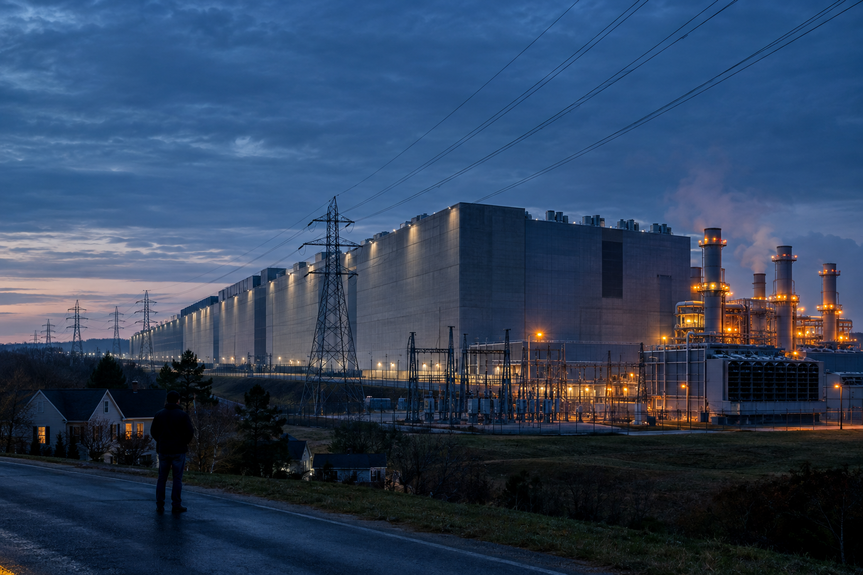
In Ashburn, Virginia, huge buildings bearing names such as Skybox and CloudHQ line major roads. This area, known as Data Center Alley, is the world’s largest data center hub. It also offers an early view of the tensions spreading as companies build larger facilities for artificial intelligence.
Technology leaders sometimes describe the backlash as a sign of wider anxiety. But the reporting in MIT Technology Review points to a more direct cause: electricity has physical costs that public relations cannot remove.
Why does AI data center power demand trigger opposition?
Large electricity needs affect nearby residents through infrastructure costs, pollution concerns, and pressure on the local grid.
OpenAI’s chief global affairs officer, Chris Lehane, wrote after the midterms that data centers “have become a proxy for public unease about affordability, corporate power, and people losing control over their futures.” That view treats opposition as part of a broader political conflict.
Virginia activist Elena Schlossberg sees the issue differently. She told MIT Technology Review that she is “always banging my head against the wall” when the industry presents the dispute as a culture war. “It was always about power,” she said, meaning electricity.
Both explanations can hold some truth. People may distrust large technology companies while also raising specific concerns about transmission lines or generator emissions. Treating those concerns only as public unease risks overlooking problems that developers must actually solve.
How do grid-connected data centers affect their neighbors?
Grid-connected facilities draw electricity from utility networks, creating questions about capacity, expansion costs, and power generation.
At an Equinix facility visited for the source report, Dominion Energy supplies electricity while large diesel generators provide backup. Much of Dominion’s electricity comes from natural gas. The source describes gas as cleaner than coal or oil, but less clean than renewable energy.
The average operating data center in this part of Virginia has a power capacity of 54 megawatts. The report compares that capacity with a power draw greater than Denver International Airport’s. Capacity is not the same as constant consumption, but it shows the scale utilities must plan around.
Who pays for grid expansion?
According to the report, protests helped bring new state rules requiring data centers to cover the full cost of new transmission lines rather than spread those costs among other customers.
Developers also said they were preparing for possible rules that would cut facilities off from grid power during peak demand. That creates another concern: if grid electricity becomes unavailable, operators may rely more heavily on diesel backup generators.
Schlossberg also worries that Dominion could expand fossil-fuel generation to meet rising demand rather than meet it with renewables. These are practical questions about utility decisions, not simply attitudes toward AI.
Why are larger AI facilities bringing their own power?
Some developers are planning onsite generation because nearby grids cannot provide the electricity their projects require.
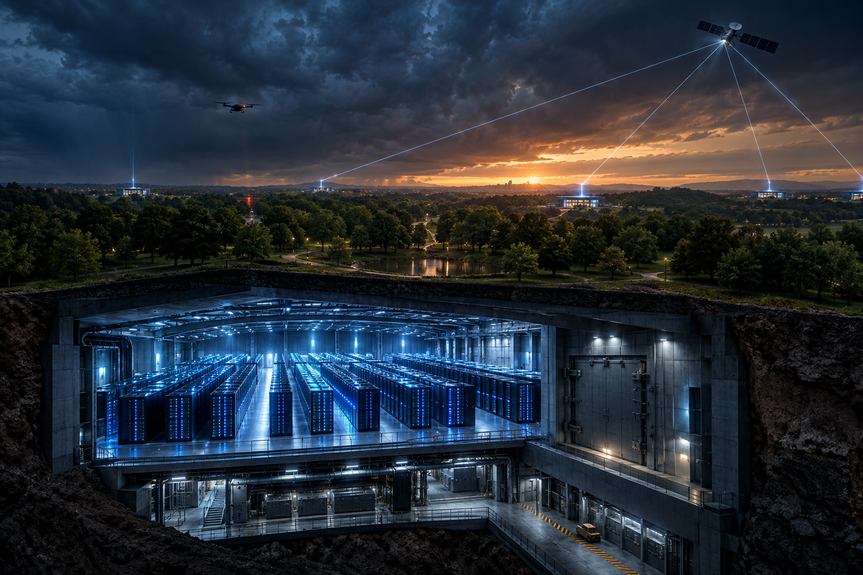
The source describes a shift toward large rural sites with little existing grid infrastructure. Companies can bring natural-gas turbines to these locations and generate electricity “behind the meter,” rather than obtain all their power through a utility. Diesel generators can still serve as backup.
Anthropic, for example, reportedly agreed to pay $3.4 billion for gas turbines. The source describes the deal as the largest power generation purchase by an AI company.
AI data center power demand also changes the search for suitable land. One developer told the publication that he was considering a former steel mill already equipped to draw 300 megawatts from the grid.
How large could these projects become?
The report describes 300 megawatts as the lower end of the facilities attractive for AI training, while placing larger ambitions around 6,000 megawatts. These figures describe the development model discussed in the source, not a minimum requirement for every AI facility.
For perspective, the report compares 6,000 megawatts with Chicago’s estimated power draw. A project at that scale is not merely another warehouse. Its electricity supply becomes a major development in its own right.
Does onsite generation solve the community problem?
Onsite generation can reduce dependence on the grid, but it does not remove the effects of producing electricity.
Natural-gas turbines release air pollutants. Diesel generators add further pollution concerns when they operate. A facility that supplies its own electricity may therefore avoid one dispute over utility capacity while creating another over local air quality.
The source also highlights a question of public oversight. Communities have traditionally expected a say when utilities build large power infrastructure. Private technology companies are now pursuing projects of comparable scale, making local participation just as important.
Developers can offer tax revenue, local hiring, and stronger community involvement. Those benefits matter, but they do not cancel out every drawback. Residents still have to weigh the value of a project against the buildings and power equipment it brings.
Where could developers build next?
Developers may favor places with available fuel infrastructure, sparse populations, or fewer obstacles to construction.
The report identifies the Permian Basin as one possible destination because developers could connect to natural-gas lines there. Overseas projects offer another route. It also reports that Google announced $15 billion in data center investment in Malaysia.
For developers, electricity availability can matter even more than public opposition. Moving a project may change who lives near it, but it does not eliminate its energy needs.
That is why AI data center power demand will remain central even if companies improve their public image. Better communication can explain a project; it cannot supply the electricity needed to run it.
Our take
The important change is that some AI developers are becoming large power producers as well as electricity customers. Earlier growth in Virginia largely relied on utility connections; the newer model described in the report pairs much larger facilities with onsite generation.
In our view, this shifts what communities should ask. Companies and developers must explain both computing plans and power plans. Consumers need clarity about which costs stay with operators. For readers in Germany and the EU, the US experience offers questions to apply locally, not proof that identical conditions exist at home.
One open question is whether operators could schedule more computing work around electricity availability and reduce some infrastructure pressure. The source does not establish how practical that would be.
In the coming weeks, watch whether elected officials turn campaign positions into rules, how developers respond to possible peak-demand restrictions, and whether community agreements address power supply rather than benefits alone.
For readers weighing a nearby project, AI data center power demand is a useful starting point: ask where electricity will come from, who pays, and what happens during shortages. The strongest proposals will need clear answers about both community benefits and the physical costs of supplying power.
For more news: Click Here
FAQ
Keep reading, keep building
Three things from our own workshop that fit this topic:
- Diktly Free is our dictation app for Mac: speech becomes text entirely on your own machine, nothing goes to the cloud. Free version, Basic 14.99 €.
- 1000+ Prompts to Level Up Your Life is our most downloaded pack. Pay what you want, including 0.
- OpenAI Agent Mode for Beginners walks you through letting AI agents handle tasks for you. 19.99 $.
Our own products. Tech Moments is our newsletter on AI and tech in plain language, one email, no noise. Subscribe below.
Contents