
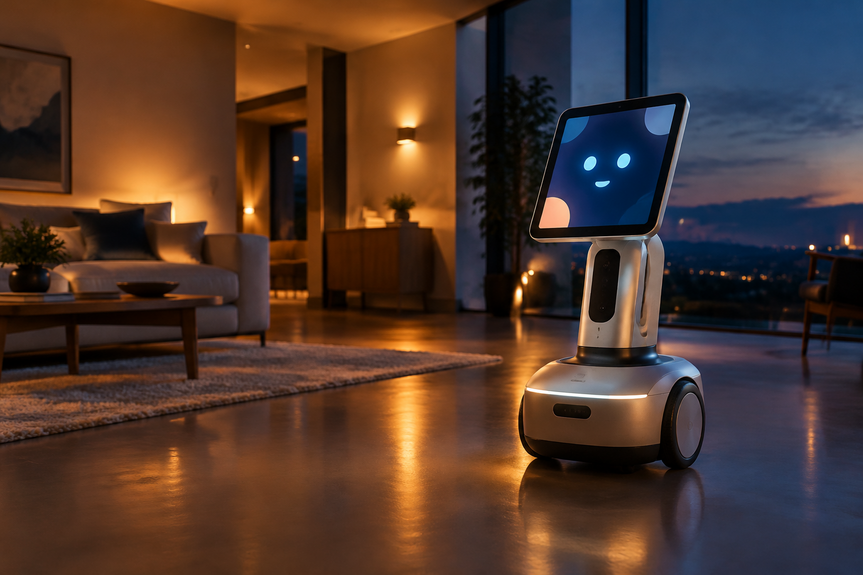
 AI-generated
AI News
10 Nov 2026
Read 11 min
Apple AI home robot features and price: Is it worth it?
Apple AI home robot features and price: Explore its features, likely cost, and real value at home.
Apple AI home robot features and price reports point to a device that could roam around homes, support FaceTime calls, and control lights. With a possible price of $1,000 or more and a launch targeted for 2027, the question is whether those conveniences would justify buying another smart home device.
Key takeaways
- Apple’s reported home robot project carries the code name J595 and could launch as HomeView Ultra.
- The Information reports a possible price of $1,000 or more and a launch target of 2027.
- Reported functions include FaceTime calls, autonomous movement, and switching on lights when someone enters a room.
- Development delays could push the robot’s arrival to 2028.
The project reflects Apple’s reported interest in bringing AI into a device that moves through the home. But movement alone does not create value. For buyers, the test is simple: would this robot solve a daily problem better than devices they already own?
What do Apple AI home robot features and price reports reveal?
The reports describe a limited-purpose home robot rather than a machine that performs physical household chores. According to The Information, people who worked on Apple’s robotics projects say the AI-driven device could combine mobile video calls with basic smart home controls.
The project is code-named J595. HomeView Ultra is a possible product name, reportedly connecting it with Apple’s HomeView stationary smart display. Neither the suggested name nor the price should be treated as a confirmed retail announcement.
A moving platform for FaceTime
FaceTime appears to be one of the robot’s main uses. Unlike a stationary screen, the reported device would move around the home while supporting calls.
That could make its screen available in different rooms without someone carrying it. However, the source does not explain how it would choose where to go, handle obstacles, or behave when several people are nearby. Those details matter because useful mobility must also be predictable.
Lights and small household interactions
The robot could reportedly turn on lights when a person enters a room. The source also describes the possibility of it telling the family cat to get off the dining table.
These features suggest a device built around sensing, communication, and control rather than physical work. Talking to a pet is very different from picking up an object, loading a machine, or folding clothes.
When could Apple launch the robot, and what might it cost?
Apple is reportedly aiming for a 2027 launch with a possible price of $1,000 or more, although delays could move the release to 2028. These are reported targets, not firm buying dates or a final price.
The timing matters because the device has already spent years in development. Its earliest prototypes appeared in 2018, and former Apple CEO Tim Cook approved continued work, according to the source.
Buyers should therefore separate three things: what engineers have explored, what Apple hopes to ship, and what a finished product would actually offer. A long development period does not guarantee that every reported feature will reach customers.
For anyone tracking Apple AI home robot features and price, the missing piece is a clear account of what the purchase would include. The report does not establish a final feature list, regional availability, or any ongoing costs.
Why is Apple still developing a home robot?
Apple is reportedly continuing the project with backing from John Ternus, whom the source identifies as its new CEO. His support extends to both the roaming home robot and a separate effort involving physical household tasks.
Engineers have spent years improving the software and adding AI technologies. Yet the source describes a central challenge: giving the roaming robot enough useful abilities to make it more than a “fancy way to make FaceTime calls.”
A large software team supports a small robotics team
One source cited by The Information describes about 10 “true roboticists” working at Apple, compared with approximately 300 people on the software side. Many members of the original engineering team have reportedly left over the years.
Those figures suggest a strong software focus, but they do not establish the project’s chances of success. A mobile home device needs both capable software and dependable physical behavior. Calls and light controls would lose their appeal if movement became a source of frustration.
Would the reported features justify spending more than $1,000?
The reported features do not yet make a clear case for a price above $1,000. Their value depends on whether combining movement, calls, and home controls creates a benefit that separate devices cannot provide as easily.
A robot vacuum offers a straightforward result: it cleans floors. Apple’s reported device has a less direct purpose. Its main promise appears to be convenience, which buyers may find harder to measure against a high purchase price.
Before deciding whether such a product is worth buying, readers should look for answers to these questions:
- Does movement make video calls meaningfully easier than using a phone, tablet, or stationary display?
- Does the robot improve lighting control enough to justify its role in the home?
- Can it move reliably without requiring frequent help?
- Does it offer useful daily tasks beyond the features already reported?
These are buying criteria, not confirmed shortcomings. Apple could demonstrate a stronger case later, but the current report leaves that case unfinished.
Is Apple also working on robots that fold clothes?
Apple is reportedly exploring a separate robotics project for household tasks such as folding clothes. Ternus is said to support that work as well.
Folding clothes would presumably require arms or other parts that can grasp and move objects. That makes it a different technical challenge from moving a screen around a room.
The source does not establish whether Apple intends to build a general-purpose humanoid robot like those pursued by robotics startups 1X and Figure AI. Readers should not assume the roaming HomeView Ultra concept would gain those physical abilities.
A limited-purpose robot also presents a more manageable starting point from a technical and safety standpoint. A machine that manipulates objects near people brings risks beyond those of a mobile display, although any roaming device still needs safe, reliable movement.
Our take
The reported robot needs a clearer everyday purpose before its proposed price looks persuasive. What is new is not the underlying effort, which dates to prototypes in 2018, but the reported backing from Ternus and the possible HomeView Ultra identity.
For Apple, the challenge is turning years of development into a product people use daily. Smart home companies and developers should watch whether Apple defines a useful role for outside devices and software; the report does not establish one. Consumers, including readers in Germany and the EU, still lack confirmed regional availability and pricing.
One open question is how household members would control a mobile device when they want privacy or quiet. That could affect acceptance as much as its headline features. In the coming weeks, watch for official confirmation, demonstrations of autonomous movement, and a clearer distinction between the roaming display and the separate household-task project. Until then, strong buying recommendations would be premature.
Apple AI home robot features and price reports give readers a reason to watch, not yet a reason to buy. At $1,000 or more, the device would need to prove that moving calls and home controls around the house offers lasting value beyond the novelty.
For more news: Click Here
FAQ
Keep reading, keep building
Three things from our own workshop that fit this topic:
- Diktly Free is our dictation app for Mac: speech becomes text entirely on your own machine, nothing goes to the cloud. Free version, Basic 14.99 €.
- 1000+ Prompts to Level Up Your Life is our most downloaded pack. Pay what you want, including 0.
- OpenAI Agent Mode for Beginners walks you through letting AI agents handle tasks for you. 19.99 $.
Our own products. Tech Moments is our newsletter on AI and tech in plain language, one email, no noise. Subscribe below.
Contents