
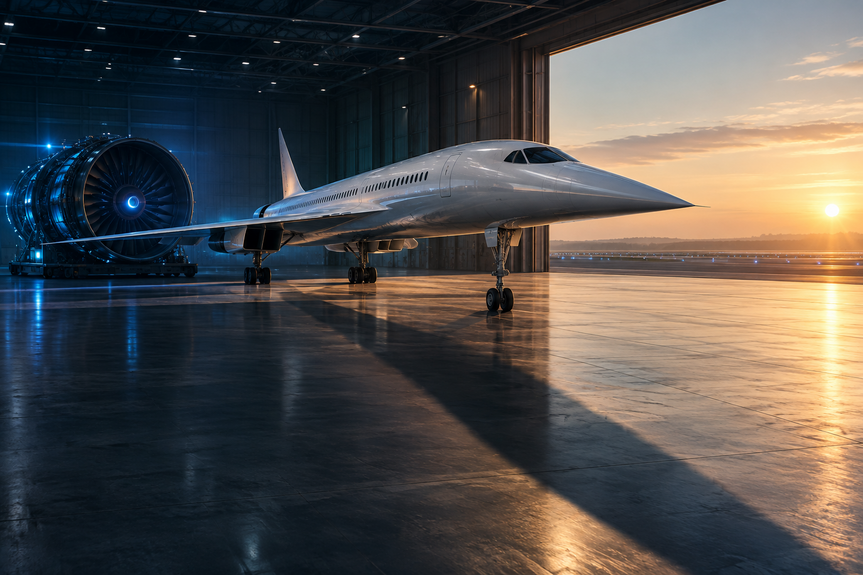
 AI-generated
AI News
08 Nov 2026
Read 11 min
Boom Supersonic Overture Delivery Delay: What to Know
Boom Supersonic Overture delivery delay casts doubt on 2029 plans; see the hurdles facing its jet.
The Boom Supersonic Overture delivery delay is a growing concern, not a confirmed revised schedule. United Airlines CEO Scott Kirby says the company’s 2029 target will not happen. Meanwhile, Boom is pursuing gas turbines for AI data centers after losing a major deal, putting both ventures’ delivery promises under scrutiny.
Key takeaways
- United Airlines CEO Scott Kirby says Boom’s official 2029 Overture timeline will take longer.
- Boom plans to deliver its first Superpower gas turbines to AI data center customers in mid-2027.
- Crusoe’s planned $1.25 billion purchase of 29 Boom gas turbines has fallen through.
- Boom plans to fire its Sprint Core prototype turbine for the first time before Thanksgiving.
What does the Boom Supersonic Overture delivery delay mean?
The delivery concern means travelers should treat 2029 as Boom’s stated goal, not a firm date for booking supersonic flights.
During an Office Hours: Business Edition podcast interview that appeared on October 28, 2026, Kirby directly challenged that goal. “‘29 is their official timeline,” he told host Monica Langley. “It’s not going to happen in ‘29—it’s going to take longer.”
Boom’s earlier press releases described achieving aircraft certification and carrying its first paying customers by 2029. Kirby did not offer a replacement date, and the source reports no revised company schedule.
His comments matter because United Airlines is one of Boom’s first customers. This is not simply an outside critic questioning the project. An airline that has backed Overture is warning that the wait could extend beyond Boom’s public target.
Why is United Airlines questioning the 2029 target?
Kirby says Boom still faces major development and certification hurdles before Overture can carry passengers.
He praised CEO Blake Scholl and the company, but said Boom has “a lot of hurdles to overcome.” He added that “it’s not a guarantee that they’ll overcome” them. That warning followed his March assessment that Overture’s chances of entering commercial service were “50-50.”
The Boom Supersonic Overture delivery delay debate therefore involves more than timing. Kirby is also questioning whether the company can complete the steps needed to launch an airline-ready aircraft.
Airline agreements do not guarantee delivery
American Airlines, Japan Airlines, and United Airlines have conditional agreements involving non-refundable deposits of undisclosed amounts. Those agreements would allow the airlines to fully purchase Overture once it becomes commercially available.
They show customer interest, but they are not proof that certification or delivery will happen on schedule. For passengers, the distinction is simple: airline backing does not yet mean a flight is available to book.
What has Boom proved with its supersonic flight tests?
Boom has demonstrated its “boomless cruise” concept with the XB-1 demonstrator, but those flights do not establish that Overture is ready for commercial service.
XB-1 flew in 2024 and 2025 as part of Boom’s effort to demonstrate the concept. It uses a phenomenon called Mach cutoff. Under specific atmospheric conditions, an aircraft flies just beyond supersonic speed at higher altitude, causing its shockwaves to bend upward and reducing their impact on the ground.
The conditions matter. The demonstration does not mean every supersonic flight can avoid a ground-level sonic boom.
NASA is testing a different approach
NASA has separately conducted test flights with its experimental X-59 since October 2025. Its long, needle-like nose is designed to reduce sonic booms. That aircraft uses a different approach from Boom’s Mach cutoff flights, so progress on one project should not be treated as proof of the other.
Do regulatory support and a completed factory settle the timeline?
Regulatory support and a completed factory help Boom’s plans, but neither removes the need to develop and certify Overture.
In June 2026, the Federal Aviation Administration proposed a rule overturning the long-standing ban on commercial supersonic flights over the United States. The proposal followed an executive order from President Donald Trump. A proposed change to flight restrictions is separate from approval of a particular aircraft.
Boom also completed its Overture factory in 2024 at Piedmont Triad International Airport in Greensboro, North Carolina. According to the source, the facility has mostly sat dormant since then.
North Carolina state leaders have raised questions because more than $50 million in taxpayer funding helped build it. The Boom Supersonic Overture delivery delay concern therefore affects public stakeholders as well as airlines and future passengers.
Why is Boom making turbines for AI data centers?
Boom is developing natural gas turbines for AI data centers as an additional revenue stream alongside its aircraft business.
On October 22, the company presented its Superpower factory in Centennial, Colorado. The facility will produce a 42-megawatt natural gas turbine. US Secretary of Energy Chris Wright and Colorado Governor Jared Polis attended the event.
Scholl declared that “it’s time for a renaissance in energy and in supersonic flight.” Boom said the factory was already making turbine parts while construction continued.
The company’s production targets are:
- Deliver the first Superpower gas turbines to AI data center customers in mid-2027.
- Reach annual production of 25 turbines in 2028.
- Increase annual production to 50 turbines by 2029.
The move follows growing interest in natural gas among data center developers seeking power. Market intelligence platform Cleanview describes projects using mobile gas generators on semitrucks and turbines originally designed for aircraft and warships.
How does the lost Crusoe deal affect Boom’s energy plans?
The lost Crusoe agreement removes a large early purchase commitment from Boom’s gas turbine business.
In a September 25 post on X, Scholl acknowledged that the $1.25 billion deal for 29 turbines had fallen through. Crusoe has been involved in Texas data centers for Oracle, Google and Microsoft, using power sources that include natural gas and renewables.
Scholl said Boom “will be delivering about 250MW of Superpowers next year to other sites.” He did not identify the customers. That leaves readers unable to assess those replacement deliveries from the information provided.
Boom says the energy and aviation projects share technology. Its completed Sprint Core prototype is intended to eventually power both Superpower and Symphony, the engine planned for Overture. Testing is scheduled at the Colorado Air & Space Port, with the first firing planned before Thanksgiving.
Our take
Our assessment is that Boom’s next test results matter more than another ambitious delivery promise. The new development is the combination of Kirby’s firm rejection of the 2029 timing, a newly presented turbine factory, and the loss of Crusoe’s purchase deal. Earlier flight demonstrations remain useful progress, but they do not settle either venture’s delivery schedule.
Airlines face uncertainty over future fleet plans. Data center developers need confidence in turbine delivery, while North Carolina stakeholders have public funding at stake. For consumers and readers in Germany and the EU, this report offers no confirmed local routes, turbine customers, or service dates.
One open question is whether shared turbine technology will save enough work to offset the demands of pursuing two markets at once. The source does not establish that balance. In the coming weeks, watch for the planned Sprint Core firing before Thanksgiving, reported test results, and named customers supporting the energy business.
The Boom Supersonic Overture delivery delay concern means readers should separate company targets from confirmed readiness. Until Boom provides stronger evidence on certification, testing, and customer deliveries, neither a 2029 passenger launch nor its turbine rollout should be treated as assured.
For more news: Click Here
FAQ
Keep reading, keep building
Three things from our own workshop that fit this topic:
- Diktly Free is our dictation app for Mac: speech becomes text entirely on your own machine, nothing goes to the cloud. Free version, Basic 14.99 €.
- 1000+ Prompts to Level Up Your Life is our most downloaded pack. Pay what you want, including 0.
- OpenAI Agent Mode for Beginners walks you through letting AI agents handle tasks for you. 19.99 $.
Our own products. Tech Moments is our newsletter on AI and tech in plain language, one email, no noise. Subscribe below.
Contents