
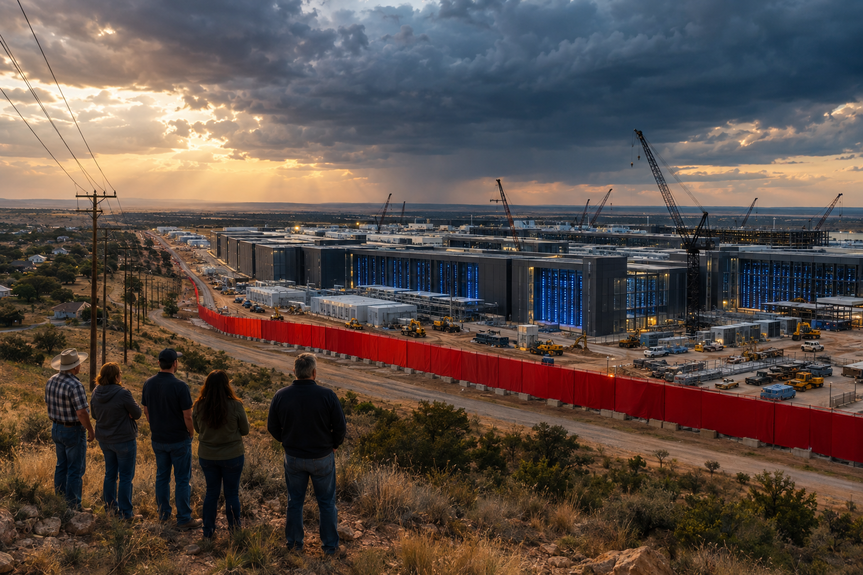
 AI-generated
AI News
08 Nov 2026
Read 12 min
Texas data center moratorium impact and what comes next
Texas data center moratorium impact could stall AI projects and reshape power costs across the state.
The Texas data center moratorium impact could reach far beyond construction sites. According to the supplied report, Democratic election wins have raised the prospect of restrictions on America’s fastest-growing data center market. Developers face uncertainty over permits, Big Tech faces possible delays, and households want protection from higher electricity bills.
Key takeaways
- The report says Gina Hinojosa campaigned for a data center moratorium before winning the Texas governor’s race.
- Greg Abbott directed a state regulator to halt data center permits on September 21, according to the report.
- Texas projects include Stargate Frontier at a projected 1,820 megawatts and Nexus Hubbard at a planned 6,400 megawatts.
- State leaders, local officials, and construction unions could shape whether proposed restrictions become lasting policy.
Why has Texas become a political battleground for data centers?
Texas has become a battleground because its rapid data center growth now faces voter concerns about electricity bills and further development.
The supplied report describes a sharp political shift. Democrat James Talarico defeated Ken Paxton for a US Senate seat. Gina Hinojosa defeated Republican incumbent Greg Abbott for governor. Democrats also won control of the Texas House for the first time in 24 years.
Talarico and Hinojosa made data centers a central campaign issue. Their wins suggest that developers can no longer assume state leaders will welcome every large project. However, election results alone do not establish which restrictions will take effect or which facilities they will cover.
The backlash also extends beyond Texas. The report says voters nationwide supported protections against data-center-related electricity bill increases and, in some cases, broader bans. Big Tech’s promises of better health care, cheaper goods, and scientific advances have not settled those immediate concerns.
What could the Texas data center moratorium impact include?
The Texas data center moratorium impact could include delayed permits, slower construction, and fewer new projects, depending on the final rules.
A permit halt and a broad development moratorium are not necessarily the same thing. Their effects depend on which approvals stop, which projects need those approvals, and whether existing developments receive exceptions. The supplied account does not provide that level of detail.
Existing projects face uncertainty rather than a confirmed shutdown
At the DCD conference in Ashburn, Virginia, on Tuesday, industry panelists expected that existing projects might slow and new ones could stop altogether. Those were expectations, not proof that every construction site would close.
Developers therefore face an immediate planning problem. A project may have a large announced capacity, but that figure does not establish when it will operate. Readers should distinguish planned capacity from capacity already serving customers.
New projects may face a harder path
Hinojosa supported data center tax breaks in 2023 to encourage construction jobs. During her campaign, she shifted toward a full-fledged moratorium. That change puts future proposals at risk, but the source does not establish the scope or timing of a final policy.
Why did developers become concerned before the election?
Developers became concerned because Abbott’s administration had already changed its approach before voters chose new leaders.
Panelists at the DCD conference said Texas had been the easiest place to build for years, until September. Developers reported that the governor’s office had stopped answering their emails.
More significantly, the report says Abbott directed a key state regulator to halt data center permits on September 21. It does not name the regulator or provide the directive’s text. That leaves important questions about its reach unanswered.
This matters because the political risk did not begin with Democratic victories. A Republican governor had already moved toward restrictions. Developers looking for a quick return to the previous approach may therefore face opposition across party lines.
Which major AI projects could be affected?
Stargate Frontier and Nexus Hubbard show how much planned AI capacity could face uncertainty in Texas.
The Stargate Frontier data center in Shackelford County has a projected capacity of 1,820 megawatts, according to the report. That is more than twice the capacity of the largest data center currently operating in Texas.
Nexus Hubbard, also under construction, has a planned capacity of 6,400 megawatts. The report says it is intended mostly to serve Anthropic and ranks as the second-largest data center being built in the US, behind Meta’s Hyperion project in Louisiana.
These figures describe the scale of the plans, not confirmed operating capacity. They also do not prove that either project will be stopped. The key issue is whether future restrictions cover their remaining approvals or construction stages.
For Big Tech, delays could disrupt the schedule for bringing new AI training facilities online. For developers and construction workers, the same delays could put expected work on hold.
How could restrictions affect financing and electricity bills?
Restrictions could make project financing harder while addressing voter demands to protect household electricity bills.
The report says banks and lenders are already becoming more selective about data center projects. Uncertain approval schedules add another issue for them to weigh. The Texas data center moratorium impact could therefore begin before a final ban exists, as developers and lenders reassess plans.
Readers following this side of the market can also explore AI data center financing risks at Riot Platforms. Financing risk is a separate question from whether demand for AI remains strong.
For households, the concern is more direct: who pays for the electricity demands of large facilities? Voters supported measures to protect ratepayers, according to the report. Still, the source provides no estimate of how much a Texas moratorium would change household bills.
Can state leaders impose restrictions without local resistance?
State leaders could face resistance because development decisions involve state offices, county officials, and city governments.
The county-level election results do not show a single statewide pattern. Dallas County and nearby counties voted Democratic, but Ellis County backed Abbott and Paxton despite leading in data center permitting requests.
Cameron County, another data center hot spot, shifted blue. Mitchell County and Scurry County, where several west Texas projects are located, voted Republican.
Those results do not prove why individual voters chose a candidate. They do show why it would be misleading to treat every data center community as supportive of a moratorium.
Local officials may resist state restrictions on projects they support. Construction unions that backed Democratic campaigns may also oppose policies that threaten jobs. Winning an election gives leaders influence, but it does not remove these competing interests.
Our take
The main change is that campaign opposition may now turn into governing decisions, although the outcome remains unclear. Abbott’s September action had already unsettled developers; the reported Democratic victories add pressure for broader restrictions.
Big Tech companies, Anthropic-linked development plans, builders, and lenders face the clearest direct exposure. Consumers want bill protection, but the source does not show whether a moratorium would deliver measurable savings. For readers in Germany and the EU, this is a development to watch in US AI infrastructure, not evidence that their own services or prices will change.
One open question is whether projects could move elsewhere rather than disappear. That could shift the location of construction without ending the wider buildout. In the coming weeks, watch for the scope of proposed restrictions, treatment of existing projects, responses from local officials, and any agreement with construction unions. Those details will matter more than campaign language.
The Texas data center moratorium impact will depend on enforceable rules, not election headlines alone. Readers should watch permit decisions and project-specific announcements before assuming either a statewide shutdown or a return to unrestricted growth.
For more news: Click Here
FAQ
Keep reading, keep building
Three things from our own workshop that fit this topic:
- Diktly Free is our dictation app for Mac: speech becomes text entirely on your own machine, nothing goes to the cloud. Free version, Basic 14.99 €.
- 1000+ Prompts to Level Up Your Life is our most downloaded pack. Pay what you want, including 0.
- OpenAI Agent Mode for Beginners walks you through letting AI agents handle tasks for you. 19.99 $.
Our own products. Tech Moments is our newsletter on AI and tech in plain language, one email, no noise. Subscribe below.
Contents