AI News
02 Nov 2025
Read 17 min
FTC crackdown on AI detectors — How to protect content *
FTC crackdown on AI detectors forces clear evidence rules so creators can trust and protect content.
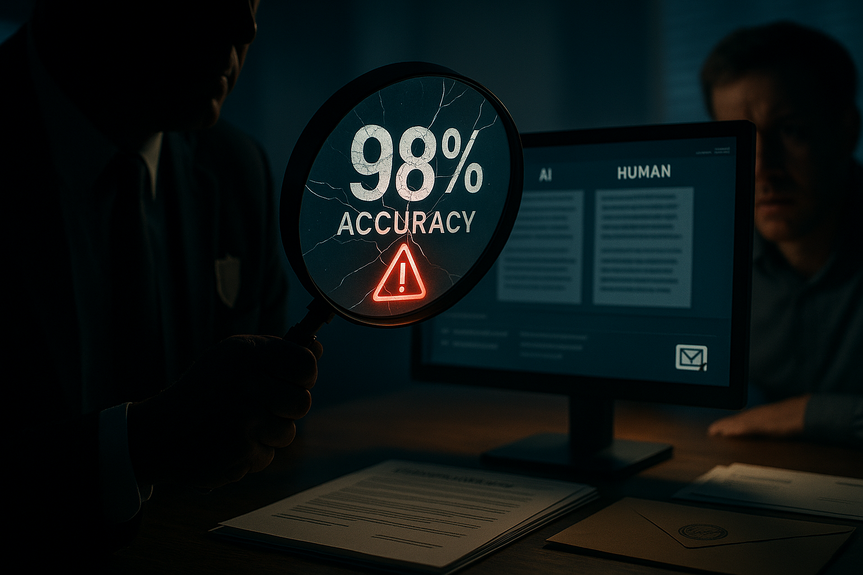
The FTC crackdown on AI detectors is a warning to vendors and a guide for users. After an enforcement order against a tool that claimed 98% accuracy but trained mostly on academic writing, the message is clear: demand proof before you trust a score. Learn how to vet tools and protect your content with layers that work.
As AI grows in daily life, it becomes harder to tell what is real. Many tools claim they can detect AI text with high accuracy. Some tools promise near-perfect results. The Federal Trade Commission now says: show evidence or stop saying it. In a recent case, the Commission finalized an order against Workado, maker of a detector first sold on Content at Scale, now known as Brandwell. The agency said the company’s claim was misleading. The tool was trained on a narrow set of academic writing, yet it was marketed as accurate across content types. That gap matters to students, writers, editors, and brands who can be harmed by a wrong call. This article explains what the action means, why detectors fail, and how you can protect your work.
What the FTC crackdown on AI detectors means right now
The Workado/Brandwell case in brief
- The company claimed its tool could tell human from AI content with 98% accuracy.
- The FTC said the training data focused on academic writing, not the wide range of real-world text.
- The Commission found the claims misleading because evidence did not match the promise.
- Under the order, the firm must stop making unsupported claims, keep records to back future claims, notify eligible customers, and file compliance reports for three years.
- This is part of a broader push by the Commission to police AI marketing claims.
Why many AI detectors get it wrong
Training gaps and bias
Detectors learn from examples. If a model trains mostly on academic papers, it may not handle blogs, news, marketing copy, or social posts. That mismatch creates bias. The detector might flag clear, simple language as “AI” or miss polished AI text that mimics a casual voice.False positives and false negatives
Every tool faces two errors:- False positives: Human writing gets flagged as AI. This can lead to unfair grades, lost jobs, or damaged reputations.
- False negatives: AI writing looks human to the tool. This gives a false sense of safety and weakens policy enforcement.
Concept drift and fast-changing models
AI models evolve fast. New versions can beat old detectors. This is called concept drift. A detector that seemed strong last month can fall behind when writers use new tools or simple tricks like paraphrasing and mixed prompts.Binary labels hide uncertainty
Real detection is probabilistic. A score should show uncertainty and explain factors. A simple “AI or human” label hides risk. Good tools present confidence ranges, not just a final verdict.Style overlap is normal
Clear grammar, short sentences, and common phrases occur in human and AI text. Many detectors look for these patterns. When many humans write with tools like spell-check or templates, detectors can confuse tidy human text with AI output.How to choose and test a detector you can trust
Start with a vendor checklist
In light of the FTC crackdown on AI detectors, ask for proof before you buy or deploy. Require the vendor to share:- What datasets trained and tested the tool (size, domains, languages, dates).
- Measured accuracy with separate false positive and false negative rates.
- Results across content types: academic, news, marketing, technical, social, creative.
- Performance by length (short vs long text) and by language variety (dialects, non-native English).
- How often the model is updated and how regressions are tested.
- Who did the evaluation (internal vs independent lab) and when.
Run your own pilot
Do a small test before any high-stakes use:- Gather a balanced set: known human text, known AI text, and mixed text.
- Blind-label the set so your reviewers do not know the source.
- Compare the detector’s scores to the true labels.
- Track false positives by group to check for bias against non-native writers.
- Repeat the test two weeks later to see if results drift.
Use detection as one signal, not the decision
Treat the score like a smoke alarm, not a judge. Combine it with:- Draft history and version control metadata.
- Source notes, outlines, and research links.
- Interviews or short writing samples done in supervised settings.
Mind the base rate
If only a small share of your content is AI-made, even a good tool may flag many innocent texts. This is a base rate problem. Ask what happens when the real share is low. Demand confusion matrices, not just a headline accuracy number.Document the policy
Write clear rules that say:- When detection is used and why.
- Which thresholds trigger review.
- Who can see the score and how privacy is protected.
- How people can contest a result and submit evidence.
Protect your content: practical moves that work
Build a trail of authorship
Keep proof that shows the path from idea to final draft:- Save drafts, timestamps, and comments in your editor.
- Export version history when you share work for review.
- Keep research notes and outlines tied to your name.
- Store these records in a cloud folder you control.
Use content credentials
Content credentials add secure metadata that says who made the file, when, and with which tools. The C2PA standard supports this. Many design and photo apps now include “Content Credentials” or “provenance” features. Turn them on when possible, and keep the signed originals. Note: editing, conversions, or platform uploads may strip metadata. Save a master copy.Watermarks and hidden signals
Some generators add invisible watermarks. Others use tiny changes in wording or punctuation as signals. These can help, but they are not 100% reliable. Watermarks can be lost by copy/paste or rephrasing. Use them as a support layer, not as proof.Voice and style profiles
Writers and brands have a unique voice. Save samples of your voice. Keep a short profile of your tone, common phrases, and structure. If a detector flags you, your style book and past clips help show consistency over time.Human review beats one-click verdicts
Set clear steps for review:- Ask for drafts and notes.
- Have a second reviewer read for voice match.
- If needed, invite a short live writing check with a similar prompt.
Contracts and team rules
If you hire writers or agencies:- State when AI tools are allowed, and when they are not.
- Require disclosure if AI assists, and ask for prompts and drafts.
- Set ownership rules and liability for plagiarism or false claims.
- Include the right to audit samples if problems arise.
Protect sensitive data
Do not paste private data or client secrets into any detector. Many tools run in the cloud and store text. Choose tools with clear privacy terms and data retention limits. For high-risk work, run checks on your own devices or on a private server.For schools, media, and businesses
Fair, transparent policies
Write policies in simple language that students, staff, and freelancers can understand. Share why the policy exists, what signals you use, and how to appeal.Training and guidance
Teach people how to cite AI assistance where allowed. Show examples of acceptable help, like grammar fixes, and banned uses, like submitting full AI drafts as original work.Multiple signals, not one
Use detection scores, drafts, interviews, and peer review. Do not punish based on a single tool result. Keep decisions consistent across teams and time.Accessibility and bias checks
Non-native English writers and people who use assistive tools can get flagged more often. Test your tools for bias and adjust thresholds. Offer alternatives to prove authorship.Governance and logs
Log model versions, thresholds, and changes to policies. If you face a dispute, your logs show diligence. They also help you improve. Policies should reflect the FTC crackdown on AI detectors by requiring evidence for accuracy claims and by banning “magic” marketing numbers without context.If you think a detector got it wrong
Steps to challenge a result
- Ask for the model name, version, and date used.
- Request the score, not just “AI or human.” Ask for the confidence and reasons.
- Share your drafts, timestamps, and research notes.
- Provide earlier samples of your writing to show your voice.
- Request human review by a second person or panel.
Escalate when needed
If a vendor refuses to show evidence for a strong claim, or you see misleading ads, report it. You can submit reports to the Commission or to the Better Business Bureau. Keep screenshots of claims and copies of emails. If you are in a school or workplace, use formal appeal channels first, then escalate with documentation.Marketing claims to distrust
Red flags
- “100% accurate” or “foolproof” detection claims.
- No technical paper, no audits, and no details on training data.
- Single number accuracy with no false positive rate.
- “Works for any language and any text” without proof.
- A hard binary verdict with no explanation or confidence score.
Better signs
- Transparent methods, including datasets and test splits.
- Independent evaluations and recent benchmarks.
- Clear limits, like “not reliable for short texts under 100 words.”
- Privacy-by-design, with local or on-device options.
- Fair-use policies and accessible appeal paths.
Looking ahead: safer detection and stronger content
We will likely see better content credentials built into tools we already use. More platforms will support signed provenance. Detectors may shift from calling out “AI or human” to giving richer risk signals, such as sections likely edited by a model, or evidence that content came from a known template. Policies will also improve. They will reward honest disclosure and focus penalties on intent to deceive, not on the mere presence of tool help. Your best defense today is a layered approach:- Keep version history and notes.
- Add provenance when possible.
- Vet detection tools with your own tests.
- Use scores as signals, not final judgments.
- Write and enforce clear, fair policies.
For more news: Click Here
FAQ
Q: What did the FTC’s action against an AI detector involve?
A: The FTC finalized an order against Workado, maker of an AI content detector sold on Content at Scale (now Brandwell), after finding its claim of 98% accuracy was misleading because the model was trained mainly on academic writing. The action is part of the broader FTC crackdown on AI detectors and underscores the agency’s demand that accuracy claims be supported by reliable evidence.
Q: Why do many AI detectors produce wrong or unreliable results?
A: Detectors trained on narrow datasets like academic papers often don’t generalize to blogs, marketing copy, social posts, or other real-world text, which creates bias and errors. They also generate false positives (flagging human writing) and false negatives (missing AI-written content), can fall behind as models evolve (concept drift), and may hide uncertainty when they return a simple binary label.
Q: What specific requirements did the FTC order place on Workado?
A: The order bars Workado from making unsupported claims about any AI detection product and requires that future claims be non-misleading and backed by reliable evidence, with records kept to substantiate those claims. The company must notify eligible customers by email and file compliance reports one year after the order and annually for the next three years.
Q: How should organizations vet AI detection tools before deployment?
A: In light of the FTC crackdown on AI detectors, ask vendors to disclose training and test datasets, provide measured accuracy with separate false positive and false negative rates, and show performance across content types and lengths. Also request information on how often the model is updated, who performed evaluations (internal versus independent), and run a small blind-labeled pilot to compare the detector’s scores to known human and AI texts before relying on it.
Q: What practical steps can writers take to protect their work from wrongful AI flags?
A: Keep drafts, timestamps, version history, research notes and master copies in a controlled location to build a clear trail of authorship, and enable content credentials like C2PA when available. Use voice and style profiles, consider watermarks or hidden signals as supportive layers, and insist on human review for high-stakes decisions.
Q: What policies should schools and businesses adopt when using detection tools?
A: Write clear, simple rules that explain when detection is used, which thresholds trigger review, who can see scores, and how people can appeal, and provide training on acceptable AI assistance and citation. Use multiple signals—detection scores, drafts, interviews, and peer review—test tools for bias against non-native writers, and keep logs of model versions and policy changes for governance.
Q: If a detector flags your content incorrectly, what steps can you take to challenge the result?
A: Request the model name, version, and date used, and ask for the numerical score with its confidence and reasons rather than a binary verdict. Share drafts, timestamps, research notes, and earlier writing samples to demonstrate authorship and request a human second review. If a vendor refuses to provide evidence or you see misleading claims, report the issue to the FTC or the Better Business Bureau and keep screenshots and correspondence.
Q: What marketing claims about detectors should raise red flags?
A: Claims like “100% accurate” or “foolproof,” a single-number accuracy without false positive/negative rates, promises to work for any language or text without supporting audits, and a hard binary verdict with no explanation are all red flags. Better signs include transparent methods, independent evaluations, clear limits (for example, unreliability on very short texts), privacy-by-design, and accessible appeal paths.
* The information provided on this website is based solely on my personal experience, research and technical knowledge. This content should not be construed as investment advice or a recommendation. Any investment decision must be made on the basis of your own independent judgement.
Contents