AI News
21 Jul 2026
Read 9 min
How AI for automotive product development halves timelines
AI for automotive product development cuts vehicle program time to two years with concurrent workflows.
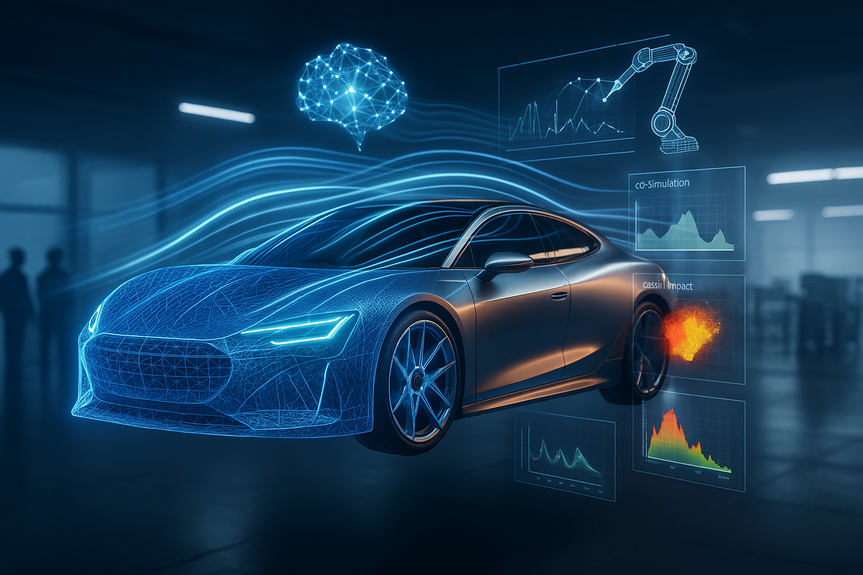
GM is using AI for automotive product development to shrink car programs from four to five years down to about two. A single digital model connects design, engineering, testing, and manufacturing. Virtual wind tunnels, crash simulations, and generative design run in parallel, so updates ripple across teams in seconds and cut costly delays.
General Motors has rebuilt how it makes cars. Under chief product officer Sterling Anderson, the company moved from step-by-step handoffs to a shared digital workflow that runs the whole program. Designers sketch, engineers analyze, and factories plan at the same time. Virtual tests guide choices before a single physical part exists. GM’s rollout shows how AI for automotive product development links decisions from idea to factory floor.
Virtual wind tunnels guide exterior forms and reduce drag sooner.
Crash simulations inform chassis and safety systems before building prototypes.
Co-simulations balance thermal comfort, battery use, and range in one loop.
These tools do not remove physical validation. They make each build count more and come later, when designs are already strong.
Faster feedback: AI-driven tools flag trade-offs in minutes, not weeks.
Fewer reworks: A shared model keeps teams aligned, so changes stick.
Smarter parts: Generative design finds lighter, stiffer shapes within set limits.
Earlier risk checks: Safety and manufacturability are tested from day one.
Better use of cash: Fewer prototypes and test loops save time and budget.
Tooling previews: Stamping dies and molds are planned off the live model, so fewer late cuts are needed.
Robot path planning: Manufacturing can test reach and clash virtually, then lock in faster.
Process updates: When design shifts, the plant playbook updates with it, reducing launch pain.
Trust but verify: Simulations must match real tests. Correlation builds confidence.
Strong data: Bad inputs make bad models. Version control and clean data are key.
Human oversight: Experts review AI outputs for safety, service, and regulations.
Cybersecurity: A shared digital thread needs strong access control and backups.
Pick one high-impact area, like aero sims or crash pre-checks.
Link CAD and CAE so design changes update tests automatically.
Run short, two-week experiments and measure cycle time and rework.
Build a change control habit: one model, one owner, clear logs.
Train teams to read sims and make decisions from them.
Time to design freeze.
Number of physical prototypes per program.
Change order cycle time and count after tool kick-off.
Wind tunnel hours replaced by validated simulation.
Crash test correlation error (sim vs. physical).
Scrap and rework at launch.
GM’s push shows where the industry is heading: concurrent work, deep simulation, and a single digital thread, all guided by human judgment. With these moves, the company aims to turn a sluggish five-year grind into a sharper, two-year sprint. For builders and buyers, that can mean safer cars, faster updates, and better value. AI for automotive product development is no longer a side project; it is the engine of speed.
(p.S. GM’s approach demonstrates how clear goals, shared data, and tight loops make AI useful. It is not magic. It is disciplined, connected work—done faster.)
(Source: https://www.fastcompany.com/91571405/gm-ai-tools-could-cut-the-car-development-timeline-in-half)
For more news: Click Here
The two-year car: inside GM’s new playbook
A single source of truth
GM now uses a unified digital model of each vehicle. Every team works from it. Change the grille shape, and the aero model updates. Adjust the battery pack, and the crash model updates. This reduces back-and-forth and stops late surprises.From serial to concurrent
Old car programs moved like a relay race. Design finished, then engineering started, then testing, then tooling. Now, work happens at once. As designers refine surfaces, engineers shape the structure and run early tests. Tooling teams plan dies and robot paths in parallel. The result is fewer waits and faster learning.Virtual testing before metal
GM leans on simulation to replace many slow, physical tests:Why AI for automotive product development speeds everything up
Generative design in practice
Engineers set goals and limits—strength, weight, space, and cost. The software proposes forms that meet them. Humans then refine for looks, service, and tooling. This pairs machine speed with expert judgment.Co-simulation keeps systems honest
Cars are systems. Cooling affects range. Aero affects noise. Weight affects ride. Co-simulation links these models so teams see how one change hits the rest. That stops local “wins” that hurt the whole vehicle.What changes on the factory side
People and skills
Designers now see airflow and structure sooner. Engineers see packaging and styling intent earlier. Data moves freely, so teams talk more and argue less over versions. New skills matter: reading sims, checking data quality, and knowing when to ask for a physical test.Risks and guardrails
How smaller teams can start
Key metrics to watch
FAQ
Q: What impact has GM’s use of AI had on the car development timeline?
A: GM’s use of AI for automotive product development, generative design, and advanced simulations has reduced typical vehicle programs from about four-to-five years to a target of two years, effectively cutting the timeline in half. The company and its chief product officer describe this shift as a new operating system for product development.
Q: How does a unified digital model speed up development?
A: The unified digital model acts as a single source of truth connecting design, engineering, testing, and manufacturing so that changes propagate across teams immediately. This alignment reduces back-and-forth, prevents late surprises, and keeps everyone working from the same updated data.
Q: What virtual testing methods does GM use before building physical prototypes?
A: GM uses virtual wind tunnels, crash simulations, and co-simulations that manage thermal comfort, battery use, and range to inform design choices before any physical part exists. These virtual tests are part of GM’s AI for automotive product development approach and do not eliminate physical validation but make each physical build happen later and be more valuable.
Q: What is generative design and how is it applied in GM’s workflow?
A: Generative design software proposes shapes that meet engineer-set goals like strength, weight, space, and cost, and humans then refine those proposals for looks, service, and tooling. Within GM’s AI for automotive product development pipeline, this pairing of machine-generated options and expert judgment helps find lighter, stiffer parts faster.
Q: How do concurrent workflows differ from the traditional serial approach?
A: Traditional programs moved in sequence—design, then engineering, then testing—while GM runs those disciplines concurrently so designers, engineers, and tooling teams work at the same time. That concurrency reduces waits, speeds learning, and allows tweaks in one area to ripple across disciplines immediately.
Q: What factory-side benefits come from GM’s digital thread?
A: Tooling previews like planning stamping dies and molds off the live model reduce late cuts, and virtual robot path planning lets manufacturing lock in processes faster. These factory-side benefits are enabled by the shared digital model at the center of GM’s AI for automotive product development strategy.
Q: What risks and guardrails does the article recommend when adopting AI-driven tools?
A: The article stresses “trust but verify,” meaning simulations must be correlated with real tests and inputs must be cleaned and version-controlled to avoid bad models. It also calls for human oversight to review AI outputs for safety and regulations and for robust cybersecurity on the shared digital thread.
Q: How can smaller teams begin implementing these AI-driven development methods?
A: Smaller teams can start by choosing one high-impact area such as aero simulations or crash pre-checks, linking CAD and CAE so design changes update tests automatically, and running short two-week experiments to measure cycle time and rework. They should build a change-control habit, train staff to read simulations, and track key metrics like prototypes per program and change order cycle time.
Contents