AI News
20 May 2026
Read 9 min
how automakers use AI for vehicle design and testing faster
how automakers use AI for vehicle design and testing to cut development time and prove safety faster.
Automakers now use AI to guide styling, airflow, and safety checks in real time. In short, how automakers use AI for vehicle design and testing is by simulating wind, stress, and road risks on a screen first, then refining parts before a single prototype is built. That cuts cost and speeds launches.
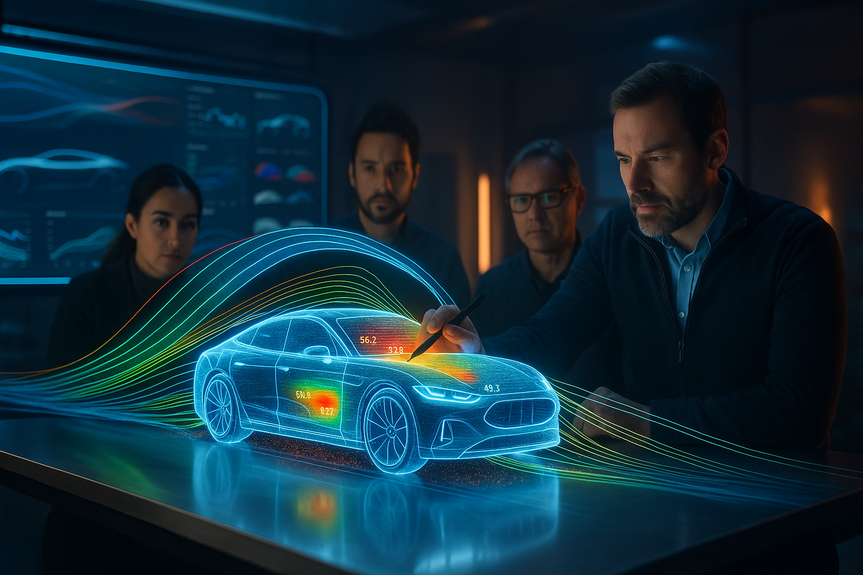
General Motors just showed how fast this shift is happening. The company is pushing AI into design studios and test labs to move quicker on new models and self-driving features. At the center is a virtual wind tunnel that gives instant feedback on shape and drag. This shows how automakers use AI for vehicle design and testing to shrink timelines and raise quality at the same time.
Virtual wind tunnels: AI estimates airflow and drag in seconds, so designers see what every crease and curve does to efficiency.
Generative design: Models suggest lighter parts that still meet strength goals, then check them against crash and durability rules.
Digital twins: Virtual copies of vehicles run thousands of “what-if” tests for weather, loads, and wear before physical builds.
Smarter simulation for autonomy: AI creates rare road events and traffic patterns to test driver-assist and self-driving code.
Faster data labeling: Computer vision helps tag camera and lidar footage, speeding validation for safety systems.
Automated test planning: Algorithms select the next most valuable test, reducing repeats and closing coverage gaps.
As companies refine how automakers use AI for vehicle design and testing, teams cut waste, share live results, and make better choices earlier in the program.
Lower drag boosts EV range and saves fuel in gas models.
Quick loops mean fewer clay models and less wind-tunnel time.
Early fixes prevent late-stage tooling changes that cost millions.
Fewer prototypes: Virtual checks replace many early builds.
Less rework: Teams catch issues before tooling cuts steel.
Shorter timelines: Fast loops keep programs on schedule.
Lower energy use: Digital tests cut wind-tunnel and track hours.
Better quality: More scenarios get tested before customer delivery.
Data quality: Bad inputs make bad models. Teams must clean and govern data.
Model drift: Real-world changes can reduce accuracy. Continuous retraining is key.
Verification: AI aids testing, but physical checks still matter for safety and rules.
Transparency: Clear logs and test evidence help regulators and build trust.
Human oversight: Engineers stay in the loop to judge trade-offs and ethics.
Design copilots: AI that turns a sketch into a tested, buildable surface in minutes.
Unified sims: Aerodynamics, thermal, crash, noise, and manufacturability linked in one live model.
Over-the-air loops: Real driving data improves models, which then improve software updates.
Industry standards: Shared test sets and safety metrics for comparing AI tools and results.
The road ahead is clear. By linking design screens to test sims and smart planning, the industry is proving how automakers use AI for vehicle design and testing to deliver better cars faster, at lower cost, and with higher safety. The winners will be teams that mix sharp tools with strong engineering judgment.
How automakers use AI for vehicle design and testing
Inside the virtual wind tunnel
From sketch to CFD in seconds
Traditional aerodynamic checks can take days. Designers must send surfaces to analysts, wait for results, then try again. With AI-powered airflow models, they can slide a fender line, adjust a mirror, or tweak a spoiler and see instant drag and flow changes on screen. This keeps creativity high while staying efficient.Why aero speed matters
Faster testing and safer autonomy
AI also helps validate advanced driver-assistance and self-driving stacks more safely and quickly.High-scale simulation
Engineers can create endless city, highway, and weather scenes. AI adds risk events like sudden cut-ins, stray pedestrians, or debris. Software improves by facing these “edge cases” before cars meet them on public roads.Data labeling and analytics
AI speeds up tagging of road objects, traffic signs, and lane lines in sensor data. It flags odd cases for human review and learns from corrections. This tight loop improves perception models while tracking where they are weak.Scenario selection
Instead of running every test, AI picks the ones that matter most next. It focuses on gaps in coverage, recent failures, and risky combinations of speed, light, and weather. That makes each test mile count more.Design-to-build flow gets tighter
Generative parts and manufacturability
AI proposes part shapes that are lighter yet strong, then checks if they can be stamped, cast, or printed. It also predicts how changes impact cost, cycle time, and supply risk. Engineers see trade-offs early and avoid late surprises.Materials and noise control
Models estimate stiffness, heat, and noise paths. Teams test different materials and sealing plans in hours, not weeks. Cabins get quieter. Batteries and motors run cooler. Brakes and tires last longer.What this means for cost, time, and sustainability
Roadblocks and responsible use
What to watch next
(Source: https://www.autonews.com/general-motors/an-gm-ai-vehicle-design-0515/)
For more news: Click Here
FAQ
Q: What kinds of AI tools are automakers using to speed vehicle design and testing?
A: Automakers use AI tools like virtual wind tunnels for fast airflow and drag estimates, generative design for lighter parts, digital twins for thousands of what-if tests, smarter autonomy simulations, computer vision for data labeling, and algorithms for automated test planning. These approaches summarize how automakers use AI for vehicle design and testing to cut cost and speed launches.
Q: How do virtual wind tunnels change the design process?
A: AI-powered airflow models estimate drag and flow in seconds so designers can tweak fender lines, mirrors, or spoilers and see instant effects on screen. That replaces days-long analyst loops, keeps creativity high, and reduces the need for early physical models.
Q: In what ways does AI improve testing for autonomous and driver-assist systems?
A: AI creates rare road events, endless city/highway/weather scenes, and risky combinations of speed, light, and weather to expose edge cases before cars see them on public roads. This is part of how automakers use AI for vehicle design and testing to validate self-driving software more safely and quickly.
Q: What are digital twins and why are they useful before building prototypes?
A: Digital twins are virtual copies of vehicles that run thousands of “what-if” tests for weather, loads, and wear prior to physical builds. They help catch issues early, reducing prototypes, rework, and late-stage surprises.
Q: How does generative design affect part weight, strength, and manufacturability?
A: Generative models propose lighter part shapes that still meet strength and durability goals, then check those designs against crash and manufacturability rules like stamping, casting, or printing. Engineers can see trade-offs on cost, cycle time, and supply risk early to avoid expensive late changes.
Q: What measurable benefits do automakers get from these AI methods?
A: Teams report fewer prototypes, less rework, shorter timelines, lower energy use from reduced physical testing, and higher quality because more scenarios are tested before delivery. These gains show how automakers use AI for vehicle design and testing to deliver cars faster and at lower cost.
Q: What are the main roadblocks or risks when applying AI to vehicle design and testing?
A: Key challenges include poor data quality, model drift as the real world changes, the need for continuous retraining, and the requirement that AI results be verified by physical checks and clear logs for regulators. Human oversight remains essential to judge trade-offs and maintain trust.
Q: How is General Motors applying these AI tools in its design studios and test labs?
A: GM is pushing AI into design studios and test labs with a virtual wind tunnel at the center that gives designers instant feedback on shape and drag. The company uses this approach to move quicker on new models and self-driving features while shrinking timelines and raising quality.
Contents