Crypto
14 Mar 2026
Read 13 min
How bitcoin miners pivot to AI to unlock profits *
bitcoin miners pivot to AI to monetize idle power, boost margins and supply flexible grid services
VanEck says the bitcoin miners pivot to AI is speeding up as demand for power and computing soars. Miners can reuse their energy deals, land, and cooling to host AI servers, often at lower cost than new data centers. This shift may unlock higher revenues and help stabilize local electric grids.
The AI boom needs huge amounts of electricity and specialized chips. Bitcoin miners already run large, power-dense sites with robust cooling and cheap energy contracts. That is why VanEck’s Matthew Sigel says miners “sit on a gold mine.” He told CNBC that many are shifting part of their capacity toward AI and grid services while still trading at a discount to traditional data-center stocks.
Megawatts: How many MW are energized today, and how many are under contract for expansion?
Mix: What share of power serves Bitcoin versus AI/HPC, and how quickly is that mix changing?
Contracts: Are there signed, multi-year AI leases with creditworthy tenants?
Economics: What is revenue and EBITDA per MW for Bitcoin vs. AI? How does curtailment income add up?
Capex and timing: What does it cost per MW to retrofit for AI, and what is the expected payback?
Grid relationship: How often does the operator curtail, and what do they earn from demand response?
Financing: Is there enough cash, debt capacity, or partner funding to finish the roadmap?
Why AI’s power hunger fits miner strengths
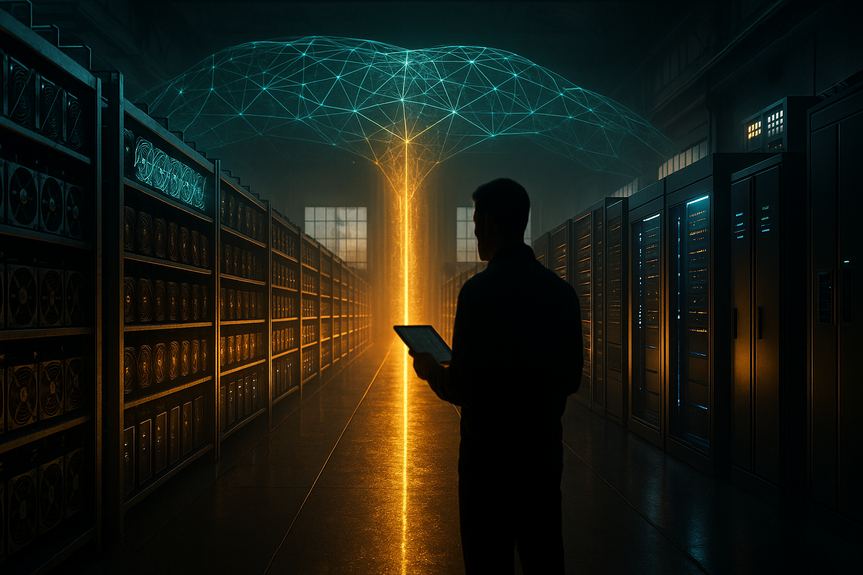
AI training and inference now push utilities and data-center builders to find more megawatts, faster. Miners bring three things that match this need.They control energy, land, and permits
– Miners set up near low-cost power, like wind, hydro, solar, or gas. – They sign power purchase agreements and often own or lease industrial land. – Their sites already have grid interconnects, cooling, and security. These assets cut the time and money needed to stand up AI capacity. That is a key edge as demand outstrips supply.They can flex up or down on short notice
Bitcoin mining is interruptible. When the grid is tight, miners can power down in minutes and sell energy back or free up capacity for homes, factories, or hospitals. Sigel called this “a useful load balancing tool.” As reshoring, AI, and even defense systems boost electric demand, this flexibility adds resilience to the grid.They trade at a discount to peers
Sigel said many miners still trade at a “huge discount” to traditional data-center operators when you compare market value to megawatts controlled. If they can convert part of that power into AI-ready space, revenue per megawatt could climb while the market narrows the valuation gap.Real moves: from Bitcoin halls to AI halls
The shift is not just talk. Several public miners have announced concrete plans to add AI infrastructure alongside or in place of some Bitcoin capacity.Marathon Digital (MARA)
– Marathon struck a deal to convert some mining sites into hyperscale data-center campuses. – The move aims to attract AI tenants that lease space, power, and connectivity. – This reduces revenue swings tied to Bitcoin’s price and mining difficulty.Core Scientific
– Core Scientific secured up to $1 billion in financing from Morgan Stanley. – Funds target a pivot toward AI infrastructure and related services. – The company seeks to scale hosting for high-performance compute (HPC), which includes AI training and inference. These examples show how the bitcoin miners pivot to AI can use existing footprints. They do not have to start from zero. They can adapt current buildings, use their grid capacity, and attract partners who bring GPUs and software stacks.How bitcoin miners pivot to AI
Miners do not swap ASICs for GPUs overnight. The playbook is practical and staged.1) Upgrade sites, not just hardware
– Power and cooling: AI racks draw more power per rack and throw off more heat than typical mining rigs. Facilities add high-capacity cooling (liquid cooling, rear-door heat exchangers) and reinforce electrical systems. – Network: AI clusters need high-bandwidth, low-latency networking between servers and to the cloud. Sites add fiber routes and redundant paths. – Security and compliance: AI customers require strict physical security, audits, and uptime guarantees (SLAs). Operators implement monitoring, fire suppression, and certifications.2) Choose the right business model
– Lease and host: The miner leases space and power to an AI tenant and charges monthly fees. This creates steady, contract-based revenue. – Joint venture: The miner partners with a compute provider. The partner brings GPUs and clients; the miner brings power and facilities. They share profits. – Sell power as a service: In some regions, the miner focuses on energy optimization and demand response, earning from grid programs while hosting a mix of Bitcoin and AI loads.3) Keep optionality
Miners often run a hybrid stack: some megawatts mine Bitcoin; some host AI; all can throttle during price spikes. This lets them chase the best return per megawatt. It also helps during Bitcoin bear markets or AI hardware cycles.4) Finance the shift
Upgrading to AI-ready space takes capital. Companies look to: – Debt and project financing backed by long-term AI leases – Equity raises when market conditions are strong – Prepaid contracts with anchor tenants – Partnerships with cloud, chip, or telecom firms As bitcoin miners pivot to AI, investors should review balance sheets, cost of capital, and the quality of signed customer contracts.Risks and what to watch
Every strategy has trade-offs. The transition to AI hosting adds new execution challenges.Key risks
– Tenant risk: AI customers may scale slower than expected or switch providers. – Build risk: Delays in power, cooling, or networking upgrades can push out revenue. – Commodity risk: Power prices can rise with heat waves or fuel shocks. – Hardware cycles: GPU supply and pricing can swing, changing tenant demand. – Regulation: Local rules on power usage or noise can tighten.Signals of strength
– Long-term, take-or-pay leases with quality tenants – Diverse power sources and strong grid relationships – Proven ability to curtail and earn grid services income – Efficient power usage effectiveness (PUE) after retrofits – Clear capital plan with runway to complete buildsWhat this means for Bitcoin and miner stocks
Sigel said Bitcoin likely trades in a range near term, roughly between $59,000 and $72,000. He noted that long-term holders have eased selling, which can support price stability. A steadier Bitcoin backdrop gives miners time to execute on AI projects without extreme revenue shocks from coin price moves. Prediction markets show mixed views. On Myriad, users recently saw even odds on a move higher to $84,000 versus a drop to $55,000. Spot prices around the time of the report sat near $70,120, up about 0.9% on the day. These figures underline the point: macro conditions, rates, and liquidity still matter. If oil or geopolitics tighten global liquidity, risk assets, including crypto and growth stocks, can feel pressure. For miner equities, the story hinges on two converging trends: – Bitcoin economics: Hash price, network difficulty, and transaction fees – AI monetization: Signed AI leases, megawatts converted, and data-center margins If miners convert power to higher-value AI hosting while keeping flexible Bitcoin exposure, their blended margins can rise. And if the valuation gap with traditional data centers narrows, multiples could expand.A practical checklist for investors
Use these simple questions to compare companies and gauge how well the bitcoin miners pivot to AI is playing out:The bottom line
AI is changing the map for electricity and compute. Bitcoin miners already live at that intersection. They own land where power is cheap. They connect to the grid with big lines and big transformers. They can ramp down fast when the grid is tight. And they can ramp up again to earn more when conditions are right. VanEck’s Matthew Sigel thinks markets have not fully priced in this setup. Early movers like MARA and Core Scientific are testing the model with real money and real partners. Execution will decide who wins. But the logic is clear: reuse the hard parts—power, cooling, permits—and layer in steadier AI cash flows. Keep optionality to mine Bitcoin when returns look best. For readers and investors, watch the megawatts, the contracts, and the grid data. If those improve, the thesis grows stronger. In a world short on power and long on compute demand, the bitcoin miners pivot to AI may be one of the most practical ways to unlock profits and stability across cycles. (p) (Source: https://decrypt.co/360836/bitcoin-miners-sitting-on-a-gold-mine-as-ai-demand-ramps-up-vaneck)For more news: Click Here
FAQ
Q: What did VanEck’s Matthew Sigel mean when he said miners are “sitting on a gold mine”?
A: Sigel meant miners can monetize existing assets—cheap power contracts, land, cooling and grid connections—to serve AI workloads and grid services and thereby earn attractive returns on capital. He also noted miners still trade at a discount to traditional data-center peers on a market-cap-to-megawatt basis.
Q: How can bitcoin miners pivot to AI using their current assets?
A: When bitcoin miners pivot to AI, they typically reuse existing energy contracts, industrial land, grid interconnects and cooling to host GPU-based AI servers, often at lower cost and with faster deployment than building new data centers. This reuse leverages permits and security already in place to reduce time and capital required to stand up AI capacity.
Q: Which public mining companies have announced moves toward AI infrastructure?
A: Examples in the article include Marathon Digital (MARA), which struck a deal to convert some mining sites into hyperscale data-center campuses, and Core Scientific, which secured up to $1 billion in financing from Morgan Stanley to fund a pivot toward AI infrastructure. These examples show miners are testing the model by adapting existing footprints rather than starting from scratch.
Q: What technical upgrades do miners need to host AI workloads?
A: Sites need higher-capacity cooling such as liquid cooling or rear-door heat exchangers and reinforced electrical systems to handle denser power per rack. They also must add high-bandwidth, low-latency networking, additional fiber routes, and enhanced security, monitoring, fire suppression and certifications to meet AI tenant SLAs.
Q: What business models can miners use to monetize AI compute?
A: Miners can lease space and power to AI tenants for monthly fees, enter joint ventures where they provide facilities and partners supply GPUs and clients, or sell power and grid services as a service. Each model offers different mixes of steady contract revenue, capital intensity and partnership roles.
Q: How does miner flexibility help electric grids as AI demand increases?
A: Because Bitcoin mining is interruptible, miners can power down in minutes to free capacity or sell energy back to the grid, acting as a useful load-balancing tool during peak demand. Sigel said this flexibility adds resilience as reshoring, AI and defense applications increase pressure on local grids.
Q: What risks should investors monitor when bitcoin miners pivot to AI?
A: Key risks include tenant risk if AI customers scale slower or switch providers, build risk from delays in power or cooling upgrades, commodity risk from rising power prices, hardware-cycle risk around GPU supply and pricing, and tightening local regulations. Investors should also review balance sheets, cost of capital and the quality of signed customer contracts to assess execution risk.
Q: How might the pivot to AI affect miner valuations and Bitcoin’s near-term outlook?
A: If miners convert power to higher-value AI hosting and sign multi-year AI leases, revenue per megawatt could rise and the valuation gap with traditional data centers may narrow. VanEck’s Sigel also framed Bitcoin as likely trading in a near-term range of roughly $59,000 to $72,000 while eased selling by long-term holders may provide more stability.
* The information provided on this website is based solely on my personal experience, research and technical knowledge. This content should not be construed as investment advice or a recommendation. Any investment decision must be made on the basis of your own independent judgement.
Contents