AI News
01 Oct 2025
Read 18 min
How ChatGPT mathematical reasoning study reveals AI thinking
ChatGPT mathematical reasoning study shows AI can improvise solutions, helping teachers check proofs
When researchers asked ChatGPT to tackle a classic Greek geometry puzzle, the chatbot surprised them by reasoning, improvising and even making a mistake. The ChatGPT mathematical reasoning study suggests AI can form new hypotheses from prompts, not just repeat training data, and it raises fresh questions about how to teach, verify, and guide AI in math education.
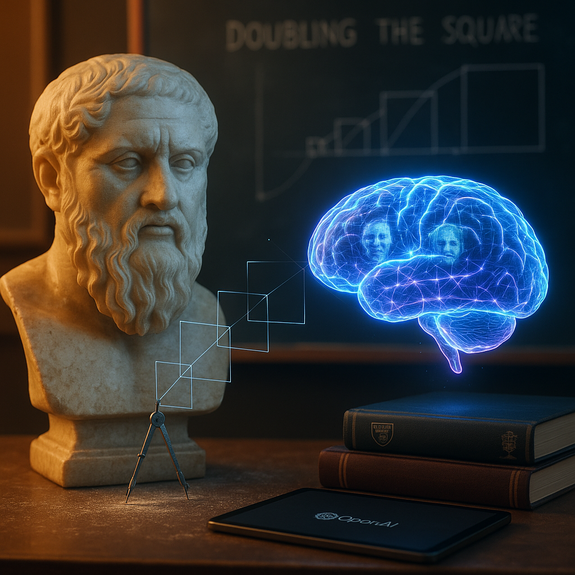
Plato told a story about Socrates and a student who tried to double the area of a square by doubling each side. That answer was wrong. The correct trick is to use the square’s diagonal. More than 2,000 years later, researchers from the University of Cambridge and the Hebrew University of Jerusalem gave this puzzle to ChatGPT. They watched not only for a correct answer, but also for signs of reasoning, error, and learning. Their observations show how today’s AI looks “learner-like” in math — and why teachers and students must still check every step.
Inside the ChatGPT mathematical reasoning study
The ancient puzzle meets a modern chatbot
In Plato’s dialogue, Socrates asks a student to double a square’s area. The student first doubles the side length. That turns a square with side s into one with side 2s and area 4s², which is four times bigger, not two. Socrates guides the student toward the diagonal. The diagonal of the original square is s√2. A square with side s√2 has area (s√2)² = 2s². That is exactly double. The study team used this well-known result as a starting point. They argued that a text-trained model like ChatGPT might not simply memorize a rare, image-heavy geometric construction. So if the chatbot solved it correctly, it might be doing more than lookup. It could be assembling a fresh chain of ideas from the prompt. They then pushed the test further. They asked ChatGPT how to double the area of a rectangle using similar reasoning. This is where things got interesting. The chatbot claimed there was no geometric solution because you cannot use a rectangle’s diagonal the way you use a square’s. The first part is true: the rectangle’s diagonal does not solve the problem by itself. But the second part is false: a geometric solution exists. Visiting Cambridge scholar Nadav Marco and mathematics education professor Andreas Stylianides called this a “vanishingly small” claim to find in training data. That means the answer was likely invented on the fly. ChatGPT took the square idea, tried to transfer it, and then made a wrong general rule. In one sense, that is what novice learners do: they over-generalize from a known pattern and then adjust. The ChatGPT mathematical reasoning study captured that learner-like behavior, including the error.Why this matters for “AI reasoning”
The researchers do not claim ChatGPT “thinks” like a person. They do suggest its behavior can look like a student working inside the “zone of proximal development” — the space between what a learner can do alone and what they can do with guidance. With careful prompts, the model produced ideas that were not obvious copies of likely training text. With a nudge in the wrong direction, it produced a confident but incorrect claim. This behavior links to the old “black box” issue in AI. We can see outputs, but not the internal steps that lead to them. That makes verification essential, especially in math. The study’s conclusion is practical: AI can help explore, but students must learn to test the steps, critique the reasoning, and ask for clearer definitions and checks.Why the rectangle answer was wrong — and the geometry that works
The diagonal trick works for a square — not for every rectangle
For a square, the diagonal has a special role. It is longer than the side by exactly √2. That constant comes from the Pythagorean theorem: s√2. That is why using the diagonal as the new side doubles the area neatly. Rectangles do not share that simple relation. If a rectangle has sides a and b, its diagonal is √(a² + b²). The diagonal is not equal to either side times √2 unless a = b (which makes it a square). So the diagonal does not provide a general “double-area” side for rectangles.A simple, correct way to double any rectangle’s area
You can double the area of any rectangle with a straightforward geometric idea: scale the rectangle by a factor of √2 in both dimensions if you want to keep the same shape, or scale just one dimension by 2 if you do not care about shape. Here are two valid options: – Keep the shape (similar rectangle): – Original rectangle: sides a and b, area ab. – To double area while keeping the same shape, multiply both sides by √2. – New rectangle: sides a√2 and b√2, area (a√2)(b√2) = 2ab. – Change the shape (not similar): – Keep side a the same. Double side b to 2b. – New rectangle: sides a and 2b, area a(2b) = 2ab. There are classic Euclidean constructions to achieve the √2 factor using only a compass and straightedge. One easy route is to construct a right triangle whose legs are equal. If each leg is 1 unit, the hypotenuse measures √2 units. You can then use that length to scale your rectangle.A visual construction idea (compass and straightedge)
If you want a construction that preserves shape: – Draw the original rectangle with sides a and b. – On a separate line, mark a segment of length 1 and build a right triangle with both legs of length 1. The hypotenuse is length √2. – Use the hypotenuse as a unit to scale both a and b. With a compass, transfer a√2 and b√2. – Draw the new rectangle with sides a√2 and b√2. Its area is doubled and it is similar to the original. If you are fine with a shape change (simpler in practice): – Extend one side b to 2b (measure and mark). – Keep the other side a the same. – Draw the new rectangle. The area has doubled. These methods show that a rectangle’s area can be doubled by pure geometry. The mistake in the chatbot’s answer was not about the diagonal being unhelpful for rectangles; it was the leap to “no solution exists.” The ChatGPT mathematical reasoning study highlights this exact misstep.What counts as reasoning for AI?
Patterns, hypotheses, and the “learner-like” label
The model seemed to test a pattern: “Diagonal solves doubling for a square.” It then tried to apply that pattern to rectangles. When the pattern did not fit, it declared a dead end. A human teacher would pause there, ask for another path, and push toward scaling. With the right prompt, the model might have shifted to “What factor multiplies area by two?” and then found √2. This is why the researchers say the model looked “learner-like.” It explored, generalized, and erred, all within a guided conversation. But we must keep the limit in mind. ChatGPT does not have geometric intuition. It predicts the next likely phrase based on training and prompt context. The useful trick is to structure prompts that elicit testable steps, not just confident prose.How to prompt and verify in math class
Prompting that teaches, not just answers
Teachers can get more value when they frame a dialog that asks the model to explore and check. Try prompts that set goals and constraints: – “Let’s explore how to double a rectangle’s area. First, list two different methods.” – “Keep the rectangle’s shape the same. What scale factor multiplies area by two?” – “Propose a geometric construction. Then explain how to verify it.” Avoid prompts like “Just give me the final answer,” especially for geometry. You want steps you can test, not a single claim.Verification first, speed second
Even when a solution looks right, build in checks: – Recompute areas using symbolic expressions, not only numbers. – Test with simple values (e.g., a = b = 1) to watch the scale clearly. – Ask for an alternative method and see if both methods agree on the final numbers. – If the model cites a rule, ask it to name the theorem and restate it in one sentence.Teach students to critique AI like a proof
Students can treat AI output as a draft: – Identify assumptions. Are they stated? – Check each step for validity. Does the step follow a known rule? – Look for leaps. Where does the reasoning jump from pattern to claim? – Rewrite the proof in your own words. If you cannot, you do not own it yet. These habits turn the black box into a glass box. The process becomes visible, even if the model’s internals are not.From text-only chat to richer math tools
Better tools for geometry and proofs
The study suggests new combinations: – Link a chatbot with a dynamic geometry system (DGS) so it can draw, drag, and test figures on screen. – Pair it with a theorem prover to check each step for logical soundness. – Add a numeric sandbox where the model can run quick calculations on chosen test values. Such a setup would let students see and test ideas at the same time. It would reduce the risk of smooth but wrong explanations.Why multimodal models could help
Because much of geometry is visual, models that handle text and images may reason better about shapes. If a chatbot can produce and inspect a diagram while it explains, it has more ways to catch errors. Still, the core rule stands: students must check claims against definitions, theorems, and measurements.What educators can take from the findings
New skills for the curriculum
The researchers argue for teaching students how to read, question, and refine AI-generated proofs. That means: – Understanding the difference between a correct result and a valid proof. – Knowing theorems well enough to spot misuse. – Applying counterexamples to test claims. – Using precise language when asking and answering. The goal is not to ban AI, but to learn with it. The class becomes a workshop where students and AI co-create drafts, then fix them.Prompt frameworks that support learning
A simple, repeatable framework helps: – Clarify the task: “We want to double area.” – Set constraints: “Keep the rectangle similar to the original.” – Ask for two approaches: “Scaling and construction.” – Require a check: “Prove the area doubles. Show the numeric test with a = 3, b = 5.” – Reflect: “Why did the diagonal trick work for a square but not a general rectangle?” This structure keeps the model inside the zone of proximal development. It invites hypotheses and validation in a tidy loop.Limits and promise
Do not over-interpret “thinking”
The Cambridge and Jerusalem team are careful. They do not say the model “understands” geometry. They say it behaved like a student at times, including making a wrong generalization. That is useful because it shows how prompts and feedback can guide the model toward better steps. But it also shows why human oversight is non-negotiable.Where research can go next
Future studies can: – Test newer models on a wider set of geometry and algebra problems. – Compare how models handle visual tasks before and after pairing with DGS software. – Measure how often the model invents false rules and what prompts reduce that risk. – Track learning outcomes when students practice verifying AI-generated proofs. This agenda aims to move from “impressive answers” to “reliable methods” that teachers can trust. The core lesson is straightforward. ChatGPT can propose ideas that look fresh, and it can make errors with the same confidence. The ChatGPT mathematical reasoning study shows both sides at once: improvisation under guidance, and the need for checks at every step. If teachers and students learn to prompt, test, and revise, AI can become a helpful partner in math learning. In short, the ancient puzzle still teaches a modern truth. Good reasoning needs clear steps and proof. AI can join the process, but it cannot replace it. With the habits above, the benefits outweigh the risks — and the next chapter of classroom math will be more hands-on, more visual, and more rigorous. That is the lasting value of the ChatGPT mathematical reasoning study.For more news: Click Here
FAQ
Q: What was the ancient Greek puzzle researchers used to test ChatGPT?
A: Researchers used Plato’s “doubling the square” puzzle, in which a student mistakenly doubled each side rather than using the square’s diagonal to double the area. The ChatGPT mathematical reasoning study used that problem because the diagonal trick gives a new side s√2 with area 2s² and the solution is not an obvious text-only fact.
Q: Why did researchers choose this geometric puzzle for the ChatGPT test?
A: Because large language models like ChatGPT are trained mostly on text while classical geometric constructions are often visual, the team judged the specific construction was unlikely to appear in training data. The ChatGPT mathematical reasoning study therefore used the puzzle to see whether the model would assemble a fresh chain of ideas rather than simply retrieve an existing answer.
Q: How did ChatGPT respond to the square problem and the rectangle variant?
A: The model produced learner-like reasoning, improvising hypotheses and sometimes making mistakes. When asked about doubling a rectangle it overgeneralized the square’s diagonal trick and incorrectly asserted there was no geometric solution for rectangles.
Q: What geometric methods actually double a rectangle’s area?
A: You can double any rectangle’s area by scaling both sides by √2 to preserve similarity, or by doubling one side if changing the shape is acceptable. The ChatGPT mathematical reasoning study notes that the √2 factor can be constructed with a compass and straightedge, for example using a right triangle with equal legs whose hypotenuse measures √2.
Q: Why do researchers think ChatGPT invented the rectangle answer rather than copied it from training data?
A: Nadav Marco described the chance that the false claim existed in ChatGPT’s training data as “vanishingly small,” so the team concluded the response was likely improvised on the fly. They compared the model’s overgeneralization to a novice learner’s mistake and described the behavior as learner-like.
Q: What does the study suggest about whether AI like ChatGPT “thinks” or understands math?
A: The researchers caution against saying the model “understands” geometry, noting instead that it sometimes behaved like a student by producing ideas and errors within a zone of proximal development. The study shows outputs can look like reasoning but still require human verification because the model’s internal steps remain a black box.
Q: How should teachers prompt and verify AI-generated math solutions in class?
A: Teachers are encouraged to frame prompts that ask the model to explore steps and list multiple methods rather than simply provide a final answer, for example “Let’s explore this problem together” and “Prove the area doubles; show a numeric test.” Students should verify AI steps by recomputing symbolically, testing simple values, asking for alternative methods, and checking any cited theorems.
Q: What future research and tool combinations do the authors recommend to improve AI math reasoning?
A: The team suggests testing newer models on a wider set of geometry and algebra problems and pairing chatbots with dynamic geometry systems, theorem provers, or numeric sandboxes so ideas can be drawn, tested, and checked. They also note that multimodal models that handle images may help with geometry and that measuring how often models invent false rules should be a research priority.
Contents