 AI-generated
AI News
12 Oct 2025
Read 17 min
How industrial-grade all-weather humanoid robot cuts downtime
Industrial-grade all-weather humanoid robot DR02 reduces downtime and maintenance in outdoor sites.
The industrial-grade all-weather humanoid robot from Deep Robotics (DR02) stays online in rain, dust, heat, and cold. It reduces unplanned stops with IP66 sealing, a wide temperature range, and quick-swap parts. With 275 TOPS on-board compute and multi-sensor vision, it navigates reliably and keeps working when many robots would pause.
Deep Robotics is pushing a clear message: uptime is the metric that matters. The DR02 focuses on rugged protection, fast field service, and reliable autonomy so each shift delivers more productive hours. It is made for outdoor patrols, hot and cold sites, and factories where climate changes during the day. In practice, that means fewer task aborts, fewer return-to-base events, and simpler repairs.
Why an industrial-grade all-weather humanoid robot keeps working when others stop
Most humanoids struggle outside the lab. Rain and dust trigger errors. Heat and cold degrade sensors and joints. Field repairs take too long. The DR02 addresses these weak points by design.
- IP66 sealing keeps dust out and shields the robot against strong water jets.
- The robot operates from -20°C to 55°C, so it can work in cold storage, humid rain, or hot workshops.
- Modular arms and legs detach quickly, cutting repair time on the shop floor or at a patrol site.
- On-board compute rated at 275 TOPS processes sensor data in real time to maintain stable navigation.
When you remove weather-related stoppages and speed up service, uptime improves. When perception stays robust in glare, dust, or drizzle, routes finish on time. When a joint gets replaced in minutes, planned work keeps moving.
What “industrial-grade” looks like in daily use
Sealing and temperature tolerance
IP66 means the body is dust-tight and protected against powerful water jets from any direction. That is a practical threshold for outdoor patrols, wet floors, and windblown debris. Add the -20°C to 55°C operating range, and a night shift in winter or a midday route in a warm factory becomes feasible without special covers or tents. This protection is the backbone of an industrial-grade all-weather humanoid robot, because it prevents many simple failures: clogged fans, wet connectors, and contaminated sensors.
Perception that stays steady
The DR02 uses LiDAR, depth, and wide-angle cameras. This diversity lets it keep a clear map when one sensor is less effective. For example, glare can wash out a camera, but LiDAR still defines range. Fog can soften LiDAR returns, but depth imaging helps at shorter distances. The robot fuses these inputs and plans paths in real time, so it can avoid obstacles, manage slopes, and keep moving.
Mobility that suits real sites
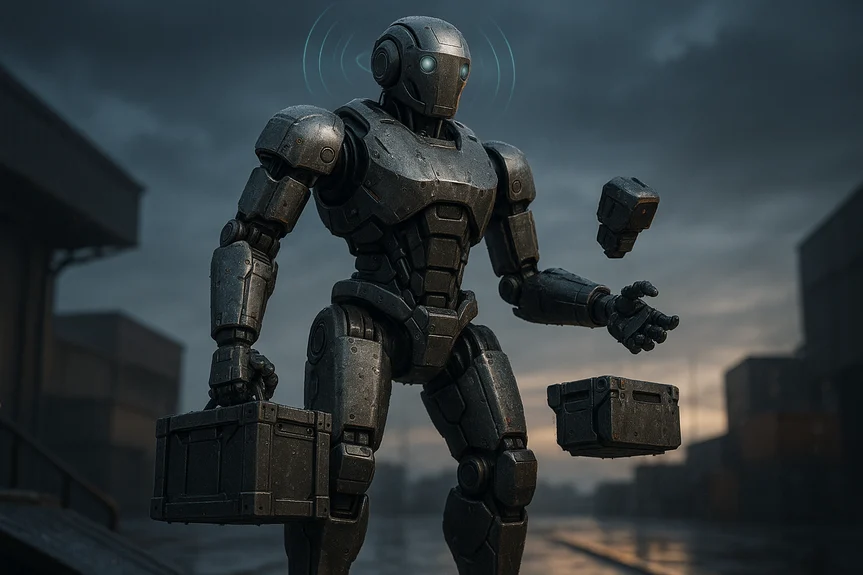
The robot stands 175 cm tall and moves at up to 1.5 m/s in normal mode, with a higher 4 m/s capability for urgent tasks. It climbs 20 cm stairs and handles 20-degree slopes. It can carry 20 kg, with 10 kg per arm. These numbers matter because they match common site features: stairs between floors, curb heights, inclined ramps, and payloads like toolboxes or small parts bins. When a robot handles these without help, staff do not need to escort or pre-stage equipment.
Modular design cuts downtime where it hurts
Fast swaps for critical components
The DR02 uses a quick-detach design for key parts, including arms and legs. In the field, a technician can remove a faulty limb and slot in a spare. This changes the service model. Instead of rolling the robot back to a workshop, you bring a module to the robot. The effect on downtime is direct:
- Mean time to repair drops from hours to minutes for common faults.
- Robots return to work in the same shift more often.
- Inventory planning becomes simpler, with a focus on a small set of spares.
Lower maintenance costs through standardization
Standard modules reduce the need for deep diagnostics on the floor. Staff can follow a simple flow: isolate issue, swap module, return to service, then bench-test the removed part later. This reduces specialized labor hours on-site and keeps the main asset productive.
Compute headroom supports reliable autonomy
On-board compute rated at 275 TOPS gives ample capacity for perception and motion planning. It helps the robot:
- Process multiple sensor streams at full speed without lag.
- Maintain navigation in dynamic scenes with people, carts, and vehicles.
- Run more robust algorithms that tolerate noise from rain or dust.
Local processing can also reduce reliance on constant network connectivity. If the site Wi-Fi drops, the robot can still navigate and complete its route, then sync logs later. That design choice limits another common source of stoppage.
Applying uptime gains across industries
Security and safety patrols
Outdoor patrols often fail when weather changes. With IP66 sealing and a broad thermal envelope, the robot continues rounds in light rain, dust, and heat. It climbs stairs in parking structures, navigates inclines, and carries small kits, like first aid items. Faster emergency speed helps when the schedule demands quick checks. The result is longer patrol windows and fewer missed checkpoints.
Manufacturing and logistics
Factories and warehouses face shifting climates: loading doors open, steam near cleaning areas, hot work cells, chilled storage rooms. The DR02’s range from -20°C to 55°C covers these zones. It can:
- Deliver parts bins up to 20 kg between cells without calls for human escort.
- Pass through wet or dusty corridors without a tarp.
- Use stairs to bridge mezzanine levels when elevators are busy.
Modular service means a failed actuator does not end the shift. A technician swaps the limb, and the route resumes.
Infrastructure maintenance
Utilities and campuses need routine inspections of outdoor equipment in variable weather. The DR02’s multi-sensor suite captures scenes even when light changes fast at dawn or dusk. It maintains footing on ramps and uneven surfaces. Its rugged build reduces forced returns to base after a rain shower. Over a week, that steadiness adds up to more completed inspections and fewer gaps in logs.
The human factors that boost uptime
Hardware matters, but process matters too. Teams get the most from the DR02 when they plan for it like any asset.
Smart route design
Break long missions into segments with defined checkpoints. Use slopes under 20 degrees when possible. Verify stair heights under 20 cm. Place charging and service points near high-traffic nodes so swaps are quick. This turns raw capability into predictable schedules.
Clear operating rules
Teach staff when to trigger the higher speed mode and when to keep normal pace. Agree on payload limits: 10 kg per arm, 20 kg total. Mark safe passing lanes on narrow walkways. Small rules prevent small errors that cause interruptions.
Spares and tools on-site
Keep at least one spare limb and essential fasteners at each site. Prepare a “go bag” with the needed tools. Train a small group to perform swaps. The goal is to restore service before a backlog forms.
Quantifying downtime reduction: a simple model
You can estimate the value of higher uptime with a quick framework. Adjust the values to your site.
- Baseline uptime: hours per shift the robot completes tasks as planned.
- Weather stoppage rate: hours lost to rain, dust, or temperature limits.
- Service time per failure: average time to diagnose and repair.
- Failure rate: expected incidents per 100 hours.
- Task value: labor hours saved or service level gains per robot hour.
Now assess the DR02 impact:
- Weather stoppage rate goes down due to IP66 and the -20°C to 55°C envelope.
- Service time per failure drops with quick-detach modules.
- Perception-related interruptions fall with multi-sensor fusion and strong compute.
Use these steps:
- Compute expected productive hours per week before and after deployment.
- Multiply the difference by task value to estimate weekly gain.
- Subtract added costs for spares and training.
This simple score shows where uptime pays off fastest: long outdoor routes, plants with mixed climates, and sites with a history of perception-related delays.
Spec highlights that tie directly to uptime
Protection and environment
- IP66 dust and water protection across the whole machine.
- Operating range: -20°C to 55°C.
Mobility and payload
- Speed: 1.5 m/s normal; up to 4 m/s for urgent tasks.
- Stairs: up to 20 cm; slopes: up to 20 degrees.
- Payload: 20 kg total; 10 kg per arm.
Serviceability and compute
- Modular quick-detach arms and legs for fast swaps.
- On-board compute: 275 TOPS for real-time data processing.
- Sensors: LiDAR, depth, and wide-angle cameras for robust navigation.
Each of these points connects to fewer stoppages and faster recoveries. That is how a robot moves from a pilot demo to a dependable member of the team.
Deployment playbook to capture uptime gains on day one
Site survey and hazard mapping
Walk the routes. Measure stair heights and slope angles. Note wet zones, dust sources, and strong light changes. Mark areas where carts and people cross often. This survey guides route selection and safety rules.
Task design and scheduling
Start with jobs that match the robot’s strengths:
- Regular patrols that include outdoor and indoor segments.
- Part runs of 10–20 kg between nearby cells.
- Inspection passes that repeat daily on the same path.
Schedule around peak human traffic to reduce interruptions. Use the faster speed only when time-critical.
Service workflow
Create a standard operating procedure for fault handling:
- Diagnose with a short checklist.
- If a limb is the suspect, perform a quick swap.
- Log the event and continue the mission.
- Bench-test the removed module later without blocking the route.
This workflow converts unplanned stops into short pauses.
From pilot to scale: proving value
Run a four-week pilot with clear goals:
- Target uptime percentage and route completion rate.
- Maximum allowed service time per incident.
- Minimum number of manual interventions per week.
Track data: weather conditions, interruptions, swap times, and completion timestamps. At the end, compare productive hours to your baseline. If the gains hold across wet days and hot days, you have real evidence, not a lab promise.
Why this form factor matters now
Humanoids fit human spaces: stairs, handrails, doors, and workstations. When the hardware is rugged and service is fast, they can live in those spaces without constant care. The DR02’s combination of IP66 sealing, broad temperature range, modular limbs, and strong on-board compute is a practical step toward that goal. It does not remove all challenges, but it reduces the common ones that stop work.
In short, the path to less downtime is not one feature. It is the blend of protection, mobility, perception, and serviceability. That blend is what makes an industrial-grade all-weather humanoid robot a serious option for patrols, plants, and infrastructure sites that cannot wait for perfect weather.
Deep Robotics positions this machine for security, manufacturing, logistics, and maintenance. The use cases share one need: reliable hours on the clock. With smart planning and the right spares on hand, teams can turn rugged specs into steady output, shift after shift.
Conclusion: If you want robots that keep delivering when the forecast looks bad and the clock is tight, choose an industrial-grade all-weather humanoid robot, build a field-ready service plan, and measure uptime like any critical asset. That is how you cut downtime and raise the value of every hour the robot is on its feet.
For more news: Click Here
FAQ
Keep reading, keep building
Three things from our own workshop that fit this topic:
- Diktly Free is our dictation app for Mac: speech becomes text entirely on your own machine, nothing goes to the cloud. Free version, Basic 14.99 €.
- 1000+ Prompts to Level Up Your Life is our most downloaded pack. Pay what you want, including 0.
- OpenAI Agent Mode for Beginners walks you through letting AI agents handle tasks for you. 19.99 $.
Our own products. Tech Moments is our newsletter on AI and tech in plain language, one email, no noise. Subscribe below.
Contents