Crypto
01 Jan 2026
Read 13 min
How to interpret crypto ETP outflows December 2025 *
crypto ETP outflows December 2025 reveal where traders can adjust allocations to limit downside risk.
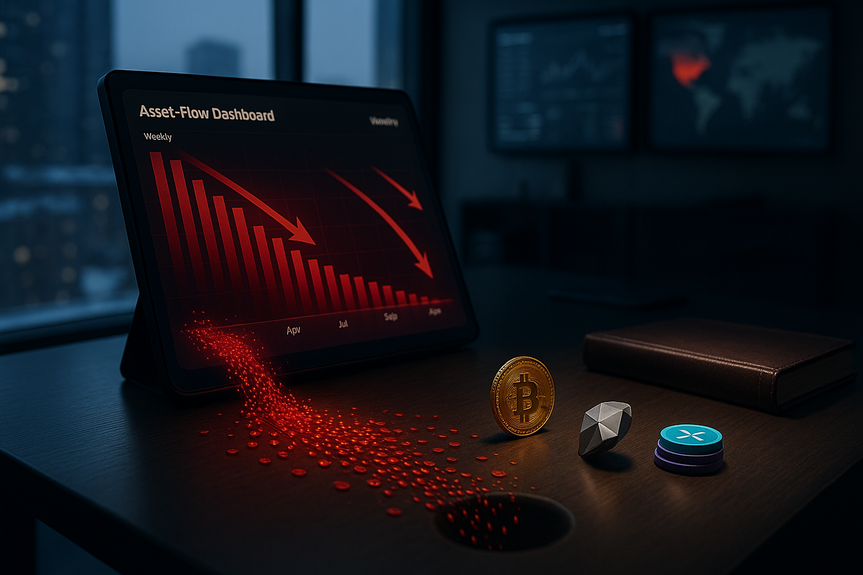
Crypto ETP outflows December 2025 signal a second week of risk-off behavior. CoinShares tracked $446 million in redemptions, led by Bitcoin and Ethereum products, even as XRP funds drew fresh inflows thanks to a new ETF from Franklin Templeton. The U.S. led outflows, while Germany bought the dip. Here’s what that means and how to act.
Markets just logged another week of selling from exchange-traded crypto products. The headline is large withdrawals from Bitcoin and Ethereum ETPs. Yet the details show a split picture. XRP funds saw steady demand, and Solana posted small gains. Regionally, outflows came mainly from the U.S., while Germany attracted new money. The key is to read what flows say about sentiment, how they might affect prices, and what steps to take next.
Macro risk: Investors are managing year-end risk after an October shock that saw heavy liquidations.
Policy uncertainty: Markets are still weighing the impact of tariff threats that shook risk assets in October.
Positioning: Many large products sit in the U.S., where flows were most negative. Tax planning and profit-taking can push outflows late in the year.
Note that flows are one lens, not the full market. Spot trading, derivatives, and on-chain activity also drive price. ETP exits can amplify a move but do not always cause it.
Rotation: Some investors moved from large-cap exposure to select altcoins with strong narratives.
Product launch effect: New ETFs can attract early flows as platforms list them and advisors sample them.
Relative momentum: Traders may see better near-term risk/reward in assets that held up during the selloff.
These are modest inflows next to the outflows in Bitcoin and Ethereum. But they show risk appetite is not gone; it is selective.
Flows are a lagging snapshot: Weekly reports show what already happened, not what comes next.
Outflows can be tactical: Investors may switch from ETPs to spot or futures to cut fees or gain flexibility.
AUM context matters: Despite outflows, industry AUM rose about 10% this year, suggesting price strength offset some redemptions.
Internals matter: Concentrated outflows in Bitcoin and Ethereum coupled with isolated inflows to XRP and Solana point to rotation, not a full market exit.
For traders, the signal is “caution, not panic.” For long-term buyers, pullbacks in flows often mark better entry points if your thesis is unchanged.
Watch weekly flows by asset, not just the total. If Bitcoin drives most outflows while selected alts gain, the market may be rotating.
Track regional trends. U.S. outflows versus German inflows can hint at where dip-buying is strongest.
Compare flows with price. Price up with outflows can mean buyers moved off-platform. Price down with outflows shows ETPs are adding to pressure.
Check AUM changes. Rising AUM with flat flows means prices are lifting the total. Falling AUM with heavy outflows can flag a deeper risk-off move.
Mind liquidity and spreads. In volatile weeks, use limit orders and watch premium/discount levels for ETPs.
Review fees and structure. If you are switching exposure, ensure the product’s custody, fees, and tracking meet your needs.
Keep a plan. Dollar-cost averaging and pre-set rebalancing rules help you act calmly during news-driven swings.
None of this is investment advice. It is a way to read the data and avoid emotional moves.
Reading crypto ETP outflows December 2025
CoinShares reported $446 million in net outflows from crypto ETPs for the week. That made it the second straight week of redemptions after a brief run of inflows. Since the October 10 market shock, total outflows have reached about $3.2 billion. This shows investors are still cautious after the fall’s sharp liquidation event. Year-to-date flows remain close to last year. CoinShares estimates $46.3 billion moved into products in 2025, compared with $48.7 billion in 2024. Still, total assets under management are up only about 10% this year. That means many holders did not see strong gains once new money and withdrawals are included. In short, the broad ETP tape is soft. But the story is not the same across coins or regions. That is where the insight lies for traders and long-term buyers alike.Why Bitcoin and Ethereum led the exits
Bitcoin ETPs shed nearly $443 million for the week, while Ethereum products lost around $59 million, according to CoinShares. Together, they explain nearly all of the red ink. There are several likely drivers:Bright spots: XRP and Solana
Not all funds saw selling. XRP and Solana drew new money. XRP ETPs brought in about $70 million. Franklin Templeton’s XRP ETF, which launched in late November, pulled $28.6 million on its own. Solana funds added roughly $7.5 million. What might explain this split?Regional dynamics behind the weekly numbers
The U.S. led global outflows with about $460 million for the week. That fits the fact that most of the largest Bitcoin and Ethereum products trade on U.S. exchanges. Switzerland posted $14 million in outflows. Germany stood out on the other side, pulling in about $35.7 million for the week. CoinShares also noted roughly $248 million of inflows into Germany over recent periods. This suggests that many German investors used weakness to build positions. Regional divergences can reflect local investor profiles, tax calendars, and how products are marketed and distributed.What the October shock still tells us
The October 10 event was one of the largest liquidation waves in crypto history. It was linked, in part, to worries over a potential 100% U.S. tariff on imports from China. Forced selling, tight liquidity, and leverage all played a role. Today’s flows show that some of that fear lingers. Outflows since that date now total about $3.2 billion, which points to slower risk-taking and stricter position sizing by institutions.What outflows mean for prices and sentiment
It is easy to read negative flows as a bearish price signal. But the connection is not always direct.Short-term versus long-term signals
Two straight weeks of selling say near-term sentiment is weak. But year-to-date inflows remain close to last year’s pace. That shows the longer trend of institutional adoption is still in place. The mix is changing, though. Investors are more selective and quicker to de-risk when headlines turn negative. Expect choppier flows around macro news, policy talk, and large product launches.A practical checklist for navigating crypto ETP outflows December 2025
When headlines highlight crypto ETP outflows December 2025, use a simple framework to decide whether to act or sit tight.Scenarios to watch heading into early 2026
Flows can flip quickly. Here are three simple paths to monitor:1) Stabilization and rebound
Macro headlines calm down, and the U.S. outflow pace slows. Bitcoin and Ethereum see neutral to small positive flows. Altcoin inflows broaden beyond XRP and Solana. AUM rises with both price and net buying.2) Continued risk-off
Policy fear or weak liquidity sparks more selling. U.S. outflows stay heavy. Switzerland and other hubs follow. Bitcoin leads declines; Ethereum lags. Altcoin inflows fade or turn flat. AUM slips even as some dip-buyers step in.3) Rotation and fragmentation
Bitcoin and Ethereum flows stay mixed, but altcoin products with strong narratives gain assets. Regionally, Europe sees steady demand while U.S. flows remain choppy. Markets trade in ranges, and dispersion favors active allocators. Key triggers across all paths include central bank hints, tariff or trade news, ETF launch calendars, and large liquidation events in derivatives.How to interpret the XRP and Solana exception
XRP’s $70 million week, with $28.6 million into the new Franklin Templeton ETF, shows that product design and timing matter. Fresh listings can capture attention and advisor workflows. Solana’s smaller inflow points to continued interest in high-throughput chains. But size and persistence matter more than one week. Watch whether these inflows repeat over several reports and if spreads and volumes stay healthy. If they do, the exception could become a trend.Bottom line on crypto ETP outflows December 2025
The latest data says risk appetite is soft, not broken. Bitcoin and Ethereum drove withdrawals, while XRP and Solana drew selective bids. The U.S. led outflows; Germany bought weakness. For investors, the best approach is to read the internals, match them to your time horizon, and act with a plan. If you keep these steps in mind, crypto ETP outflows December 2025 become a useful signal, not a scare. (Source: https://www.theblock.co/post/383866/xrp-funds-up-eth-btc-etp-outflows-coinshares) For more news: Click HereFAQ
Q: What caused the crypto ETP outflows December 2025?
A: CoinShares reported $446 million in weekly redemptions, driven mainly by selling in Bitcoin and Ethereum ETPs after the October 10 market shock and year-end positioning. Likely drivers cited include macro risk from the flash crash, policy uncertainty around tariff threats, and year-end tax planning and profit‑taking among U.S.-listed products.
Q: How large were the outflows and which assets were most affected?
A: CoinShares tracked $446 million in net outflows for the week, with Bitcoin ETPs shedding nearly $443 million and Ethereum products losing about $59 million. Since the October 10 market shock, total outflows have reached about $3.2 billion.
Q: Why did XRP and Solana see inflows during the outflow week?
A: XRP and Solana drew inflows of roughly $70 million and $7.5 million respectively, with Franklin Templeton’s new XRP ETF contributing $28.6 million. The article cites rotation into select altcoins, product‑launch effects, and relative momentum as likely explanations.
Q: What regional patterns emerged in the weekly flows?
A: The U.S. led global outflows with about $460 million while Switzerland posted $14 million in outflows, and Germany attracted about $35.7 million of inflows for the week and roughly $248 million over recent periods. This divergence suggests German investors were using weakness to accumulate positions while U.S. products saw more year‑end de‑risking.
Q: Do crypto ETP outflows December 2025 signal a broken market?
A: Not necessarily — the article describes the flows as a sign of soft risk appetite rather than a broken market, noting YTD inflows of about $46.3 billion versus $48.7 billion in 2024 and AUM rising roughly 10% YTD. The concentration of outflows in Bitcoin and Ethereum alongside selective altcoin inflows points to rotation and caution, not broad abandonment.
Q: How should investors read and respond to these outflows?
A: Use a simple framework: watch weekly flows by asset and region, compare flows with price and AUM, mind liquidity and spreads, review fees and product structure, and use limit orders and pre‑set rules like dollar‑cost averaging. These steps are aimed at helping readers interpret crypto ETP outflows December 2025 and avoid emotional moves, and they are not investment advice.
Q: What scenarios should market participants watch heading into early 2026?
A: The article outlines three paths: stabilization and rebound if macro headlines calm and U.S. outflows slow; continued risk‑off if policy fears and weak liquidity trigger more selling; or rotation and fragmentation if altcoin products gain while Bitcoin and Ethereum flows remain mixed. Triggers to monitor include central bank hints, tariff or trade news, ETF launch calendars, and large liquidation events.
Q: How significant was Franklin Templeton’s XRP ETF to the inflows?
A: Franklin Templeton’s XRP ETF, launched in late November, brought in $28.6 million and accounted for a notable portion of the roughly $70 million that flowed into XRP funds that week. The article notes that new listings can attract early flows as platforms and advisors sample products, which likely helped boost short‑term demand.
* The information provided on this website is based solely on my personal experience, research and technical knowledge. This content should not be construed as investment advice or a recommendation. Any investment decision must be made on the basis of your own independent judgement.
Contents